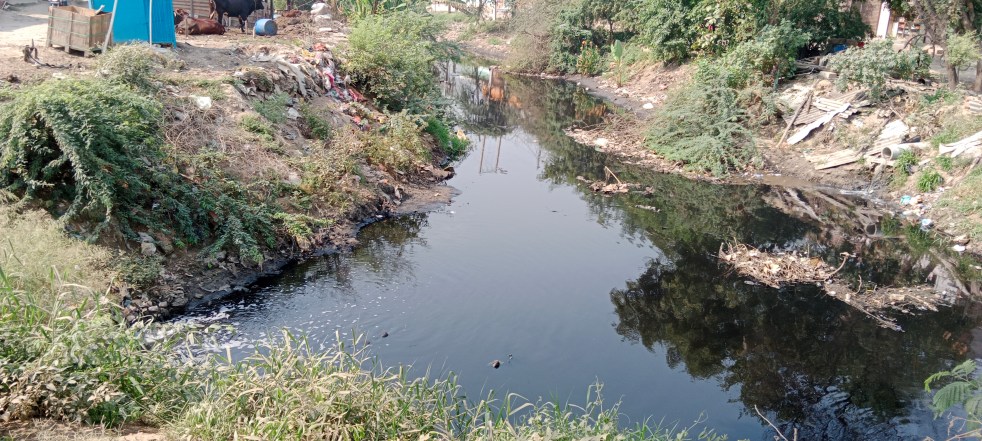
(Feature Image: Filled with untreated industrial effluents Drain No. 6 in May 2023, passing through Kundli industrial area in Sonipat and causing groundwater pollution along its course. Bhim Singh Rawat/SANDRP)
This third and concluding 2023 yearend overview on Groundwater in India, compiles top ten judicial interventions dealing with the depletion and contamination of groundwater. The SC asking Punjab govt to review groundwater conservation law in the face of air pollution crisis in Delhi is the biggest judicial development of 2023. The Kerala HC directing state govt to bring selling of well water under Food Safety & Standards Act 2006 & Regulation 2011 comes next.
The NGT too on its part has taken note for groundwater depletion and contimination across the country and issued notices to central and state governments. Following NGT orders, there have been action against commercial and industrial units extracting groundwater without permission in Delhi and NCR areas. In another ongoing noteworthy case, the NGT has asked MoJS consider prohibiting groundwater use for cricket ground maintenance.
Broadly, the legal course mostly taken by NGT has apparently become ritualistic e.g. taking cognizance, issuing notices, seeking reports and imposing fines which have so far not shown any significant change in ground situation. The judicial actions are turning futile as the responsible agencies in both the central and state govts are non-serious to improve groundwater governance.
The first part of the series covering overall groundwater scenario can be seen here and the second part covering important efforts by governments can be seen here.
1. SC asks Punjab to review groundwater conservation law The Supreme Court Nov 7 advised the state govt to reconsider Punjab Preservation of Subsoil Water Act, 2009 aimed at conserving groundwater, which was resulting in stubble-burning and increased air pollution in the north India, especially the Delhi and NCR. The law prohibits sowing of paddy seeds before 10 May every year and transplantation before 10 June, allowing for the crop to be sown only during the monsoon months.
As a result, paddy is sown in June-July (monsoon months) and harvested in October-November, while wheat is sown in November-December and harvested in April-May. Owing to this law the farmers are left with less time to prepare their fields for the wheat crop after the paddy has been harvested. They resort to burning paddy crop residue, adding to the air pollution. The apex court also called for the substitution of paddy with other crops over concerns that paddy cultivation was affecting the groundwater table of the state.
The link between groundwater conservation and air pollution had also been flagged in a study titled ‘Trade-offs Between Groundwater Conservation and Air Pollution From Agricultural Fires in Northwest India’, published in Nature Sustainability in 2019, and was later confirmed by researchers at Dehradun-based Indian Institute of Remote Sensing in a 2022 study published in Scientific Reports. https://theprint.in/theprint-essential/what-is-the-punjab-groundwater-conservation-law-why-its-being-blamed-for-delhis-air-pollution/1838049/ (09 Nov. 2023)
Punjab farmers stick to paddy amid depleting groundwater Stable economic returns, free power for irrigation and procurement by the central govt at minimum support price are some of the reasons why Punjab’s farmers are continuing to cultivate paddy, despite its impact on the groundwater levels. Paddy is currently grown over 87% of the total area under kharif crops (June-October) in Punjab, according to data shared by the Punjab Agriculture department which notes that in the 2022-23 kharif season, the area under paddy was 3.13 million ha out of 3.59 million ha under kharif crops. https://india.mongabay.com/2023/01/punjabs-paddy-dilemma-amid-depleting-groundwater/ (24 Jan. 2023) Farmers want canal water for irrigation, while the govt backs crop diversification. Both initiatives have seen limited success. (Sanskriti Talwar) https://scroll.in/article/1059144/punjabs-farmers-are-struggling-as-groundwater-levels-plummet-with-few-solutions-in-sight (21 Nov. 2023)
2. Arsenic; fluoride in groundwater: NGT issues notices to States, UTs The NGT has issued notices to 24 states, including Kerala, and four Union Territories in a matter regarding the presence of arsenic and fluoride in groundwater. The green panel observed that the presence of these metals or chemicals are “very serious” and requires “urgent preventive and protective steps”.
NGT bench said the Central Ground Water Authority (CGWA), responsible for regulating groundwater, did not take any independent steps on the grounds that water is a state subject. But its contention had been rejected by a 1997 Supreme Court verdict and a 2022 tribunal order, the bench said. “We are surprised that after such a long time, even today, the CGWA has the audacity of shirking away from its own statutory responsibility and obligations and taking such flimsy grounds which have already been rejected by the apex court itself,” it said.
“The issue raised in the present matter with regard to the presence of arsenic and fluoride in groundwater in such a large number of states and districts is very serious and requires urgent preventive and protective steps by all authorities concerned,” the tribunal added. The tribunal made 28 states and Union Territories along with the Central Ground Water Authority and the MoEF parties or respondents in the matter seeking their response within a month. Further proceedings on Feb 15. https://english.mathrubhumi.com/news/kerala/arsenic-and-fluoride-in-groundwater-green-tribunal-issues-notices-to-kerala-other-states-uts-1.9185723 (26 Dec 2023) https://www.livelaw.in/environment/national-green-tribunal-arsenic-fluoride-toxic-groundwater-state-governments-central-ground-water-authority-responsibility-245407 (27 Dec 2023) 230 districts in 25 states including three in Karnataka has arsenic contamination of ground water in excess of 0.01 mg/l. 469 districts in 27 states including all 31 districts of Karnataka has fluoride contamination above 1.5 mg/l. https://www.deccanherald.com/india/karnataka/groundwater-contamination-ngt-slams-central-authority-for-shirking-responsibility-2825809 (26 Dec. 2023)
3. Kerala Well owners selling water must obtain licenses & conform to FSA: HC The High Court recently issued general directions to the State to bring water drawn from wells that is being sold to the public as drinking water, under the purview of the Food Safety and Standards Act, 2006 and the Food Safety and Standards (Food Products Standards & Food Additives) Regulation 2011.
The court was considering two writ petitions filed by a person holding a licence for running the business of selling water. He would purchase water from a well owner and sell it to the public as ‘drinking water’. One petition challenged a communication issued to the petitioner pointing out that the water being sold by him had a lesser pH value than what was prescribed for drinking water under IS 10500:2012 specification read with Regulation 2.10.9 of the 2011 Regulations. The other petition challenged a report that showed the presence of Coliform in the sample and also the communication to the petitioner regarding the same. https://www.livelaw.in/news-updates/kerala-high-court-well-water-sold-drinking-water-tankers-food-safety-act-license-225226 (31 March 2023)
4. NGT asks Centre, states, UTs to respond on depleting GW levels The case was initiated based on an article published in Hindustan Times titled ‘UN predicts groundwater level in India will reduce to ‘low’ by 2025.’ Recognizing the seriousness of the issue, the NGT has sought the response of the Central Ground Water Board (CGWB), the Ministry of Jal Shakti, the MoEF&CC, as well as the water resources departments in 19 states and 2 union territories.
The CGWB, in response, submitted a report stating that the govt has implemented measures encompassing all the recommended actions outlined in the UN University report to enhance the groundwater situation. However, the NGT noted that the CGWB’s Annual Report of 2022 portrayed a significantly different picture compared to the one presented before the Tribunal.
The NGT recorded that the CGWB’s report showed over-extraction in several areas, particularly in Rajasthan and Gujarat, where prevailing arid climatic conditions resulted in low groundwater recharge. Further hearing on Feb 9, 2024. https://www.barandbench.com/news/ngt-centre-states-uts-respond-depleting-groundwater-levels-in-india (28 Nov. 2023)
5. NGT seeks report on use of groundwater for cricket playgrounds NGT has directed the secretary, ministry of jal shakti (MoJS), to file a status report within two months in a matter related to regulation of groundwater extraction for maintenance of cricket playgrounds. The tribunal had earlier directed the secretary to hold a joint meeting with nominees of the ministry of youth affairs and sports (not below the rank of joint secretary), representative of BCCI and CPCB to consider prohibiting use of groundwater for maintenance of playgrounds, when the matches were not being played. Next hearing on August 10.
Earlier, NGT had ordered to utilise treated water, ensure rainwater harvesting in all playgrounds and engage experts for every cricket stadium and use sport events for awareness of environment protection. However, the order of the tribunal was stayed. The applicant recently submitted in NGT that “the stay does not apply to the present case and there is no reason for the secretary, MoJS not to take action in terms of orders of this tribunal.” https://timesofindia.indiatimes.com/city/delhi/ngt-seeks-report-on-use-of-groundwater-for-cricket-playgrounds/articleshow/99132656.cms (31 March 2023)
6. Uttar Pradesh NGT committee issue notices to hotels for using GW w/o permission A committee of officials, formed on the direction of the NGT, has issued notices to 84 hotels operating in Ghaziabad for allegedly extracting groundwater without permission. Penalty notices ranging from ₹10 lakhs to ₹50 lakhs have been issued to the hotels found in violation of the regulations. The directions came in response to a petition filed by Arti in 2018, highlighting the unauthorized withdrawal of groundwater by hotels in Ghaziabad. The tribunal took up the issue not only in Ghaziabad but also in other major cities of Uttar Pradesh.
Following the tribunal’s directions on Feb 25, 2022, joint committees consisting of officials from the Central Ground Water Board, the state pollution control board, and the district magistrate were formed. These committees began inspecting nine cities in Uttar Pradesh. In an order on Oct 17, 2022, the tribunal stated that out of 1903 hotels in the nine cities, 1407 did not obtain No Objection Certificates (NOCs) to extract groundwater.
Hari Om, the executive engineer from the minor irrigation department and nodal officer for the district groundwater council, said, “Recovery proceedings can be initiated if the hotels fail to pay the fines,” he said. https://www.hindustantimes.com/cities/noida-news/committee-issues-notices-to-84-ghaziabad-hotels-for-illegal-groundwater-extraction-penalty-up-to-50-lakhs-imposed-101688236348586.html The fines amount to Rs 50 lakh per establishment with more than 100 rooms, Rs 25 lakh per establishment with 50-100 rooms, and Rs 10 lakh per establishment with up to 50 rooms. “This is calculated at the rate of Rs 80 per kilolitre, taking consumption to be 350 litres per room per day, which comes to Rs 10,000 per room per year. For 100 rooms, it will be Rs 10 lakh per year, i.e., Rs 50 lakh for five years. The same applies to other calculations,” said Hari Om. Next hearing on Jul 3. https://timesofindia.indiatimes.com/city/ghaziabad/84-hotels-face-fines-over-groundwater-use/articleshow/101427565.cms (2 Jul 2023)
7. Delhi NGT Crack down on city hotels extracting groundwater illegally NGT has directed the chief executive officer of the Delhi Jal Board (DJB) and the member secretary of the CGWA to take action against hotels illegally extracting groundwater. It has also asked them to consider the issue of management and control of groundwater in Delhi.
The Delhi Pollution Control Committee (DPCC) had earlier informed the tribunal that out of the 536 hotels, 257 were illegally extracting groundwater and 185 were doing so under a voluntary disclosure scheme. “During the course of argument, an issue also came up as to who is the competent authority to regulate and manage extraction of water through borewells in Delhi. The stand of the counsel for DPCC is that the competent authority is DJB, and not CGWA. To support the contention, the counsel has placed reliance upon Section 9 of the DJB Act 1998 and submitted that in terms of sections 9(1)(b) and Section 9(1)(d), the responsibility to regulate and manage the exploitation of groundwater in Delhi is with DJB,” noted the tribunal.
NGT also observed that the MoEF&CC in 1997 had exercised the power conferred upon it under Section 3(3) of the Environment (Protection) Act 1986 to constitute the CGWB as an authority for the regulation and control of groundwater management and development. The bench, hence, issued the notice to both DJB and CGWA. https://timesofindia.indiatimes.com/city/delhi/ngt-crack-down-on-city-hotels-extracting-groundwater-illegally/articleshow/105796634.cms (07 Dec. 2023)
NGT asks remedial action on illegal gw extraction by hotels NGT has directed a panel to take remedial measures over alleged illegal extraction of groundwater by 536 hotels in the bustling Paharganj locality in the national capital. The bench, also comprising judicial member Justice Sudhir Agarwal and expert members A Senthil Vel and Afroz Ahmad, said it was going into the merits of the matter noting the serious allegations which, if true, showed a serious violation of norms and the judgement of the Supreme Court by individuals and authorities concerned. https://theprint.in/india/illegal-groundwater-extraction-by-536-paharganj-hotels-ngt-asks-panel-to-take-remedial-action-2/1518276/ (14 April 2023)
8. Punjab NGT directs govt to provide potable water to pollution-hit villages The NGT has directed the Punjab govt to ensure safe drinking water in the villages near a private distillery at the Mansoorwal Kalan village in Ferozepur’s Zira which is lying shut after samples drawn from 29 borewells near it were found unfit for drinking and one recorded cyanide presence four times that of the permissible limit. Taking strong note of the reports of the Central Pollution Control Board and the CGWB, the NGT has ordered the Punjab Pollution Control Board to inspect all distilleries in Punjab for groundwater contamination and submit a report. The NGT order came on a plea filed by the Public Action Committee on Sept 26. The CPCB had submitted its report to the NGT in May 2023. https://indianexpress.com/article/cities/chandigarh/ngt-punjab-govt-safe-drinking-water-pollution-affected-villages-around-malbros-distillery-zira-8962770/ (01 Oct. 2023)
9. Haryana Form panel to probe groundwater use at construction sites The NGT on July 28 directed the govt to form a committee to inspect the use of groundwater allegedly extracted from borewells at some construction sites that include those in new sectors in the city. The order came on a petition filed by NGO Paryavaran Vikas Sangh that alleged millions of gallons of groundwater was being sucked out at four construction sites in Sector 108, 103 and 37D. The plea, filed by the NGO representative Parmanand Rana in Jan, also said that extracted groundwater — once used — was being flushed out without any treatment in violation of the Water (Prevention and Control of Pollution) Act, 1974. https://timesofindia.indiatimes.com/city/gurgaon/form-panel-to-probe-groundwater-use-at-construction-sites-ngt-orders-hry/articleshow/102221234.cms (29 July 2023) An order by NGT chairperson Sheo Kumar Singh, judicial magistrate Arun Kumar Tyagi, and expert member A Senthil Vel said, “We deem it just to ask a report on the matter from a joint committee that comprises the Gurugram district administration, a representative of the SPCB and a representative of the CGWA”. The committee has been directed to visit the place and submit an action taken report within four weeks. https://www.tribuneindia.com/news/haryana/ngt-asks-haryana-govt-to-check-use-of-groundwater-for-construction-530540 (31 July 2023)
10. Delhi NGT committee seeks penal action to save groundwater A joint committee of the Jal Shakti ministry has suggested in a report that Delhi should have a penal provision for contamination of groundwater due to faulty recharge. The committee was formed on the direction of the NGT to look into installed rainwater harvesting systems. The other suggestions made by the committee are that all rainwater harvesting sites should be geo-tagged for better visibility for monitoring and as water quality may not be strictly checked, the water stored in harvesting structures may be used for non-potable purposes.
Post the NGT order, the ministry formed the committee headed by the chairperson of the CGWB. It inspected random sites in five states, including Delhi. The committee said that in the other states it visited – Haryana, Rajasthan, Karnataka, Tamil Nadu – rainwater harvesting in urban areas has been made mandatory under building rules or other state acts or rules. “However, penal provisions for ground water contamination due to faulty design or due to lack of proper and timely maintenance are missing. Overall, rainwater harvesting systems were found as per design under the norms of the central/ state agencies at all the visited sites,” the report said. https://timesofindia.indiatimes.com/city/delhi/ngt-panel-seeks-penal-action-to-save-groundwater/articleshow/100196454.cms (13 May 2023)
Some More Relevant Reports
Punjab NGT notice to govt over water pollution Expressing concern over the findings of a study conducted by Indian Institute of Technology (IIT), Mandi, which uncovered water pollution in Punjab due to agricultural runoff, the NGT has issued notices to different departments of Punjab — PPCB, departments of water supply and sanitation and agriculture and farmers welfare. The CPCB and IIT-Mandi have also been impleaded parties in the case.
The PPCB has been directed to file a report in response to facts in the study, including the issue of heavy metals, radioactive substances, pesticides and chemical pollutants found in the groundwater of the concerned area in sample testing within six weeks.
The tribunal had taken suo motu notice of a TOI news report ‘Agricultural Runoff Causing Groundwater Pollution in Punjab, Making Drinking Water Unsafe, Reveals Study’. The study highlighted an increase in demand for groundwater, local farmers exploiting groundwater from deeper geological strata which have heavy metals and a few are radioactive, having serious health impacts. Such incidents relating to the decline in water quality are mainly in the southwest Punjab.
The PPCB sought time to examine the report and file its reply before the tribunal. It was noted that the board is actively monitoring groundwater quality at 46 different locations. However, the tribunal observed that while the PPCB claims to be monitoring groundwater quality at various locations, they were unable to provide the current water quality status. Next hearing on Jan 18, 2024. https://timesofindia.indiatimes.com/city/chandigarh/ngt-notice-to-punjab-over-water-pollution/articleshow/105055290.cms (08 Nov.2023)
Haryana NGT seeks facts on illegal GW use The NGT was hearing a petition claiming the Mitsui Kingzoku Components India Pvt Ltd in the industrial town of Bawal in Rewari district for violating the CGWA’s NOC condition specifying the quantity of groundwater to be extracted & that the CGWA had already categorised the area as ‘over exploited’. The report had to be submitted within two months, the bench said, adding the state SPCB will be the nodal agency for coordination and compliance. Further proceedings on July 10. The NGT noted that according to the petition, the tribunal’s Nov 2022 order directing the CGWA to take remedial action against non-compliance, including recovery of compensation equal to 0.5% of the project cost, was not followed. https://www.business-standard.com/article/current-affairs/ngt-seeks-facts-on-petition-claiming-illegal-groundwater-usage-in-haryana-123030900740_1.html (9 March 2023)
Delhi NGT asks DPCC to submit report on GW pollution in Dwarka NGT has directed the DPCC to submit a report regarding groundwater contamination in rainwater harvesting systems installed across housing societies in Dwarka. A bench of NGT Chairperson Justice Prakash Shrivastava noted that in pursuance of the tribunal’s earlier directions, the Delhi govt had filed a report, as per which, 8 of the 54 housing societies in Dwarka refused entry to the inspection teams.
The report does not specifically cover the aforesaid issues, though there was a clear direction in this regard, the tribunal said. We deem it proper to issue a direction for filing two separate reports, one relating to the factual situation found on the spot and the other relating to the remedial action. Let these reports be filed by the DPCC within eight weeks, the tribunal said. It directed that the DPCC officials along with other authorities concerned will have police protection for inspecting the remaining eight societies. Further hearing on Jan 5. https://www.moneycontrol.com/news/business/wire-news/groundwater-contamination-in-dwarka-ngt-asks-dpcc-to-submit-report-11580831.html (22 Oct. 2023)
Compiled by Bhim Singh Rawat (bhim.sandrp@gmail.com)

 SANDRP