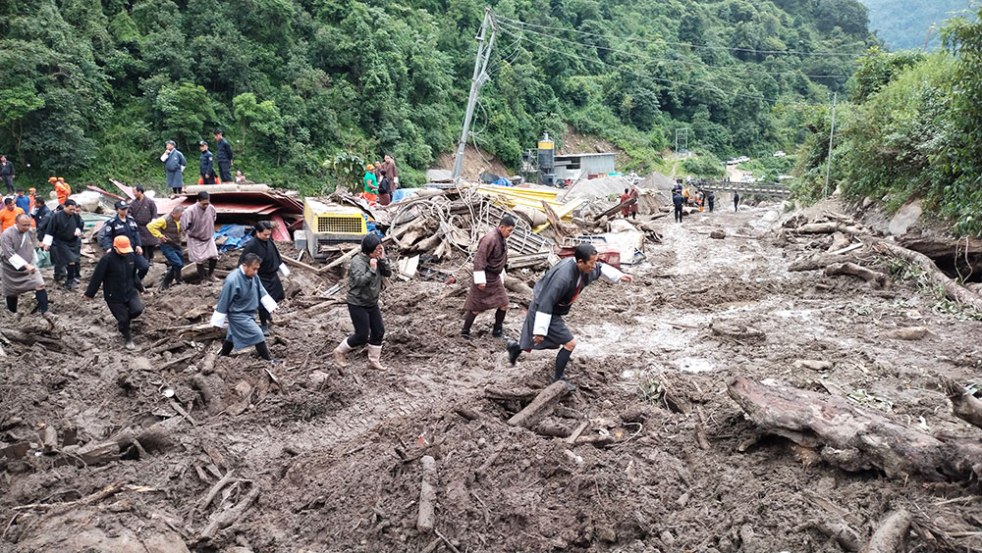
At least seven people were killed and 16 others missing in Bhutan after flash floods and landslides triggered by heavy rains washed away a section of a hydroelectric plant on July 20 2023[i]. They were washed away by the sudden burst at the residential area next to the worksite at Ungar village, according to a press release from the Prime Minister’s Office. Prime Minister Dr Lotay Tshering, who is in Lhuentse, said the devastating flashflood presented one of the biggest loss of lives and properties in recent memory, and shook the core of the nation.
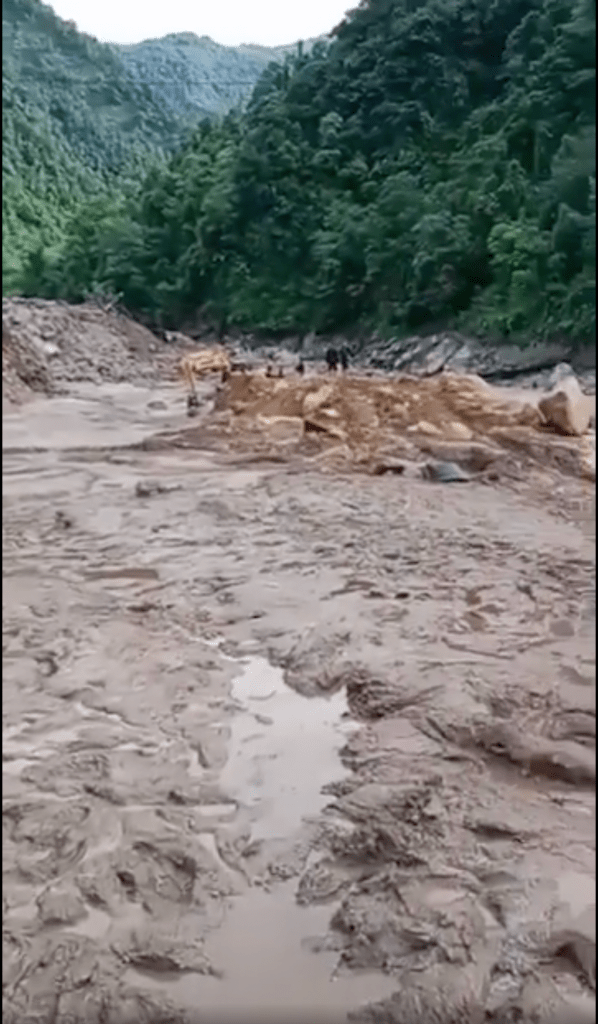
Rescue and search teams have rushed to the area, authorities said. Prime Minister Lotay Tshering has arrived at the site and is taking stock of the situation and guiding rescue and search operation. The flash flood struck Onggar chiwog in Lhuentse. Rescue operations are ongoing. One more female body was retrieved on July 22, 2023[ii] from a place called Dung, approximately 4 km from the Unggar flash flood site. The flash flood also damaged rice fields and killed about 10 cattles which were along the stream.
Of the 23 people, one was a Desuup (Volunteer worker) and five were DGPC staff. The rest were the family members of the staff. The officials were working for the Yungichhu Hydropower Project. The flash flood washed away machines of DGPC and vehicles belonging to the staff. The flash flood also buried 10 cattle and paddy fields of Oong-gar village. According to the officials, the cause of flash flood has not been ascertained.[iii]
A section of the 32 MW Yungichhu Hydro Power Project in a remote area in the east of the country was washed away, but the main part was not hit. Five of the seven killed have been identified. “It is a major disaster,” Bhutanese quoted an unnamed official from Druk Green Power, which is in charge of the plant’s construction, as saying. The missing included project staff.
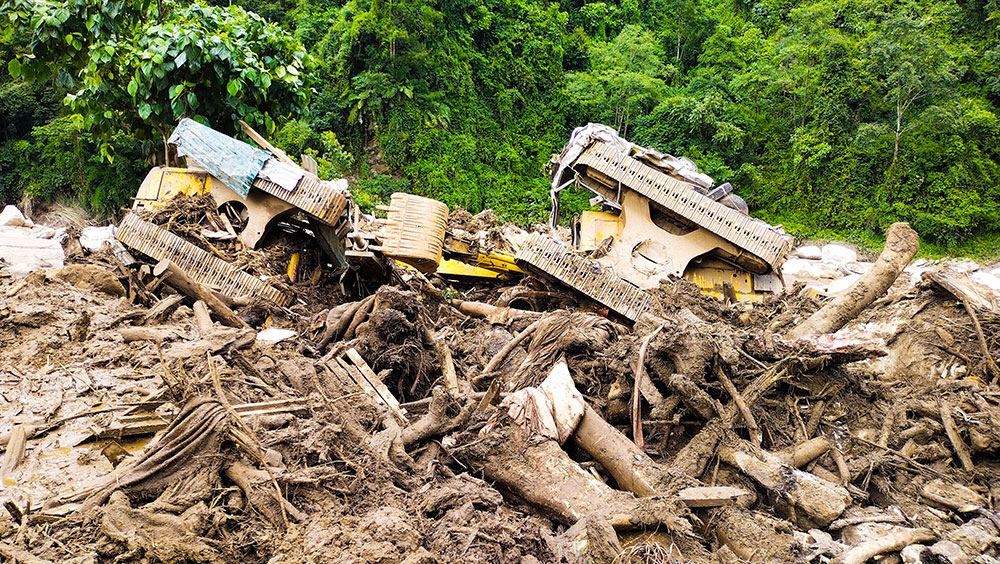
Huge, sudden, short duration floods – due to landslide dam? Dechen Pelden, 28, staying close to the disaster site, heard a rumbling sound and the earth beneath them shake at 7.40 pm on July 20 2023. “I thought we were going to die when I heard the rumbling of the boulders crashing down the valley. I was shocked,” said Dechen Pelden. Dechen said she had never seen a disaster of such magnitude and scale. The flood swept away the entire camp and buried several vehicles including excavators. Tashi Gyeltshen, 30, a resident, said that the weather was clear for three days, and that only on Thursday evening it was raining. “I suspect heavy rainfall at high mountains could be the cause of floods,” he said. “It is the first time we have experienced such a disaster in our village.”[iv]
Considering that the sudden flash floods lasted about 20 minutes and without too much rain, there is possibility that a landslide dam may have been created in the upstream, the breach of the dam could have led to sudden, huge flash flood that passed away within minutes.

Foot print of climate change? An editorial in The Kuensel on July 22 2023[v] said: “But what we have to realise is that we are no longer a blessed country in the face of natural disasters, especially induced by climate change… it is the melting glaciers, landslides, and flash floods that are a threat” for a mountain country like Bhutan. The Edit further says: “What we could do is prepare for the impending disasters. Adaptation and mitigation is the only way forward. Are we prepared? Is it a priority? As a country located in a fragile Himalayan ecosystem, we need to be more concerned about the impact of climate change.”
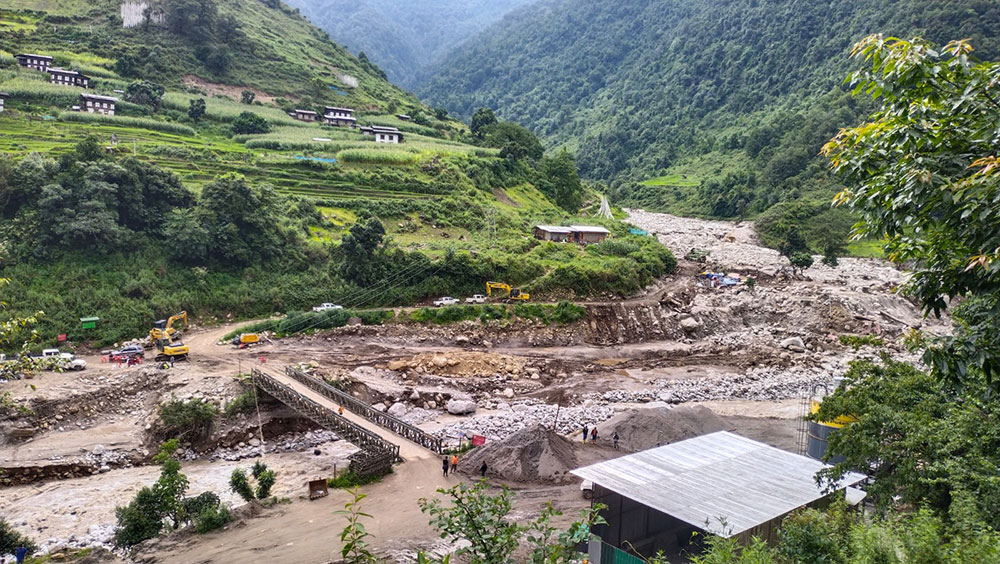
THE PROJECT The construction of the headworks complex of the 32 MW Yungichhu Hydropower Project (Head 506 m, design discharge of 7.46 cumecs[vi]) on Yungichhu River (a tributary of Kurichhu River, which in turn is a tributary of Drangmechhu, the biggest river basin of Bhutan) in Maedtsho Gewog in Lhuentse was inaugurated on Dec 7, 2022[vii]. The Headworks complex comprises the temporary water diversion, barrage, intake structures (elevation 1706 masl, catchment area 125 sq km) and desilting chambers that will divert and deliver water to the powerhouse for power generation. The construction is expected to complete in three years and project cost is estimated at Nu 3.5 Billions.
SANDRP (ht.sandrp@gmail.com)
UPDATE:
1. July 24 2023: “The victims included Druk Green Power Corporation employees like work supervisor, section officer, surveyors, machine operators, electricians, and plumbers... Machinery like excavators, air compressors, bumping machines, rod bending and other machines were lost to the flood. The eight private light vehicles were also damaged.” Search continues, no more bodies recovered so far. (https://kuenselonline.com/search-continues-for-16-missing-persons/)
2. July 25 2023: In the image before the disaster, there appears to be a set of structures in the channel immediately below the confluence of the two tributaries. In the image after the debris flow, these structures have clearly been destroyed. The decision to locate a camp, if that is what happened, in such a vulnerable position is interesting. As I noted previously, there are multiple examples in which landslide hazard has not been properly considered in hydroelectric schemes in the Himalayas. This is clearly a very steep, dissected landscape, with multiple small tributaries feeding into the main channel. This is a classic for landscape for small slips combining to create a channelised debris flow. (https://blogs.agu.org/landslideblog/2023/07/25/ungar-1/)
3. July 26 2023: Officials from Druk Green Power Corporation, dzongkhag disaster management, and gewog will hike up the stream today to determine the breakage point and trace other factors that led to the flood in Ungar. “Our assessment team is waiting at Ungar for the sky to clear to hike up towards Rodungla pass,” said Druk Green Power Corporation’s (DGPC) Managing Director Dasho Chewang Rinzin. “Once they reach a specific point, the team will use a drone to identify the source of the flash flood.” He said that the team is expected to start their hike early today morning if there is no rain or cloud cover. The team hiked up more than four kilometers on July 23 but had to return because of poor visibility and rain. “After hiking for more than four kilometers, the team used a drone to identify the origin of the flash flood,” a source said. “However, the drone could not obtain a clear picture due to the bad weather.”
– The flood swept away DGPC’s guest house, which was hired from the Ungar community to serve as the site office, four residential blocks with five units each, a de-suup’s official quarter, three boys hostels, two girls hostels, one dining hall, one kitchen, and two toilets. The camps were set up for officials and workers for the construction of a 32MW powerhouse at the Yungichhu hydropower project. The flash flood also damaged paddy fields and killed 10 cattle.
– It is suspected that sudden heavy rain on that evening caused landslides along the course of Nyewanchhu, obstructing the flow of the stream and overflowing down the steep incline of the source, causing the flash flood. Some said that the flash flood could have been triggered when many small tributaries upstream swelled and formed an artificial lake, which later burst due to heavy rain. Nyewanchhu is a stream that flows down by the camps, where workers and families of Druk Hydro Energy Limited, a subsidiary company of DGPC, and a de-suup lived. “Nyewangchhu is a small tributary of Yungichhu that hardly provides enough water for workers to drink,” Dasho Chewang Rinzin said, adding that the camps were set up at the present location last year after assessing the safety of the site. So far eight bodies have been recovered, 15 are still missing.
– However, considering the recent spate of natural disasters, it is now validated that Lhuentse is prone to landslides and flash floods. After almost 22 years, Lhuentse has had to face repeated natural disasters since 2017 which claimed 28 lives in 10 months. Five people lost their lives, and two were injured when a village house in Jasabu, Kurtoe gewog, was hit by a flash flood on the early morning of November 30 last year. (https://kuenselonline.com/investigation-team-to-use-drone-to-determine-cause-of-ungar-flood/)
References:
[i] https://www.reuters.com/world/asia-pacific/about-20-missing-bhutan-floods-wash-away-part-hydropower-plant-2023-07-21/
[ii] https://www.facebook.com/search/top?q=kuensel
[iii] http://www.bbs.bt/news/?p=189318
[iv] https://kuenselonline.com/seventeen-still-missing-in-ungar-flash-flood/
[v] https://kuenselonline.com/blessed-no-more-in-the-face-of-global-climate-change/

 SANDRP