
Arunachal Tawang residents protest against unfulfilled promises Hundreds of residents on July 22 marched through the streets of Tawang, the home district of newly elected CM Pema Khandu, in protest against non-fulfillment of their demand for jobs to kith and kins of two anti-dam activists killed in police firing on May 2. During the protest march they also led a signature campaign against large dams planned in Tawang, where the predominantly Buddhist Monpa tribe feared that many of the proposed hydro-power projects would damage sacred Buddhist sites in the district. At least 13 large hydro-power projects have been planned in the district, which shares border with China’s Tibet region. On June 21 the Lamas-led Save Mon Region Federation had issued six-point charter of demand to the state government for fulfillment in 30 days. Arunachal comprises a fragile, rich parcel of wildlife and ecosystem, among the richest ecosystems in India. But planning & building of hydro projects has been and will cause irreversible environmental damage. Perhaps it’s time for an aggressive freeze on all the un-built projects and an evaluation of other models of energy. Mr Prema Khandu must consider why Arunachal should become India’s mitochondria-the country’s energy provider, while losing its own enormous wealth. But contrary to this new while addressing a press conference, the new CM, on July 18 said that the govt would find ways to tap the petroleum resources & harness the hydropower potential which could be a money spinner for the state. On the 2000Mw Lower Subanisiri HEP at Gerukamukh, Mr Khandu has emphatically said he would discuss the issue with the Assam govt as well as the Centre for a solution. He said that in all the hydropower projects the affected people should be taken into confidence by both the executing agencies as well as the state govt. The new CM elected from Tawang, seeing the hydropower projects as money spinner does not sound very encouraging. Let us see how far he actually goes to take people into confidence as promised by him.
Continue reading “DRP: 25 July 2016 (Tawang residents protest against unfulfilled promises)”Tag: Water Options

DRP: 4 July 2016 (In Proposed Hydro Policy, Govt Pushing Hydro Through Subsidies)
New Hydro Policy: Govt unjustifiably pushing hydro through subsidies A comprehensive policy to promote hydropower generation is set to be announced by September—with viability gap funding for projects, compulsory hydropower purchase obligations for distribution companies and a set of good practices that states have to follow. The idea is to address factors that currently drive hydropower costs up way above those of other sources of power and give policy support in its market development, according to a government official, who asked not to be named. The policy being prepared by the power ministry will have provisions for viability gap funding, which will help in meeting the shortfall in project costs and reducing hydroelectricity tariffs for consumers. Hydropower is expensive and in some cases more than double the cost of power from coal-based thermal plants, which is available at Rs.3-5 per unit.The ministry will also expand the scope of power distribution companies’ renewable power purchase obligations to include hydropower from projects with a capacity greater than 25 Mw. At the moment only power from those with less than 25MW is considered renewable power. According to officials, compulsory hydropower purchase from large projects will either be made part of the existing renewable power purchase obligation of distribution companies or a separate requirement, so that its inclusion does not affect the market for other renewable sources of energy like wind, solar or biomass. Govt unjustifiably pushing hydro through subsidies in proposed new hydro policy can be lead story. It is not going to help push hydro.
Continue reading “DRP: 4 July 2016 (In Proposed Hydro Policy, Govt Pushing Hydro Through Subsidies)”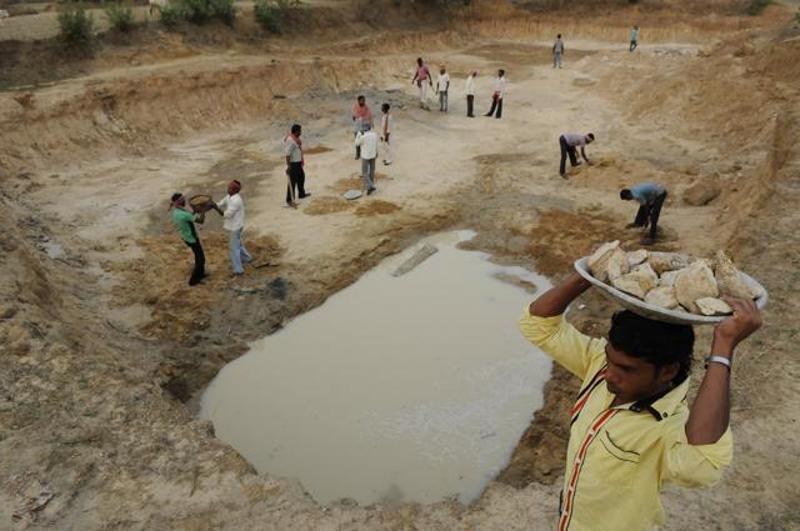
Community Driven Water Conservation Initiatives In 2016 Drought
In 2016, India has been witnessing one of the severest droughts after independence. The phenomena has led to a ‘never before’ kind of water crisis across the country. As a result the surface water sources are under severe stress and aquifers beneath ground have been over drafted. An already depressed agrarian community is worst hit. Thousands of parched villages have been dotting the rural landscape. Many somewhat immune urban centers are also facing the wrath of heat.
However there is no dearth of inspiring tales in the field of water conservation pan nation presenting a ray of hope amid gloomy scenario. The exemplary works being done by several villages, people and organizations across the country offer some lasting solutions to growing water scarcity. So here is an attempt to present a State wise account of drought hit areas which have been wading through the water crisis sound and safe by reinventing the community driven and local water harvesting practices.
Continue reading “Community Driven Water Conservation Initiatives In 2016 Drought”

DRP: 23 May 2016 (WHY LARGE HYDRO IS NOT JUSTIFIED)
Chenab river runs its course amid spate of threats Chenab river’s money-spinner hydropower fate appears to run parallel to that of Sohni-Mahiwal – the legendary lovers who drowned into the river because their love was unacceptable. The govt as usual has shut its eyes to the needs of the river and its catchment area. There are multiple factors hidden below its surface. One is melting of glaciers sooner than anticipated. If glaciers lose their ice cover quicker, the Chenab would swell up abruptly before hitting a cruel, dried-up phase in as much deathly suddenness. There are several hydro projects coming up on the river which don’t have the approval of the Geological Survey of India. Once all the identified hydroelectric projects are installed, it will have a negative impact on the river. It may not get even a kilometre free space for running the course. At that point of time, it will not be a river, but a small stream. Meanwhile scientists have warned of large scale earthquake in J&K. The situation in Arunachal Pradesh is also grim. And yet the Parliamentary committee recommends further sops for Hydr. Misguided recommendations, to put is most charitably. There should be no question of subsidies to destructive Hydropower projects. Continue reading “DRP: 23 May 2016 (WHY LARGE HYDRO IS NOT JUSTIFIED)”
DRP: 25 APRIL 2016 (One Year After Nepal Earthquake, Has the World Learnt Any Lesson?)
On this day in 2015, the massive Nepal earthquake of 7.9 intensity (Richter scale) shook the scenic Himalayan Nation. The earthquake left a major trail of destruction affecting over 20 districts and killing over 9 thousand people. According to expert Dave Petley, Langtang rock and ice avalanche was the most dramatic and significant landslide, that killed the most individuals. The earthquake killed over 9000 people, with 255 still missing. The severity of the quake can be gauged from the fact that more than a third of the disaster related deaths in 2015 occurred in Nepal’s April 25 earthquake. The earthquake-induced flash floods, landslides and aftershocks also damaged up to 15 hydropower plants, which has not been still restored fully. Surprisingly despite the increasing number of disasters taking place across the globe, world only spends less than a fifth of the money on Disaster Risk Reduction Compared to Disaster management. Nepal will still take years from recovering socio-economic losses caused by the quake. But it is pertinent that in the wake of the quake and other disasters, human civilisation must learn its lesson. It’s true that development and disaster cannot be stopped but we must make our developmental decisions more informed, rule based and democratic so that it helps us deal better with disasters by decreasing their intensity and velocity and our short-sighted developmental choices do not get translated into a disaster itself. Continue reading “DRP: 25 APRIL 2016 (One Year After Nepal Earthquake, Has the World Learnt Any Lesson?)”
DRP: 11 April 2016 (Harsh Summer: In Search of Green Pastures)
With ponds and lakes drying up, cattle in Telangana are forced to travel long distances for fodder and water. Here, buffaloes are moving towards a water source near Medipalli in Adilabad district on 09 April.
Continue reading “DRP: 11 April 2016 (Harsh Summer: In Search of Green Pastures)”
DRP: 4 April 2016 (India Water Week shows absence of fresh thinking from water resources establishment)
SANDRP Comments India Water Week continues to show absence of any fresh thinking from water resources establishment The 4th India Water Week being organized by Union Ministry of Water Resources, River Development and Ganga Rejuvenation during April 4-8, 2016 in Delhi shows continued absence of any fresh thinking from water resources establishment.
The Information Brochure of the event says: “Ministry of Water Resources, RD & GR is to organize the India Water Week -2016 between April 4-8, 2016 to use it as a platform to elicit ideas and opinions from global level decision makers, politicians, researchers and entrepreneurs in the field of water resources for mutual benefit and goodwill… This is the fourth event of its kind with the theme “Water for all : Striving together” focusing on improving efficiencies of water use across all sectors… ”
DRP: 21 March 2016 (‘Towards Noyyal’ A people’s initiative to restore a river’s glory)
Tamil Nadu A people’s initiative to restore a river’s glory The Noyyal River Restoration Federation will launch ‘Noyyalai Nokki’ (Towards Noyyal), a people’s initiative to restore the Noyyal river system on 26 March. Social activist Anna Hazare will launch the project at Kooduthurai in Alandurai in Coimbatore district. The river originates in the Western Ghats and runs through the four districts to join the Cauvery at Noyyal village. Known as Jungle stream, in olden times as many as 34 streams used to feed water into it and the river would flow throughout the year with two or three annual flood spell. But now, just 4 or 5 streams feed the river. In many places, the river is encroached upon, sewage is let into it, or the river needs to be desilted. The river is all set to regain its glory with the ‘Noyyalai Nokki’ initiative. What is encouraging is the willingness of the public to be part of it. The project proposes to divide the river into segments of 500 metres for restoration and maintenance. Ownership groups will be formed for every 500 metres and it will consist of the local people, experts and patrons (divide-distribute-develop model).
DRP: 22 Feb. 16 (Unprecedented water crisis in Delhi due to Jat quota stir)
Unprecedented water crisis in Delhi due to Jat stir Terming the water crisis in the national capital as “unprecedented”, Delhi minister Kapil Mishra has warned that the situation might worsen in the next few days if the supply from Haryana is not immediately restored. He said the Delhi Jal Board (DJB) had almost run out of water and advised people to use water judiciously. Delhi gets its bulk of water supply from Haryana and the stir has affected 65% of water supply in Delhi has been cut with the shutting down of seven water treatment plants— Wazirabad, Chandrawal, Dwarka, Okhla, Haiderpur, Nangloi and Bawana which provide around 500 million gallons per day (MGD). In all Delhi has nine water treatment plants which together produce 820 MGD of potable water. Of these, only two Sonia Vihar and Bhagirathi fed by water from Uttar Pradesh are operational. The current production is only 240 MGD. Among the areas affected were Dwarka, Janakpuri, Munirka, Palam, Rajouri Garden, Punjabi Bagh, Vasant Kunj, Saket, Green Park and Lodhi Colony, where residents complained of little or no water. In another news report DJB is reported to have made 140 water filling points functional to feed tankers which would be sent across the city, reeling under an unprecedented water crisis. Water Minister Kapil Mishra reviewed the contingency plan for water management in West, North, North-west, Outer and Central Delhi and said tankers will deliver water at 663 points to partially meet the shortage of 480 MGD. These points will keep rotating. Plan is to cover around 2,000 points by Monday evening. The DJB supplies around 900 MGD of water daily out of which around 600 MGD of raw water come from Munak Canal. Even if Haryana releases water immediately, it will take at least 24 hours to restore the supply. Meanwhile Supreme Court on 22 Feb.16 scolded Delhi government. for approaching the court instead of resolving the water crisis with Haryana. The Kejriwal government had approached the top court on in view of the severe water crisis in the national capital after Jat protesters blocked water supply through Munak canal in Sonipat. During the hearing on government’s plea, the court took strong objection to Water Minister Kapil Mishra’s presence inside the courtroom. On the other hand, the minister accuses Haryana & Central Government for providing no official information on the crisis He said the Delhi government was “repeatedly trying to communicate” with the two governments to find out when will the supply resume, but without much success. Also see Jat quota stir: Water supply cut, Delhi may go dry
Continue reading “DRP: 22 Feb. 16 (Unprecedented water crisis in Delhi due to Jat quota stir)”
DRP: 8 Feb.2016 (Hiding Environment Information-Against Sabka Sath, Sabka Vikas?)
SANDRP Open Letter to MoEF&CC Is Not Hiding Environment Information Against Sabka Sath, Sabka Vikas? Even as the Ministry of Environment, Forests and Climate Change has been sanctioning cascades of hydro power projects on here-to free flowing rivers in the Himalaya and North East India, Cumulative Assessment of the Impacts of these projects became a crucial area of concern. The cumulative impacts of these projects on the hydrology, downstream flow, sudden water releases, deforestation, muck disposal, influx of migrant workers, seismicity of the region etc. is huge as compared to individual impacts. The projects together stand to change the social and ecological fabric of these regions.
Cumulative Impact Assessment (CIA) studies are a part of the Environment Impact Assessment Process under the EIA Notification (2006) and Environment (Protection) Act 1986. The documents of these CIAs have been uploaded on the Environment Clearance website in the past, as was required under number of laws. However, as the EAC is slated to consider whopping 4 CIAs in its upcoming meeting on the 8 and 9th Feb, not a single CIA-related document is available on the MoEF and CC website! We are told that these may not be made available in the future.
Continue reading “DRP: 8 Feb.2016 (Hiding Environment Information-Against Sabka Sath, Sabka Vikas?)”
 SANDRP