Introduction
Fresh water inland fisheries in Maharashtra contribute to over 1 lakh MT fish catch each financial year and generate around ₹ 600-800 Crores for dependent fisher folks[i]. As per the economic surveys (2011-12) for Pune region i.e. Pune, Satara, Sangli, Solapur and Kolhapur districts, there are over 20 thousand fisher folks supported by inland fisheries generating ₹ 8,722 Lakh for the fishing community in the entire Pune region.
Table 1. Status of Inland fisheries in Pune region (Source: Extracted from District economic surveys of respective districts produced at the financial year end of 2011-12, available at: http://mahades.maharashtra.gov.in/publication.do?pubCatId=DSA)
| District |
length of the river stretches (km) |
Total area under inland fisheries (including river, lakes, and dams)- ha |
Inland fisheries production (MT) |
Economic wealth (Lakh Rs.)
|
Number of cooperative societies |
Fisher folk supported |
| Pune |
1252 |
24721 |
22000 |
6600 |
87 |
3762 |
| Solapur |
772 |
27200 |
3000 |
750 |
133 |
4341 |
| Satara |
676 |
14504 |
1950 |
683 |
60 |
2470 |
| Sangli |
392 |
4678 |
1547 |
232 |
83 |
4701 |
| Kolhapur |
955 |
4266 |
2285 |
457 |
47 |
4747 |
| Total= |
4047 |
75369 |
30782 |
8722 |
410 |
20021 |
Though these are in the Bhima-Krishna Basin, the above records are only for reservoir fisheries! The fisheries department does not collect or maintain any data on riverine fish or fisheries in this region. In fact, the Fisheries Department clearly mentions that it concerns itself only with reservoir fisheries and not riverine fisheries.

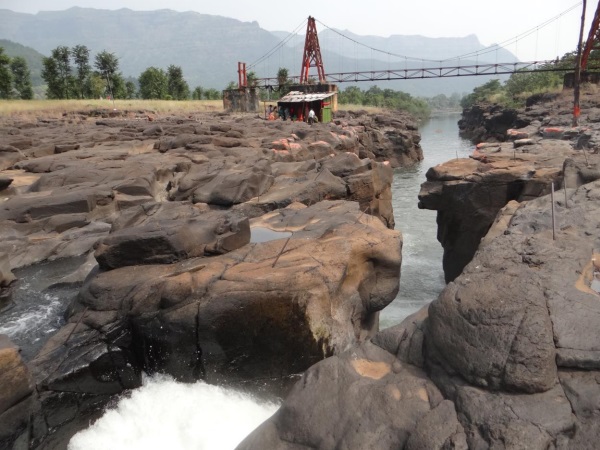
Figure 1. Fishing in Khodshi Dam region
Why is this a problem?
Across India, the potential of riverine fisheries is decreasing rapidly. At the same time, it is the rivers which form the backbone of the nutritional and economic security of over 10 million marginal fisher folk in India. But, neither are the riverine fisher folk counted by Fisheries Department, nor is their fish catch is monitored.
This has resulted in chronic downplaying of riverine fisheries sector and concentration of attention on aquaculture and marine fisheries.
No regulation or appreciation of riverine fisheries also means that no attention is being paid to the crisis of riverine fisheries, fisher folk and fish diversity. Across the nation[ii] dams and barrages and related changes in hydrology: Dry rivers, stagnant reservoirs, increasing sedimentation in rivers, rising salinity of estuaries, have adversely impacted the fisheries and dependent people. But this is not very well documented and no attention is being paid to address these issues.
Fisheries Department and Riverine Fisheries in Maharashtra
Highlights of The Maharashtra Fisheries Act (1961)[iii]: The Act applies to inland, riverine as well as marine fisheries. However, the act does not have anything specific to offer to riverine fisheries. It does not talk about traditional fisher folk, their rights, water levels that need to maintained downstream dams, fish biodiversity etc. at all. It is only an Act about edible fisheries, mostly applicable for marine and reservoir fisheries.
- The act is said to provide for protection, conservation and development of fisheries in Maharashtra
- The word “fish” includes fishes, crustaceans, oysters and shell fish
- The act provides for the appointment of “fisheries officers”, person not below the rank of sub-inspector to look after the welfare of the fisheries in the jurisdiction
- It prohibits use of nets, gears or anything that is fixed in the soil for catching the fish, use of explosives, toxic chemicals, obnoxious material and arrows for catching the fish
- The State Government is empowered to make rules to regulate or prohibit any discharge of solid or liquid material deleterious to fishes as long as it does not affect the powers of local bodies to discharge sewage water
- Interestingly, the Act also empowers the State Government to enact rules for protection of fish in selected waters to “prohibit or regulate the construction temporary or permanent or weirs, dams and bunds.”
Unfortunately, the Act does not offer any specific protection to riverine fisheries or conservation of fish.
How does the fisheries department work?
SANDRP discussed issues surrounding riverine fisheries and fisher folk with Fisheries Development Officer of Pune Region. The Fisheries Development Officer said that fisheries department transfers fishing rights for a period of 5 years at a stretch, either to a fisheries cooperative society or contractors. Fishing rights[iv] on dam reservoirs with area more than 200 ha and less than 200 ha are leased out for the period of 5 years to fishing cooperative societies or to contractors if no cooperative society approaches to the department. The fishing rights on the tanks with less than 200 ha area are preferably leased out to local fishing cooperative societies.
According to the Fisheries Development Officer, Pune District alone has 87 water bodies, on which fishing rights are controlled by fisheries department. Out of them, 17 water bodies are more than 200 ha in area. On 7 of those 17 water bodies, there are local cooperative fishing communities while 10 are leased out. On the other hand, there are 70 water bodies which are less than 200 ha. Out of those, 38 are controlled by local fishing cooperative societies, while 32 are leased out to contractors.
He said that in case of marine fisheries in Maharashtra, annual reports[v] are available giving details of about species, fish catch, fish landing stations, number of mechanized boats and so on. However, the picture about fresh-water fisheries is very dismal with complete lack of basic data about number of fishermen, species, yearly fish catch, distribution and abundance of fish species etc. In the section of fresh water fisheries, the department only controls leasing out fishing rights in lakes and dams. Therefore, the aspects related to conservation and protection of riverine diversity remains untouched.
In fact, the fisheries development officer went to the extent of saying that we should not ask more questions about riverine fisheries as the mandate of the Fisheries Department is only to look at fisheries in reservoirs and not rivers!
There has been some research on fish diversity in various parts of the Pune region. For Warna basin, an exhaustive fish species abundance and cause-effect analysis is done by Dr. Mohite and Dr. J. Samant[vi]. For the Pune district, an organization named RANWA attempted to study riverine fish diversity. Interestingly, their initial records indicate that rivers flowing through Pune, once had over 110 fish species![vii]
The department breeds the healthy fishes (called as brood stock) in the controlled conditions and sells the young fires or fingerlings to the contractors or local fishing cooperative societies operational in the jurisdiction. The ponds are seeded with the cultures and the fishing continues to the next season.
The rare riverine fisheries cooperatives
Though the fisheries department of the state concerns itself with fishing in the dams and tanks, there are some rare exceptions, which provide a brief glimpse of the potential and richness of riverine fisheries.
In case of Sangli, Kolhapur and Nanded, the fishing rights on Krishna, Warna, Panchaganga, Dudhaganga, Bhogawati (Sangli and Kolhapur) Godavari (Nanded) are leased to the local fishermen. The reason is that, such leasing was being carried from the times of Patwardhan sansthaniks of Sangli and Shahu Maharaj of Kolhapur. Even after the princely states were annexed by the British, such leasing of fishing rights in the open river continued and is going on till today.
However, in these cases too, the department has no clue about the distribution of fish species or the status of fisher folk.
Example of Kolhapur We interacted with 3 cooperative societies in Kolhapur which operate in the rivers to understand the situation and problems the fishermen face. We interacted with 1. Daulat Sahakari Macchimar Sanstha, Shirol, 2. Hatkanangale jalakshetra macchimar sahakari sanstha, Hatkanangale, and 3. Shirol Taluka Sahakari Macchimar Sanstha, Kurundwad

Figure 2. Fish catch in the Sangli Market. Credit:Mandar Paingangkar
Atmaram Apate, Chariman of Hatkanangale jalakshetra macchimar sahakari sanstha elaborated that “In the Kolhapur district alone, there are 52 different fishing cooperative societies fishing in the open river and there are around 4-5 thousand fishermen from the region. All the fishermen are traditional fisher folks who are genuinely familiar with the waters. Each fishing cooperative society has fishing rights decided traditionally on the rivers of Krishna and Panchaganga”.
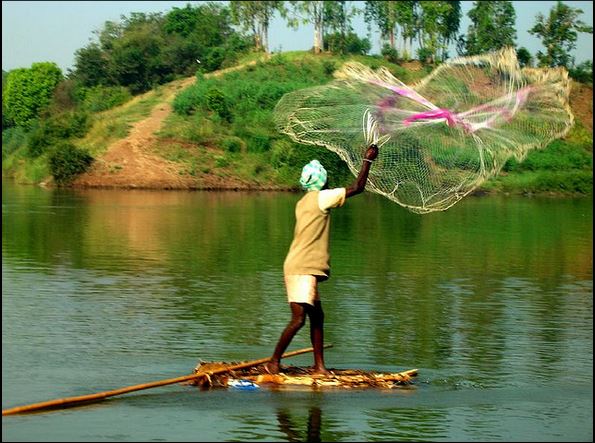
Figure 3. Fishermen casting his net in Krishna River. Credit: Mr. Nerlikar
On a different note, Shirol taluka macchimar sahakari sanstha wrote a letter to Assistant Commissioner, Fisheries (Technical) of the Kolhapur district seeking “process of collecting revenue from the fishermen of the open river is unjustifiable and should be stopped. Fishermen are aggravated by the fact that such practice is followed in no other district of Maharashtra except these three, so they want such measure to be discontinued.”
However, there are some contrary opinions to this demand too. Atmaram Apte of Hatkanangale fisheries cooperative society feels that “it is by the very process of leasing, rights of fisher folks on the river are recognized and protected. If the process of such leasing is stopped, anyone could come in our area and do fishing while the local fishermen will not be able to make their ends meet”.
In fact, simply recognizing fisherfolk and leasing fishing rights is still an important function, as per Mansih Rajankar, who has worked extensively on fisheries in Vidarbha. According to Rajankar, “At least some user right of these fisherfolk on the rivers is thus recognized. In Vidarbha, dams like Gosi Khurd will destroy downstream fisheries and fisherfolk do not even have nominal user rights on the river and hence, are not even counted as being affected by the dam!”
Pollution It is important to understand that the significant problem fishermen face is about water pollution. The Shirol, Hatkanangale and Jaisingpur MIDCs release highly untreated and toxic effluents which results in fish kills and thereby hampers the fish catch. The fish death have been alarmingly high in the district and the causative agents are sugar mills as well which release their stored wastes in the water on the onset of monsoon[viii].
In Dec 2012 and January 2013, Kolhapur taluka fisheries cooperative society, Bhoiraj fisheries cooperative society, and those from Shirol, Shridhon, Awali had written to fisheries development officer of the Kolhapur district, seeking compensation against the reduced fish catch. The same request was forwarded to Kolhapur district collector by the fisheries department. The district collector dodged the ball in the respective Tehsildar’s court. Tehsildars said that they don’t have enough money to grant for compensation. However, no concrete action was taken against the polluters. Maharashtra Pollution Control Board did not intervene in the matter either.
Unfortunately, no government department is ready to act for betterment of riverine fisher folks in the district.
The fishermen from Shirol Taluka (which has Dutta Cooperative sugar mill, and Shriol MIDC) say that about a decade ago, they used to receive around 10-12 kg of fish catch a day, now they only get 4-6 kg of fish catch per day. They attribute this reduction to the polluted discharges.
Most of the seeding done in reservoirs is exotic fish. Although Tilapia is an exotic pest species which competes with native fish, Fisheries Department is using Tilapia seeds in many reservoirs, from where they enter into river systems, contaminating the rich gene pool. For information on exotic fish invasion in our rivers: http://www.downtoearth.org.in/content/silent-invasion
In fact, Mr. Suneel Koli from Daulat Macchimar Sangathana, Shirol, Kolhapur told us that they get around 60-65 fish varieties in their catch, indicating the richness of riverine fisheries. Dr. Nilesh Dahanukar of Indian Institute of Science, Education and Research (IISER), Pune has recently[ix] discovered a new fish species in the Krishna river basin of Maharashtra section of Western Ghats. Experts believe that fish diversity in the rivers of Western Ghats is highly understudied and more focus needs to be given to the same.
In conclusion
Maharashtra state government and the Maharashtra state Fisheries Department needs to pay urgent attention to welfare of riverine fish diversity, fisheries and fisher folk. When the Fisheries Act 1961 clearly states that it provides for conservation and improvement of fisheries in the state, why is state government turning a blind eye to riverine fisher folks? It is important that the state fisheries department starts identifying the fishing communities (at least-if not the individual fishermen) of the open river. This will also help in understanding the plight of fisher folk in Maharashtra. Inland fisheries should not just be confined to the seeded fishing in dams and reservoirs.
Riverine fisher folk also need to get user rights on the rivers in which they fish. They should also be part of social impact assessment when dams and other structure are built on rivers and also part of Rehabilitation plans.
Rules under the Fisheries Act 1961 about “prohibit or regulate the construction temporary or permanent or weirs, dams and bunds” need to be formulated and enacted.
The polluters (including municipal corporations) and sugar mills need to be penalized as per the Fisheries Act 1961 to safeguard the livelihoods of riverine fisher folk.
The fisheries department needs to acknowledge local biodiversity of fish fauna and take efforts to conserve and promote them instead of only focusing on common carps and major carp varieties of the fishes. The department is not entrusted to protect only these varieties.
It is crucial that the fisheries department and State Department shows some will and initiative to protect riverine fish diversity against the onslaught of more, taller and bigger dams, polluting industries, law defying barons so that riverine fishery would survive for generations to come. With Climate Change becoming a reality, biodiversity and resilience of small scale, riverine fisheries can provide an important adaptation measure, which needs to be promoted urgently.
Damodar Pujari
(damodar.sandrp@gmail.com)
[i] Maharashtra District Economic Survey 2011-12, page number 100




 SANDRP