This analysis tracks the decisions taken by Union Ministry of Environment and Forests’ (MoEF) Expert Appraisal Committee (EAC) for River Valley and Hydropower Projects between Jan. 10 and Dec. 19, 2025 regarding Dams, Hydroelectric Power (HEP), Pumped Storage Projects (PSP) and Irrigation related proposals seeking Terms of Reference (TOR) for Environmental Impact Assessments and Environment Clearance (EC) approvals. It also covers various water projects related proposals considered by the MoEF’s Forest Appraisal Committee (FAC) between 27 Jan. to Dec. 02, 2025 for Forest Clearances (FC) approvals. SANDRP’s 2024, 2023, 2022, 2021 and 2020 overviews on the subject can be seen by clicking the hyperlinks.
Continue reading “2025: Env & Forest Clearance Decisions on Dams, Hydro, Irrigation Projects”Tag: Pump Storage Project
DRP 14×24: Big Dams, Long distance water will not solve Urban Water Crisis
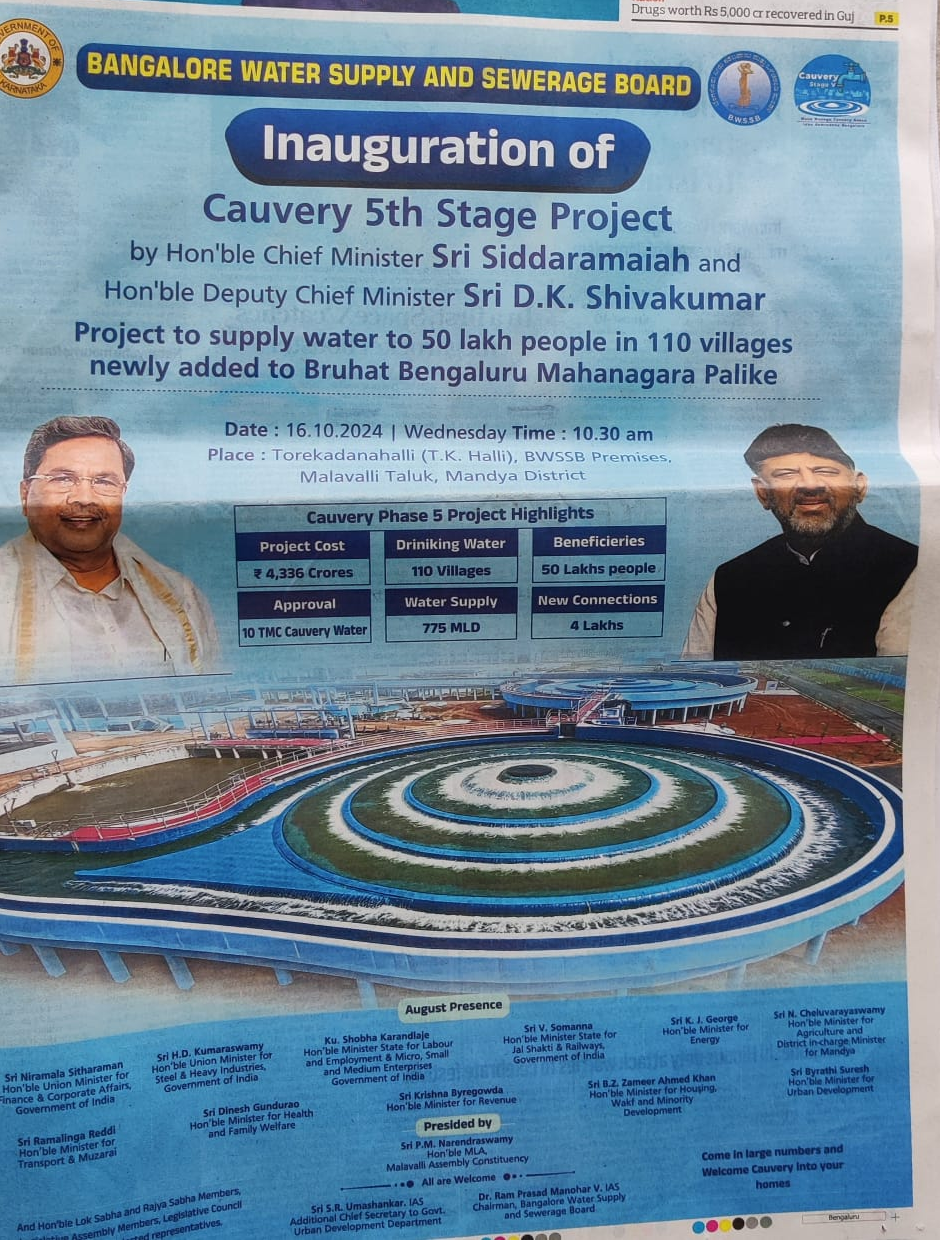
In a pointed article this week, Sachin Tiwale rightly writes that Mumbai does not need more dams, but needs to fix the distribution of more than enough water that it gets currently. Same is the case with highly capital and energy intensive 5th stage of Cauvery Water Supply being inaugurated on Oct 16 by the Karnataka Chief Minister and Deputy CM for Bangalore, advertised through full page advertisements today (Oct 14) in newspapers in Bangalore.
What the India’s cities need is to exhaust the potential of local water resources, including rain water, local water bodies including rivers, groundwater recharge, recycle and reuse of treated sewage and also demand side measures, including fixing the distribution and reducing transmission and distribution losses. All of this needs attention through a National Urban Water Policy that will also fix the Urban Water Governance.
Continue reading “DRP 14×24: Big Dams, Long distance water will not solve Urban Water Crisis”
2023: EAC & FAC Decisions on Dams, Hydro, Irrigation Projects
(Feature Image: Yamuna river deprived of e-flows downstream 120 Mw Vyasi HEP dam in Dehradun, Uttarakhand in June 2023. Bhim Singh Rawat/SANDRP)
This annual overview examines minutes of meetings held by Expert Appraisal Committee (EAC) for River Valley and Hydropower Projects between 15 December 2022 and 24 November 2023 for consideration of Dams, Hydroelectric Power (HEP), Pumped Storage Hydro Projects (PSP) and Irrigation related proposals seeking Terms of Reference (TOR) and Environment Clearance (EC) approvals. The report further analysis various water projects related proposals considered by the Forest Appraisal Committee (FAC) between 27 December 2022 and 18 December 2023 for Forest Clearances (FC).
Continue reading “2023: EAC & FAC Decisions on Dams, Hydro, Irrigation Projects”
DEVASTATING DEVELOPMENTS IN AYODHYA HILLS
Guest article by Kaushik Mukherjee and Sourav Prokritibadi
‘Kotto jongol chhnirbek! Sohoje ee jongol chnirte lairbek’ [‘How many trees are they going to cut down? These forests can never be destroyed so easily’]- comment by a tribal lady, Marang Buru hills, Ajodhya, Purulia.
The hilly area of Ayodhya is located within the dry deciduous forest belonging to a sub-region of the north-eastern part of Chhotonagpur plateau, included within a distinctive agro-ecological zone of West Bengal—the undulating red and laterite zone. Some of the prominent and well known hills of this area are Mathaburu, Gorgaburu, Pakhipahar, Ayodhya. The distinctive geological-hydrological backdrop and its characteristic floral and faunal diversity support a local human population—who, as official documents testify, are dependent on the forest for their life and livelihood. Moreover, the topography, forest wealth and wildlife attract tourists, wildlife researchers and naturalists in considerable numbers. Apart from being a popular tourist destination, Ayodhya hill range is significantly important for the entire Santhal population of all over India. The area is located precariously close to excavation sites that have yielded a rich outcrop of microliths—pushing the prehistory of Bengal back to 42,000 years BP[i] and promoting the area to the status of one of the most sensitive archaeological locales in West Bengal[ii]. Continue reading “DEVASTATING DEVELOPMENTS IN AYODHYA HILLS”
 SANDRP