Dams · DRP News Bulletin

DRP: 16 May 2016 (Water conservation: Lessons from ancient India)

Water conservation: Lessons from ancient India As drought-like conditions have gripped many parts of India this year, the pressure to drill borewells in search of increasingly scarce groundwater has escalated. Many regions are in the grip of a vicious cycle of drilling causing the water table to sink further. There is an urgent need to explore what benefits water conservation can bring, whether through modern or ancient water storage structures. This report explains, ecologically safe engineering marvels of water conservation have existed in India for nearly 1,500 years, including traditional systems of water harvesting, such as the bawari, jhalara, nadi, tanka, and khadin. Even today these systems remain viable and cost-effective alternatives to rejuvenate depleted groundwater aquifers, according to experts. With govt support, these structures could be upgraded and productively combined with modern rainwater-saving techniques such as anicuts, percolation tanks, injection wells and subsurface barriers. This may be a far more sustainable approach to alleviating the water scarcity crisis across India. Ultimately, water conservation has to be a key element of any strategy to bring an end to India’s perennial swings between drought and flood.

Continue reading “DRP: 16 May 2016 (Water conservation: Lessons from ancient India)”
Dams · DRP News Bulletin

DRP: 9 May 2016 (Welcome initiative by Lok Sabha Speaker on draught and ILR)

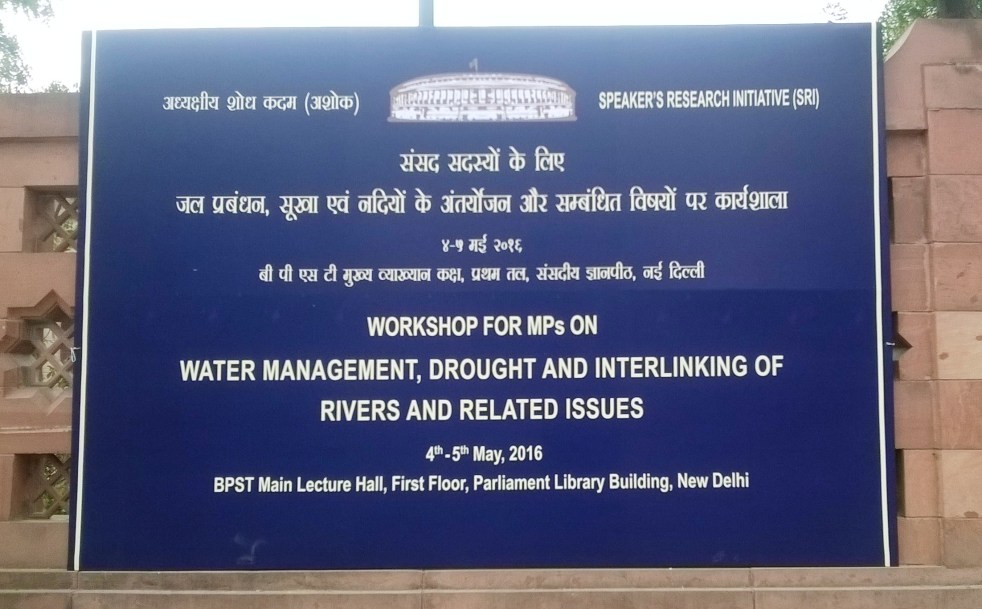
On May 4-5, 2016, Lok Sabha Speaker Smt Sumitra Mahajan took the lead in organising a workshop for Members of Parliament on Drought, Agrarian Crisis and ILR. As part of the newly constituted Speaker’s Research Initiative’s (SRI for short) work, Smt Mahajan inaugurated the workshop at 4 pm on May 4, 2016, where a panel of eight speakers were invited (4 on each day, SANDRP coordinator was one of the invited speakers on 1st day) to share their views, followed by questions from Members of Parliament. The idea was that on these important issues, Parliament Members are better equipped to raise the relevant issues when debating and raising questions in Parliament. It was heartening to see that at least 90 MPs (88 from Lok Sabha and 2 on Rajya Sabha) were present for 2.5 hours on first day, and they wanted to ask so many questions that there was not sufficient time to allow all of them to ask, nor sufficient time for speakers to make full presentations or answer all the questions. Similarly on second day too Speakers showed lot of interest on these issues. While inaugurating the workshop, Smt Mahajan mentioned how in Solapur, Maharashtra, because of the work of the collector and his team of officials, the impact of drought is lower than that in other districts. This was certainly heartening since it was SANDRP Associate Coordinator Parineeta Dandekar who first wrote on this issue, following her visit to Solapur and interview with the district collector. The workshop highlighted the need for many such workshops, possibly more focussed, but the impact of the workshop was already visible in the (as yet unfinished) debate under section 193 that started in Lok Sabha on May 5, 2016, hopefully to be continued in current week.

Continue reading “DRP: 9 May 2016 (Welcome initiative by Lok Sabha Speaker on draught and ILR)”

Dams · DRP News Bulletin

DRP: 2 May 2016 (Patoda: How a village in drought hit Maharashtra achieved water independence)

Patoda: How a village in drought hit State turned water self-reliant  At a time when almost every village in drought-hit Marathwada is facing acute water scarcity tiny Patoda, on the fringes of water-starved Aurangabad city, is offering valuable lesson in water management conservation and harvesting. Though it is surrounded by arid villages but Patoda’s residents regard water as more precious than money. They follow strict rules about usage and strictly carry the water audits. Water meters are installed in every households and entire village recycles each drop of waste water it generates. Today no rain water flows out of the village. Percolation has recharged the aquifers and the water table has risen. So effective is its water conservation model that Patoda has now become a model for the rest of Marathwada and has won 22 state & national awards. But it did not happened over nights. In fact it is a result of over 10 years joint efforts done by villagers.

Continue reading “DRP: 2 May 2016 (Patoda: How a village in drought hit Maharashtra achieved water independence)”

Dams · DRP News Bulletin

DRP: 25 APRIL 2016 (One Year After Nepal Earthquake, Has the World Learnt Any Lesson?)

On this day in 2015, the massive Nepal earthquake of 7.9 intensity (Richter scale) shook the scenic Himalayan Nation. The earthquake left a major trail of destruction affecting over 20 districts and killing over 9 thousand people.  According to expert Dave Petley, Langtang rock and ice avalanche was the most dramatic and significant landslide, that killed the most individuals. The earthquake killed over 9000 people, with 255 still missing. The severity of the quake can be gauged from the fact that more than a third of the disaster related deaths in 2015 occurred in Nepal’s April 25 earthquake. The earthquake-induced flash floods, landslides and aftershocks also damaged up to 15 hydropower plants, which has not been still restored fully. Surprisingly despite the increasing number of disasters taking place across the globe, world only spends less than a fifth of the money on Disaster Risk Reduction Compared to Disaster management.  Nepal will still take years from recovering socio-economic losses caused by the quake. But it is pertinent that in the wake of the quake and other disasters, human civilisation must learn its lesson. It’s true that development and disaster cannot be stopped but we must make our developmental decisions more informed, rule based and democratic so that it helps us deal better with disasters by decreasing their  intensity and velocity and our short-sighted developmental choices do not get translated into a disaster itself. Continue reading “DRP: 25 APRIL 2016 (One Year After Nepal Earthquake, Has the World Learnt Any Lesson?)”

Dams · DRP News Bulletin

DRP: 18 April 2016 (Prior action & planning can reduce Drought impact: Solapur shows)

Union Water Resources Minister Uma Bharti in an interview tried to refute charges that the Centre reacted late to India’s drought crisis. Water minister makes strange statements that one cannot do any planning about drought & her govt is the first govt to provide water through tankers. However, Solapur, a chronically drought-hit district in Maharashtra was serviced with more than 200 tankers in 2013-14, even when the monsoon rainfall was better than this year. In this drought, there are only 16 tankers plying in Solapur. Drinking water sources have been secured, water from Ujani dam for and sugar cane has been disallowed. The district leads the way in Jal Yukta Shivar Program in the state, new avenues of Agricultural credit are opening, options to sugarcane are being developed, errant sugar factories are being fined for polluting drinking water sources. Will the Union Government accept its mistakes and make amends?

Continue reading “DRP: 18 April 2016 (Prior action & planning can reduce Drought impact: Solapur shows)”

Dams · DRP News Bulletin

DRP: 4 April 2016 (India Water Week shows absence of fresh thinking from water resources establishment)

SANDRP Comments India Water Week continues to show absence of any fresh thinking from water resources establishment The 4th India Water Week being organized by Union Ministry of Water Resources, River Development and Ganga Rejuvenation during April 4-8, 2016 in Delhi shows continued absence of any fresh thinking from water resources establishment.

The Information Brochure of the event says: “Ministry of Water Resources, RD & GR is to organize the India Water Week -2016 between April 4-8, 2016 to use it as a platform to elicit ideas and opinions from global level decision makers, politicians, researchers and entrepreneurs in the ­field of water resources for mutual benefi­t and goodwill… This is the fourth event of its kind with the theme “Water for all : Striving together” focusing on improving efficiencies of water use across all sectors… ”

Continue reading “DRP: 4 April 2016 (India Water Week shows absence of fresh thinking from water resources establishment)”

Dams · DRP News Bulletin

DRP: 28 March 2016(Is India facing its worst-ever water crisis?)

Is India facing its worst-ever water crisis? On 11 March first time in 30 years history power generation at Farakka power plant in West Bengal was suspended for 10 days due to non-availability of water in Ganges. Nobody is sure why but the evidence about the declining water levels and waning health of the 2,500km long Ganges is mounting. Monsoon rains have been scanty for the second year in succession. The melting of snow in the Himalayas has been delayed. Water tables have also been declining in the Ganges basin due to the reckless extraction of groundwater. The 3-month-long summer is barely weeks away but water availability in India’s 91 reservoirs is at its lowest in a decade, with stocks at a paltry 29% of their total storage capacity, according to the Central Water Commission. Thousands of villagers in drought-hit region of Maharashtra depend on tankers for water & authorities in Latur district, fearing violence, have imposed prohibitory orders on gatherings of more than 5 people around storage tanks. Tens of thousands of farmers and livestock have moved to camps providing free fodder and water for animals in parched districts. The govt has asked local municipalities to stop supplying water to swimming pools. States like Punjab are squabbling over ownership of river waters. In water-scarce Orissa, farmers have reportedly breached embankments to save their crops. Realy the waning health of the sacred river underscores the rising crisis of water in India.

Continue reading “DRP: 28 March 2016(Is India facing its worst-ever water crisis?)”

Dams · DRP News Bulletin

DRP: 21 March 2016 (‘Towards Noyyal’ A people’s initiative to restore a river’s glory)

Tamil Nadu A people’s initiative to restore a river’s glory The Noyyal River Restoration Federation will launch ‘Noyyalai Nokki’ (Towards Noyyal), a people’s initiative to restore the Noyyal river system on 26 March. Social activist Anna Hazare will launch the project at Kooduthurai in Alandurai in Coimbatore district. The river originates in the Western Ghats and runs through the four districts to join the Cauvery at Noyyal village. Known as Jungle stream, in olden times as many as 34 streams used to feed water into it and the river would flow throughout the year with two or three annual flood spell.  But now, just 4 or 5 streams feed the river. In many places, the river is encroached upon, sewage is let into it, or the river needs to be desilted. The river is all set to regain its glory with the ‘Noyyalai Nokki’ initiative. What is encouraging is the willingness of the public to be part of it. The project proposes to divide the river into segments of 500 metres for restoration and maintenance. Ownership groups will be formed for every 500 metres and it will consist of the local people, experts and patrons (divide-distribute-develop model).

Continue reading “DRP: 21 March 2016 (‘Towards Noyyal’ A people’s initiative to restore a river’s glory)”

Dams

Smart Urban Water options: Recycle waste water

Recycling and reuse of wastewater is an important aspect of water management providing a way to increase available water while also preventing pollution of water bodies by sewage.

An estimated 62,000 million litres per day (MLD) sewage is generated in urban areas across India, according to the Environment Minister, while there is treatment capacity for only 23,277 MLD as of Dec 2015. A CPCB report further reveals that the actual amount of sewage treated stands at 18,883 MLD as only 522 out of 816 sewage treatment plants listed across India were operational, as of March 2015 (even this claim of 81.1% capacity utilization seems HIGHLY exaggerated). Thus, at least 70% of sewage generated in urban India is being dumped in rivers, seas, lakes and wells, polluting water bodies and contaminating fresh water sources. Partially treated or untreated sewage is responsible for large part of the pollution in streams and water bodies. Up to 80% of water bodies could be polluted.

Continue reading “Smart Urban Water options: Recycle waste water”