Dams · DRP News Bulletin

DRP: 3 April 2017 (India: Power Surplus & Exporter, Record Solar-Wind Growth, Need Not Push Destructive Hydro)

Power surplus, power exporter India, with record solar& wind wind generation trend, why push more destructive hydro projects According to power ministry statement on March 29, 2017, India for the first time became NET EXPORTER OF ELECTRICITY during 2016-17, it exported 4% more power during last 11 months (April-Feb), that what it imported from Bhutan. At the same time, power plants, on a national average, are opera ting at roughly 60%, down from nearly 65% in 2014-15.

Meanwhile, the Cabinet Committee on Economic Affairs has approved the amendments in the Mega Power Policy to push 31 GW stuck projects entailing an investment of Rs 1.5 lakh crore. The stuck projects in mega power policy include hydro projects of above 350 Mw in designated states (J&K and eight NE states) and above 500 Mw in other states.

Amid this, New and Renewable Energy Ministry has added over 5400 Mw wind energy capacity in 2016-17 against the target of 4000 Mw. This year’s achievement surpassed the previous higher capacity addition of 3.423 Mw achieved in the previous year. The leading States in the wind power capacity addition during 2016-17 are Andhra 2190 Mw, followed by Gujarat 1275 Mw and Karnataka 882 Mw.

In the last couple of years, India has not only seen record low tariffs for solar power but wind power too has seen a significant drop in tariffs. The onshore wind power potential alone is about 302 Gw. Preliminary estimates show the Gujarat coastline has the potential to generate around 106,000 Mw of offshore wind energy and Tamil Nadu about 60,000 Mw.

Continue reading “DRP: 3 April 2017 (India: Power Surplus & Exporter, Record Solar-Wind Growth, Need Not Push Destructive Hydro)”
Dams · DRP News Bulletin

DRP: 27 March 2017: (WE NEED TO LEARN TO TRULY CELEBRATE OUR RIVERS)

This is about the proposed Brahmaputra Festival being planned by the Assam Govt from March 31 to April 4, 2017. The five-day festival will witness significant participation from China. Various other countries such as Vietnam and Singapore are also reported as attending the program. It is scheduled to be inaugurated by President Pranab Mukherjee.  

It is true that the word business appears four times on the opening page of this festival website, but the word flood, erosion and people do not appear even once. This is relevant since for very large sections of people of Assam, the river also means floods, erosion, displacement and disaster on regular basis and not just “lifeline of Assam” or “life-giving prosperity and countless blessings”.  

The festival website also errs in many ways, including when it claims “India’s only male river”, since there are several male rivers, including Damodar, Ajoy, Pagla, Gadadhar, among others. It is true that even the word Nemami is copied from the Nemami Gange, but that should not be such a big issue?

It is true that people also suffer when river dries up or is polluted or is encroached or unsustainably mined, and none of these issues are highlighted by the festival website. It is true that the the Assam also means all the communities, including the bodos and mishing and many others, not just Guwahati or Dibrugarh or Majuli. The festival organisers may argue that we are taking the festival to all 21 districts, but it is important to recognised all communities of Assam.

This is in addition to the fact that Brahmaputra includes all the states of North East India, and more. The Brahmaputra, 2,900 km long, is an international river with 918 km of it flowing in India, 1625 km in China and 337 km in Bangladesh.

It is true that the festival is more about attracting tourists, business and transport along the river. And so it is not even giving a comprehensive picture of the rivers of Brahmaputra basin in Assam, nor is there attempt to do anything to improve the state of the rivers. Similarly, the destruction of the rivers of Guwahati and Assam needs to be halted and reversed, and may be this occasion can be used to push that advocacy?

Continue reading “DRP: 27 March 2017: (WE NEED TO LEARN TO TRULY CELEBRATE OUR RIVERS)”
Dams

Rajasthan Rivers Profile

About Rajasthan

Location: North West India; Area:- 342,239 sq km; Geography:-Desert plains and mountainous (Aravalli range); Population:- 68.54 million People; Rivers:- 6 Major River basins; Districts:-33 Districts; Climate:- Drier Western and Tropical Eastern part

About Rajasthan Rivers 

Rivers in Rajasthan are mostly seasonal, but this fact explains little because a river is not just the surface flow, evident to a naked eye. All the rivers and their floodplains in this desert state are vast grazing grounds supporting millions of livestock. These unseen rivers also recharge the groundwater making well irrigation possible.  

Modern-day development activities, however, are putting an enormous pressure on them. If deforestation has reduced the water flow, rampant sand mining has affected the water retention and seepage into subsurface channels. Aravallis also has large number of marble mines and processing units. While digging operations extensively damage the environment, discharge of a large amount of slurry by processing units also blocks water channels. Industrial and domestic wastewater has further affected the quality and biodiversity of rivers. 

Continue reading “Rajasthan Rivers Profile”

Dams · DRP News Bulletin

DRP: 20 March 2017 (South India Reeling Under Severe Drought)

The drought has extended its grip in the South, with the South-West (S-W) monsoon falling significantly short and the North-East monsoon proving a total failure. Reeling under the impact of failed monsoons, Kerala, Karnataka, Tamil Nadu and Puducherry have declared themselves as drought affected. Kerala and Karnataka, which are the worst affected, are already contemplating actions such as cloud seeding to tide over the situation.

In Kerala, the S-W monsoon deficit stood at -34 per cent, and the North-East monsoon, -61 per cent. Similarly, in Tamil Nadu, the deficits were -19 per cent and -62 per cent (North-East monsoon). For Coastal Karnataka, the shortfall stood at -21 per cent and -63 per cent, respectively. Drought-like conditions are also prevailing in parts of Andhra Pradesh and Telangana.

Water levels in key reservoirs in the region are at their lowest. The water tables have declined further even as the civic administration in many cities, small towns and panchayats has been increasingly tapping groundwater to ensure supplies. The situation is so dire that the Kerala govt has directed PepsiCo to cut down drastically on the use of groundwater for its Palakkad plant. Traders in Tamil Nadu are also boycotting these fizzy after claims that foreign firms are exploiting the country’s water resources.

Continue reading “DRP: 20 March 2017 (South India Reeling Under Severe Drought)”
Dams · DRP News Bulletin

DRP: 13 March 2017 (20 Big Hydro Projects Costing Over 30K Crore, Stalled & Stressed: Piyush Goyal)

20 hydro projects stalled or stressed  The Power Minister Piyush Goyal on March 09, 2017 in a written statement has informed the parliament that as many as 20 under construction HPPs totalling 6,329 MW are either stalled or stressed in the country and Rs 30,147.08 crore has already been spent on them. These projects include 2,000 MW Subansiri Lower of NHPC Ltd, 500 Mw Teesta VI of Lanco Teesta Hydro Power Ltd, 120 MW Rangit-IV of Jal Power Corp, 300 Mw Panan of Himagiri Hydro Energy Pvt Ltd, 850 MW Ratle of GVK Ratle HEP Pvt Ltd, 100 Mw Sorang of Himachal Sorang Power Ltd and 960 MW Polavaram of Polavaram Project Authority.

Continue reading “DRP: 13 March 2017 (20 Big Hydro Projects Costing Over 30K Crore, Stalled & Stressed: Piyush Goyal)”
Dams · DRP News Bulletin

DRP: 6 March 2017 (Farm Ponds In Maharashtra Causing Groundwater Decline)

SANDRP Blog Farm ponds in Maharashtra Causing Groundwater Decline Farm ponds recognized as a drought proofing measure have received a great push from the central Govt recently. On the flip side however serious concerns are being raised over implementation of the farm ponds and more importantly –their use. Civil society organizations like Watershed Organization Trust and also SANDRP have been pointing out that the use of farm ponds has long drifted from its objective of storing rainwater for protective irrigation. Most of the farm ponds are instead being used as storage tanks for pumped out groundwater exposing this underground resource to losses through evaporation, etc. In the process they are accelerating the rate of groundwater exploitation multi fold.

Continue reading “DRP: 6 March 2017 (Farm Ponds In Maharashtra Causing Groundwater Decline)”
Dams

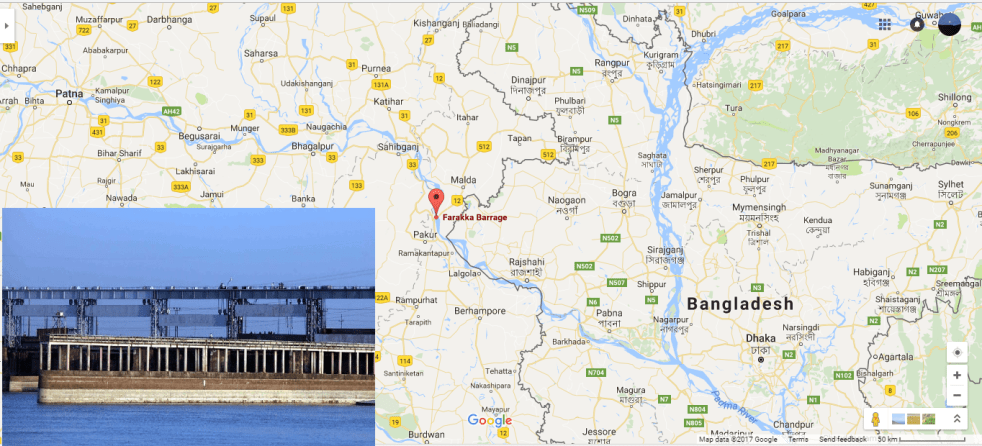
DRP: 27 Feb 2017 (Urgent Need To Review Impacts Of Farakka Dam: Experts)

During a global seminar held on Feb. 25-26, 2017 in Patna experts from across the country have advocated an “urgent review” and comprehensive study of the Farakka dam to revive the Ganga river. The experts were discussing various concerns facing River Ganga and the possible solutions for them. The seminar titled as “Incessant Ganga” was organised by Bihar’s Water Resources Department, almost week after, Bihar CM Nitish Kumar has openly termed the barrage as genesis of floods in the State. Speaking in the program, the CM again expressed deep concerns behind receding water flow in the Ganga and increasing silt deposit due to Farakka dam.

Speaking during the seminar, environment expert Himanshu Thakkar the coordinator of SANDRP advocated urgent need for review of Farakka barrage claiming that it has failed to fulfill any of the purpose – irrigation, hydro electric power, water supply – of the barrage for which it was built. As per, Himanshu Thakkar the dam was built to maintain the navigability of Kolkata port. 

Thakkar also suggested that the gates of Farakka be opened during monsoon to mitigate the intensity of floods in Bihar. As per Thakkar there was an urgent need for a comprehensive study of the Farakka barrage to find out its achievements or whether the barrage fulfilled its objectives. The committee constituted for study must include the Centre, Bihar, West Bengal and all states having Ganga, he said adding that a study should be made on the social and livelihood impact of the barrage, how it affected people’s lives, whether its existence was justified and cost-benefit assessment among other issues.

Continue reading “DRP: 27 Feb 2017 (Urgent Need To Review Impacts Of Farakka Dam: Experts)”

Dams · DRP News Bulletin

DRP: 20 Feb. 2017 (Bihar Govt Demands Decommissioning of Farakka Dam)

Bihar wants Farakka barrage to be decommissioned The Nitish Kumar govt has held the Farakka barrage in West Bengal responsible for heavy floods in Bihar and asked the Centre to decommission it to de-silt the heavily loaded upstream of Ganga River. The state has made the recommendation, observing that the dam is the “genesis of severe” flood consequences and responsible for “alarming” silt increase in the river’s upstream. According to sources, Nitish Kumar dispensation has made the demand before an experts’ committee formed by the Centre to work out guidelines for de-silting Ganga following last year’s devastating floods. 

As per the statement, decommissioning the barrage will help automatically de-silt the heavily loaded upstream, allowing silt to move to deltas before the sea thus helping  in restoration of deltas and its eco-system which is also getting adversely affected due to this barrage. To buttress its point, the state government has referred to Kolkata Port Trust’s data, which suggests that silt dredging at the port has increased from 6.40 million cubic metres annually from pre-Farakka days to four times, i.e. at 21.88 MCM annually, during 2003. The state government has also recommended the panel to come up with ‘National Silt Policy’ to address the problem. Bihar faced one of its worst floods as Ganga swelled in August last year, claiming lives of over 20 persons and affecting 20 lakh people.

Bihar Government has rightly asked for decommissioning of Farakka barrage and held it as the genesis of severe, destructive and prolonged floods that Bihar and other regions upstream from Farakka face year after year. Good to see that Bihar government has officially demanded decommissioning of the Farakka barrage before an expert committee of Ministry of Water Resources. Hope this starts the ball rolling to remove this unnecessary and giant dam on Ganga, which will also help the cause of fisheries (including Hilsa), downstream Bengal and also the river in general. The road cum rail line on the  barrage can continue to exist.

Continue reading “DRP: 20 Feb. 2017 (Bihar Govt Demands Decommissioning of Farakka Dam)”
Dams · DRP News Bulletin

DRP: 13 Feb 2017 (Oroville Dam Disaster, USA: A Wake up Call for India’s aging big Dams)

Finally the Oroville Dam spillway damage has turned into a disaster. Report at this time (01:00pm, Feb. 13, 2017) finds dam level rising about 1 feet above the danger level. Water currents have started pouring out all over and around the emergency spillway which has never been put in use for last half a century. Meanwhile, more water is gushing in the dam reservoirs due to recent heavy rainfall in catchment areas upstream.

Continue reading “DRP: 13 Feb 2017 (Oroville Dam Disaster, USA: A Wake up Call for India’s aging big Dams)”
Dams · DRP News Bulletin

DRP: 6 Feb 2017 (MSPCB Directs Reduction in Water Supply to Polluting Industries)

Maharashtra SPCB cuts 40% water supply to Taloja industries After the pollution board identified that chemical effluents from common effluent treatment plant (CETP) at Taloja were polluting the Kasadi river, the Maharashtra Pollution Control Board (MPCB) have directed to Maharashtra Industrial Development Corporation (MIDC) to cut 40 per cent of the water supply to industrial plants from February 1.

According to the letter issued to the industrial plants, earlier they were receiving 24-hour water supply but after MPCB’s directive, the plants would not receive water from 12am to 8am, effective from February 1.

Last year fishermen from the local Koli community had complained of decline in 90 per cent of fish catch from Kasadi river due to pollution. They had also alleged of inaction by authorities despite several complaints.

To highlight their plight, the fishermen then collected water samples in August 2016 from the Taloja CETP pipeline areas discharging treated waste and samples from the banks of the Kasadi river, and submitted them for a water quality test at Navi Mumbai Municipal Corporation’s (NMMC) environmental laboratory.

The samples were found failing several crucial parameters and having high levels of chloride , which is toxic to aquatic life and impacts vegetation and wildlife. Several reports had also mentioned that the pumping of industrial waste into the river had raised pollution levels 13 times higher than the safe limit. 

Taking cognizance of the complaints, MPCB issued a notice to MIDC highlighting the pollution problem on Jan. 31 2017 and informing the MIDC that until the Taloja industrial area does not start online pollution monitoring, adequate water supply would not be provided to them. The plants have two months to comply or else further action would be taken.

Continue reading “DRP: 6 Feb 2017 (MSPCB Directs Reduction in Water Supply to Polluting Industries)”