DRP News Bulletin

DRP NB 111223: NMCG failure: Wither Ganga Rejuvenation?

Continue reading “DRP NB 111223: NMCG failure: Wither Ganga Rejuvenation?”
DRP News Bulletin

DRP NB 110923: Another independent institution-CEC destroyed

Continue reading “DRP NB 110923: Another independent institution-CEC destroyed”
DRP News Bulletin

DRP NB 04092023: Will National Ganga Mission too fail to clean up Ganga?

Continue reading “DRP NB 04092023: Will National Ganga Mission too fail to clean up Ganga?”
Dams

DRP NB 070823: Forests & Biodiversity amendments: Gap between intent & application

Continue reading “DRP NB 070823: Forests & Biodiversity amendments: Gap between intent & application”
Dams

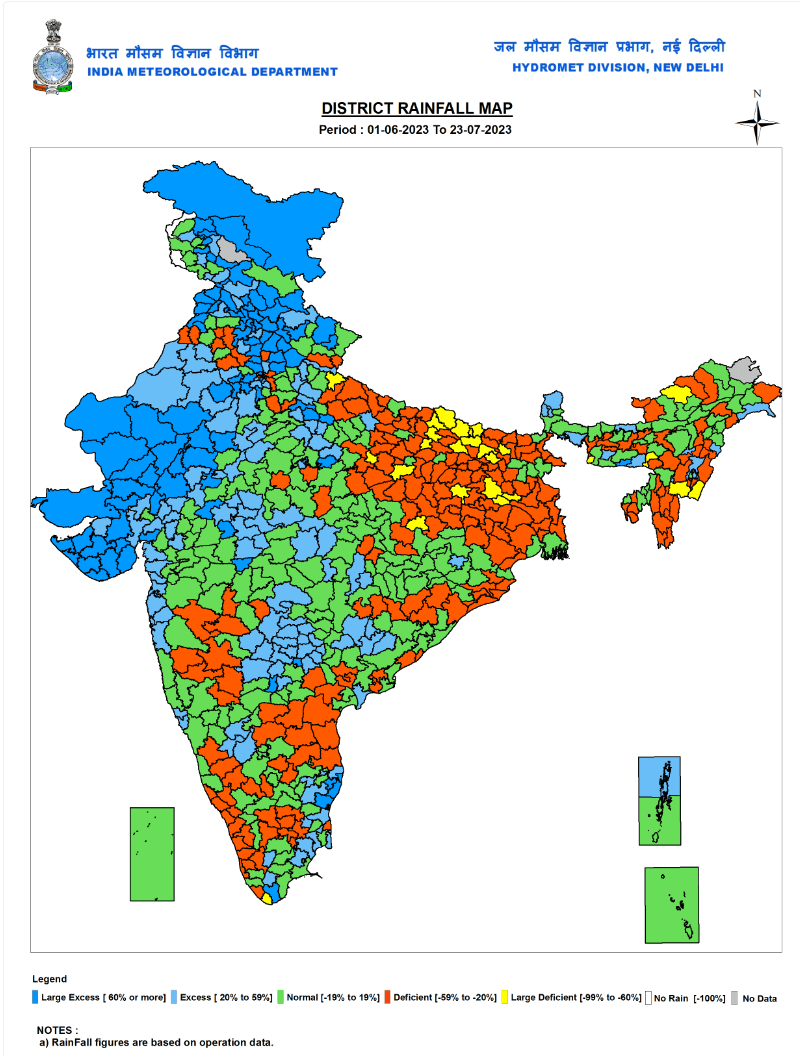
DRP NB 240723: Urgently need parameters that will truly reflect rainfall pattern

(Feature Image: – IMD’s District Wise Cumulative Rainfall Map for 01 June to 23 July 2023)

India received 389.2 mm rainfall till 0830 hrs on July 23, 2023 in SW monsoon. This being 5% above the normal rainfall till this date of 370.9 mm, India Meteorological Department and with it, the whole nation calls it Normal Monsoon. But anyone who is familiar with the rainfall pattern across India will not call it Normal.

We must urgently develop new parameters for describing the monsoon that also take into account spatial (across states, districts, Tehsils, blocks) and temporal variability. These parameters should take into account the departure from normal for each unit of space for each day and combine such departures to arrive at a figure that will better describe the monsoon for each unit of space. It can also take into consideration the high intensity rainfall events as also the longer dryer patches. This will help us understand not only the nature of monsoon rainfall, but also alert the farmers and everyone else but also help us understand how this pattern is changing over the years. This should not be so difficult for IMD to initiate and accomplish quickly. When aggregated at river basin level, this will also help us understand the actual rainfall pattern in each river basin but also how it is changing. Is this too much to ask?

Continue reading “DRP NB 240723: Urgently need parameters that will truly reflect rainfall pattern”
DRP News Bulletin

DRP NB 220523: Water Options as we await South West Monsoon 2023

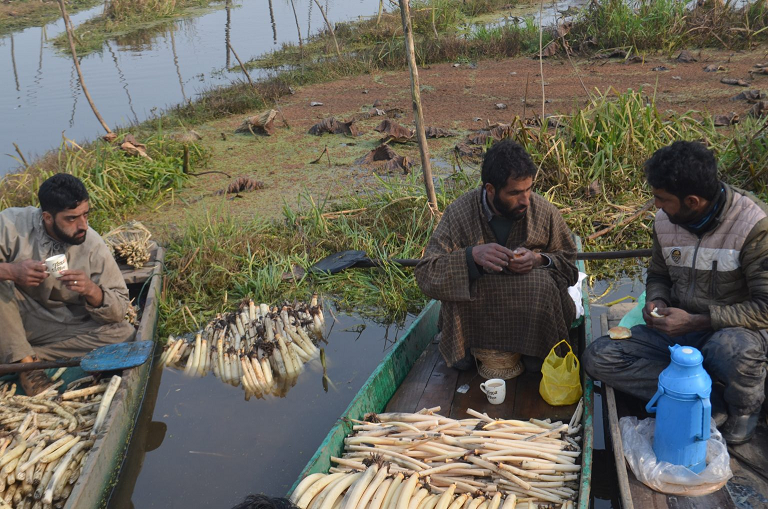
(Feature Image: Waster Chest nut cultivators removing weeds from Giri Taal of Kashipur. April 2023)

As we await the onset of South West Monsoon 2023, we would like to highlight the water options stories in lead story here, that includes examples from Ladakh, Madhya Pradesh, Rajasthan, Gujarat, Chennai, among others. It is important to remember these as we need to be ready to welcome and nourish the coming annual bounty that monsoon brings.

It also reminds us the fascination our poets have for this season, particularly the wonderment that Gulzar keeps expressing. In this one of his non filmy poetry “Baarish” he warns:

“Mujhko ye fikr, ke is baar bhi sailab ka paani…

Kud ke utrega kohsahr se jab..

tod ke le jayega ye kachhe kinaare..”

Continue reading “DRP NB 220523: Water Options as we await South West Monsoon 2023”
DRP News Bulletin

DRP NB 080523: Pune citizens Oppose River Front Development Project

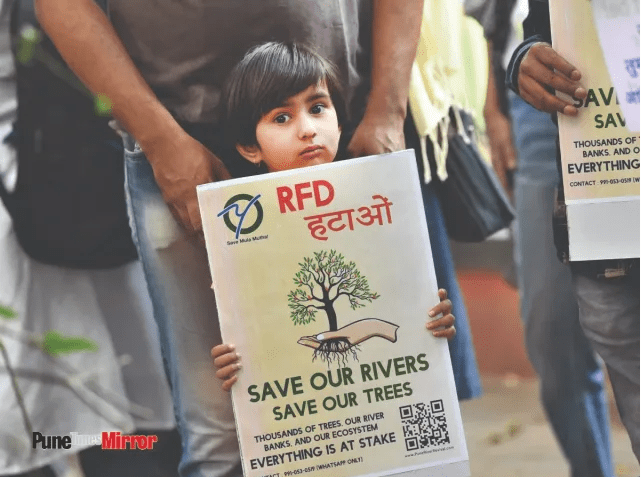
(Feature Image: On April 29, thousands of Pune citizens join Chipko Andolan against the planned cutting of over 7,000 trees for the Mula Mutha Riverfront Development (RFD) project. Image Credit: Rahul Deshmukh, Source: Pune Mirror.)

It is heartening to see thousands of Pune citizens out on the streets over the last two weeks protesting against felling of thousands of trees for the destructive Mula Mutha River Front Development Project. The project will destroy the best biodiversity habitat along the rivers in Pune, fell thousands of trees, encroach on riverbeds and floodplains, destroy bird migration corridor, and create fresh flood hazards for the city, which will further worsen in changing climate.

We hope this protests continue and intensify till the Pune Municipal Corporation and the Maharashtra government wakes up and scraps the project and instead, uses the scarce available resources for protecting and rejuvenating the water bodies and biodiversity in Pune in collaboration with the people of Pune.

Continue reading “DRP NB 080523: Pune citizens Oppose River Front Development Project”
DRP News Bulletin

DRP NB 240423: The world is moving away from Big Dams: Are we?

(Feature Image: Construction works going on at Polavaram Dam site. Source: The Hans Media, May 2021)

This well substantiated report from Yale School of Environment this week shows that the end of the big dam era is approaching. The well argued report from Jacques Leslie uses the reports from UN University, International Renewable Energy Agency, Oxford University, Inclusive Development International, China, among others to show how the pace of construction of dams and hydropower projects and also pace of financing such projects have hugely reduced in recent years and decades.

Even the International Hydropower Association, sensing the change, is now advocating pump storage hydro rather than conventional hydro and that too off stream version, to complement the power from solar and wind. Emerging economics with rising cost of hydropower projects and rising cost of power from such projects compared to solar, wind (onshore and offshore) are a major reason for the massively slowing pace of new hydropower projects.

Continue reading “DRP NB 240423: The world is moving away from Big Dams: Are we?”
DRP News Bulletin

DRP NB 060323: India’s regulators blind to increasing threats in Himalayas

This week the weekly DRP bulletin brings news of increasing threats from changing climate in inherently disaster prone Himalayas. The news come from Ladakh in the NW to Nagaland in the NE, and includes Uttarakhand among others. The news is about retreating glaciers, increasing threats of Glacial Lake Outburst floods and landslides. The news also notes that factors like indiscriminate infrastructure development and lack of drainage are worsening the disaster potential of the Himalayan states. Most importantly, implicitly more than explicitly, the news reports highlight complete inattention of the regulators to these increasing threats and risks in inherently vulnerable Himalayas while considering new infrastructure projects like Highways, Railways, Hydropower projects, Dams and urbanization and also in terms of disaster management laws and practices.

It underlines that the threats and risks in the Himalayan states is also increasing due to changing rainfall patterns due to changing climate. This trinity of inherent vulnerability, changing climate and inattention to the risks of indiscriminate infrastructure projects is clearly very very dangerous, but there is little hope for any immediate change. One clear indication is the handling of the Joshimath disaster, a clear case of how not to handle communication as Dave Petley has noted. The Prime Minister’s office is sitting on the report submitted by the investigating agencies several weeks ago. Why should this report be a secret or will we get a negotiated report?

Continue reading “DRP NB 060323: India’s regulators blind to increasing threats in Himalayas”
DRP News Bulletin

DRP NB 200223: US EPA starts reporting methane emissions from dams

(Feature Image:-Vyasi HEP dam reservoir on Yamuna river in Dehradun. Credit: Varsha Singh/Third Pole, Jan. 2022)

In a landmark move, United States Environment Protection Agency has started reporting methane emissions from dams and hydropower projects in its annual reporting to UN in 2022. It needs to go a step further and make it mandatory for all dams and hydropower projects to annually report such emissions on their websites. This will not only help clear the mistaken notion that hydropower projects are climate friendly, it will also help take right policy measures and project construction or decommissioning decisions. It will also lead to more scientific accounting of global warming causing emissions. It will also give the consumer right picture about GHG emissions from such projects when they look at options for electricity supply. There is a lot that India and rest of the world that needs to learn from this and implement on urgent basis as US EPA seems to be the first agency to do this.  

Continue reading “DRP NB 200223: US EPA starts reporting methane emissions from dams”