
This report is about the interventions by various judicial bodies in India in the hydro power projects related issues in 2020. This also covers judicial decisions either delaying the justice or facilitating the projects thus unhelpful for the public interest cause and paving way for financially unviable and environmentally destructive projects. The account first looks at judicial interventions at the National level and then in states in North, North East and South Zones.
Continue reading “Judicial Interventions in Hydro Projects in India in 2020”Tag: NGT

DRP 080321: Will Madras HC action help save water bodies?
While on the face of it the Madras High Court order on March 2, 2021 that all district collectors of Tamil Nadu must upload by March 17, GPS/ satellite images of all the water bodies in their districts is not only welcome, it needs to be done in all the districts across India. This order is by the bench of Chief Justice Sanjib Banerjee and Justice Senthilkumar Ramamoorthy.
The same bench had earlier in January 2021 said, in response to a PIL that the government officials must have zero tolerance towards encroachment of waterbodies and ensure that every inch of such encroachment gets removed at the earliest by following the due process of law. The PIL had sought for removal of encroachments from a two-acre swamp at Arehalla in Ithalar, a village in Nilgiri hills.
While these are welcome, we hope these orders get implemented and provisions be made by the HC to ensure accountability of the DMs to ensure that all information is put out on the district water bodies website in form and manner that people understand as also in english and should be archived so that the information can be used in future. The information from the past should also be put up on such websites and a transparent, participatory monitoring of the water bodies be instituted for each district.
Continue reading “DRP 080321: Will Madras HC action help save water bodies?”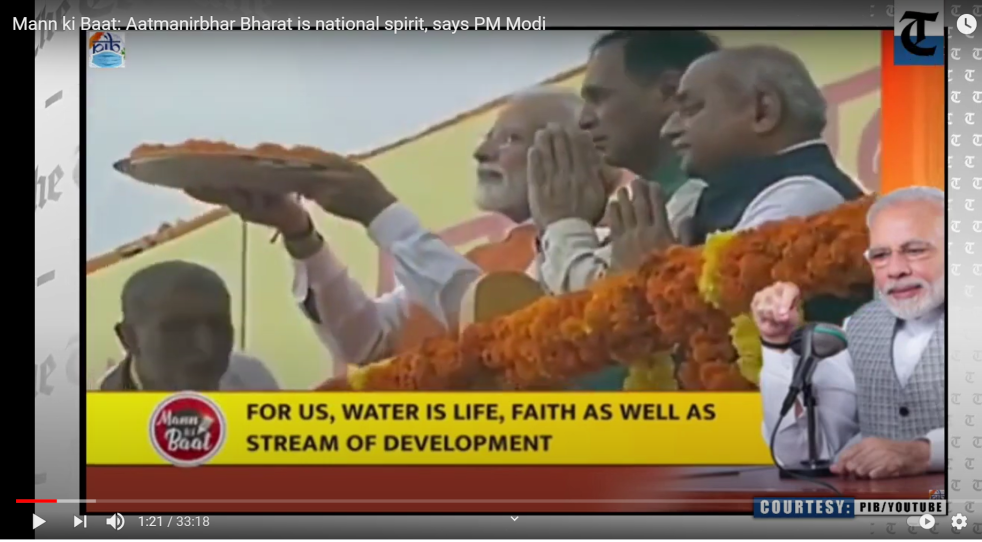
DRP 010321: Actions speak louder than words on PM’s appeal for water, river conservation
In his #MannKiBaat on Feb 28, 2021, India’s Prime Minister Shri Narendra Modi appealed to people to conserve our Rivers, Water, referring to Magh Purnima on Feb 27 2021 and Sant Ravi Das teachings. He also said that India’s traditions, festivals, scriptures, etc have so much place for rivers, also mentioning the Kumbh mela this year at Haridwar. He mentioned that a 100 day campaign will be launched soon by the Jal Shakti Ministry for rainwater harvesting. He gave several examples from across the country where individuals and groups have taken up such words.
All that sounds fine and welcome. But the trouble is that his all-powerful government is working consistently and with increasing intensity towards opposite direction. This very week his Power Minister expressed ignorance if hydropower projects have any environmental adverse impact, right in the face of destruction wrought by the hydropower projects in Chamoli disaster in Uttarakhand on Feb 7, 2021. Why is the Union Government still pushing hydropower projects which are no longer even economically viable, they never were environmentally sustainable or socially acceptable.
Continue reading “DRP 010321: Actions speak louder than words on PM’s appeal for water, river conservation”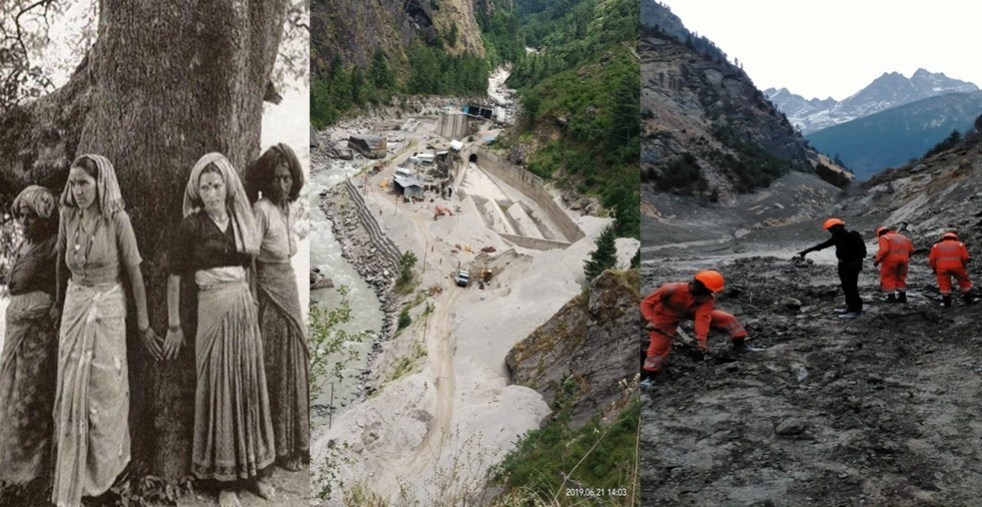
Rishiganga HEP: A foretold disaster for River, People and Chipko legacy
The February 7 2021 Chamoli deluge has completely destroyed Rishiganga Hydro Electric Project (HEP). The 13.2 MW run of the river project has also become graveyard for over 50 innocent workers and villagers. The damages to homes, bridges, forest and river eco-system is additional which cannot be restored easily.
In fact, the disaster is among the threats against which experts and locals had been warning the authorities time and again. Sadly, the past history of struggle and destruction shows that not only the state government but the judiciary also failed miserably to address the pleas of locals and assess the disaster risks in a timely manner.
Continue reading “Rishiganga HEP: A foretold disaster for River, People and Chipko legacy”DRP 220221: Case against NTPC for criminal negligence in Tapovan Project?
Consider these facts: The NTPC, the project developer, failed to appraise that the 520 MW Tapovan Vishnugad Hydropower project, where maximum damage and deaths occurred in Chamoli Avalanche disaster that started on Feb 7, 2021 morning, is in Paraglacial influence zone. Such an appraisal would have meant a number of implications, including possibly a decision that the project is geologically unviable.
NTPC failed to take any action to save the workers even after it was known upto 10-20 minutes before the disaster struck. Something that Mangshri Devi could do to save about 25 lives, NTPC could not do.
The project had faced several disasters since 2008, but fails to put in early warning system in place. For several days post disaster, reports say that NTPC failed to share even the detailed map of the tunnel where over 30 workers were stuck. NTPC’s disaster management system showed no signs of existence throughout the disaster. Reports say that the barrage gates were closed, which if they were open, it may have helped the flow of the flood debris downstream, which in turn could have possibly meant more time and saving of more lives.
Continue reading “DRP 220221: Case against NTPC for criminal negligence in Tapovan Project?”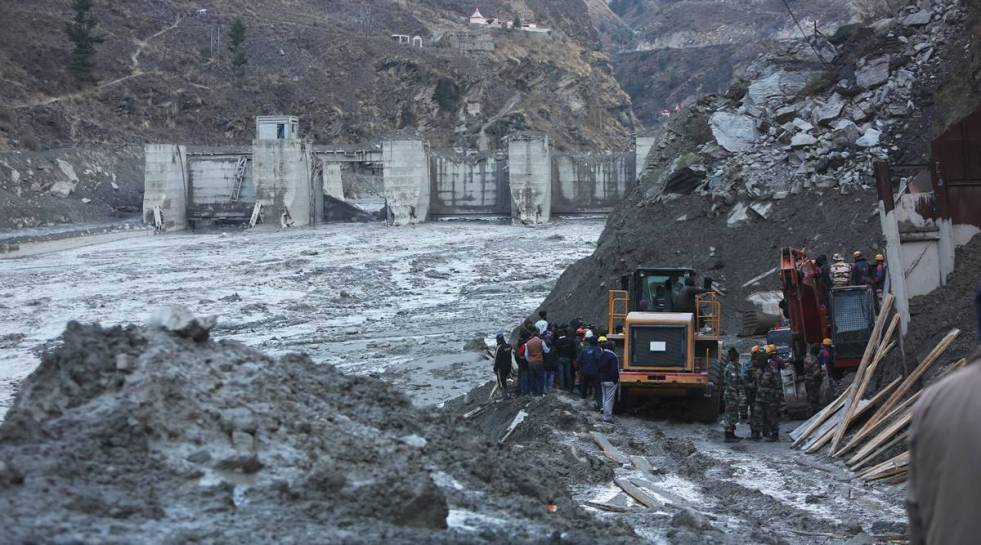
DRP 150221: Why Mangshri Devi of Tapovan Should Head Uttarakhand’s Disaster Management Department?
Feature image Tapovan-Vishnugad hydropower project in Chamoli district on Feb., 7 by Gajendra Yadav, Express Photo
In a fantastic story, Shivani Azad of The Times of India has reported possibly the most remarkable story of the Chamoli avalanche disaster that started on Sunday morning on Feb 7, 2021. She reported that Vipul Kairuni of Dhaak village in Tapovan, working at the time at the now destroyed Tapovan Vishnugad project, got saved thanks to frantic calls by his mother Mangshri Devi as she and his wife saw from their village home, situated at a height from the river, that a massive flood is approaching the dam site. It was thanks to frantic, repeated calls by Mangshri Devi that not only Vipul, but at least two dozen more people could run to safety of a ladder and saved their lives.
So effectively, Mangshri Devi has saved at least two dozen lives in Chamoli disaster. Who else can claim to have achieved anything like that in the disaster? The disaster management department seems completely absent from the scene either in terms of pre disaster monitoring or in taking steps to save lives during the disaster. In fact, there should have been an early warning system in place that could have saved many more lives. But it does not exist. Either in Rishiganga/ Dhauliganga basin or anywhere else in Uttarakhand. NTPC’s Tapovan Vishnugad Project has faced so many disasters already since 2008, but is only now talking about putting in place early warning system. Should not the NTPC and power ministry top brass as well as Uttarakhand disaster management department held accountable for that?
Continue reading “DRP 150221: Why Mangshri Devi of Tapovan Should Head Uttarakhand’s Disaster Management Department?”
DRP 080221: Will NITI Aayog study the costs of overturning the Radhakrishnan Judgement on Uttarakhand?
NITI Aayog, we learn, has started studies of implications of the Supreme Court and NGT orders on environment issues. In the context of the massive Chamoli disaster now unfolding in Uttarakhand, NITI needs to urgently institute an inquiry as to who all are responsible for overturning the Justice Radhakrishnan led verdict of Aug 13, 2013 about the June 2013 Uttarakhand disaster and role of hydropower projects in the disaster and the costs of overturning that verdict. In fact if the Justice Radhakrishnan verdict were to have been sincerely and honestly implemented to its logical conclusion, the proportions of the current Chamoli disaster and others would have been majorly reduced. So the costs are no doubt huge and mounting. Will NITI Aayog institute such an independent inquiry urgently?
Continue reading “DRP 080221: Will NITI Aayog study the costs of overturning the Radhakrishnan Judgement on Uttarakhand?”
DRP 010221: Dissolving YMC is retrograde
In a shocking and disappointing move, the National Green Tribunal last week dissolved the Yamuna Monitoring Committee (YMC) in Delhi, UP and Haryana along with Justice Pritam Pal Committee and asked the state government to implement the various measures in earlier YMC and NGT reports and directions. This seems like a major set back for the future of Yamuna and other rivers. This seems to have been a direct fall out of the Supreme Court of India Suo Moto taking up the Yamuna pollution issue. This is not going to help solve the seemingly intraceable issue of tackling pollution of our rivers. If the states were interested and capable of implementing the necessary measures, we won’t have required YMC in the first place. YMC was taking a number of useful steps and as we wrote in the DRP lead story dated January 18, 2021, what is required is strengthening the hands of the YMC, but as if our worst fears were to come true, YMC has now been dissolved, even before it could make its mark in achieving cleaner rivers.
It should be noted that our judiciary does not have very remarkable track record in achieving cleaner rivers. In fact the same Supreme Court took up Yamuna case Suo moto in 1994 and not having been able to achieve any better state of Yamuna, after dealing with it for 23 long years, handed over the case to NGT in 2017. Supreme Court had been dealing with Ganga case even longer, and again not achieving better state of the river, handed over the case to NGT in 2017. It seemed like NGT had done something right in setting up YMC, but that also has been dissolved. Its clear that unless the citizens and society does not rise up, there is no hope for our rivers.
Continue reading “DRP 010221: Dissolving YMC is retrograde”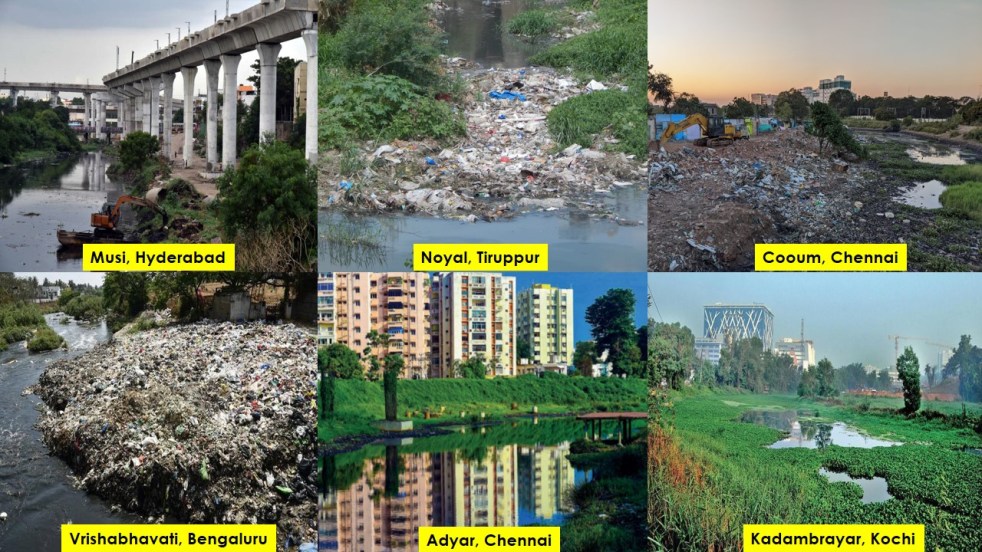
South India Urban Rivers Overview 2020
Urban rivers provide a lot of services, but the urban areas are inviting major trouble by destroying them through dumping of solid and liquid waste, encroachments, river front developments, unsustainable mining among others. The urban areas also operate in almost total policy vacuum and none of the cities under smart city programs are dealing with Urban rivers with any smartness.
This overview includes some key developments about Urban Rivers in 2020 from the South Indian states of Karnataka (Vrishabhavati in Bengaluru; Swarna-Netravati in Udupi), Tamil Nadu (Adyar, Buckingham Canal and Cooum rivers in Chennai; Kiruthumal in Madurai; Noyyal in Tiruppur; Bhavani in Coimbatore; Palar in Vellore; Vasishta in Salem), Telangana (Musi in Hyderabad), Andhra Pradesh (Tungabhadra in Kurnool), Kerala (Periyar, Kadambrayar & Konthuruthy in Kochi; Kodoor in Kottayam) and Puducherry (Sankarabarani).
Continue reading “South India Urban Rivers Overview 2020”
DRP 250121: UN warns about aging Dams & Floods in changing climate
A new UN report released on January 21, 2021 UN has warned the major big dam owning counties about the aging population of fast silting up dams in changing climate and urgent need to start working on decommissioning of uneconomical large dams. Among the few countries that UN has warned includes India with its third largest number of big dams. The added problem in India is the ill maintained and ill operated large dams that UN report did not look into. Indian dams are sanctioned based on highly under estimated siltation rates, there is practically no transparency and accountability in operation of Indian dams and dam almost every year get away with creating avoidable flood disasters. This latest problem is not just related to old dams, but even the newest celebrated ones like the Sardar Sarovar Dam as happened in Gujarat in late August-early Sept 2020. No legal regime exists in India for dam safety, either structural safety or operational safety. And in changing climate, with increasing frequency of higher intensity rainfall events, such risks are already increasing multi-fold.
Continue reading “DRP 250121: UN warns about aging Dams & Floods in changing climate” SANDRP