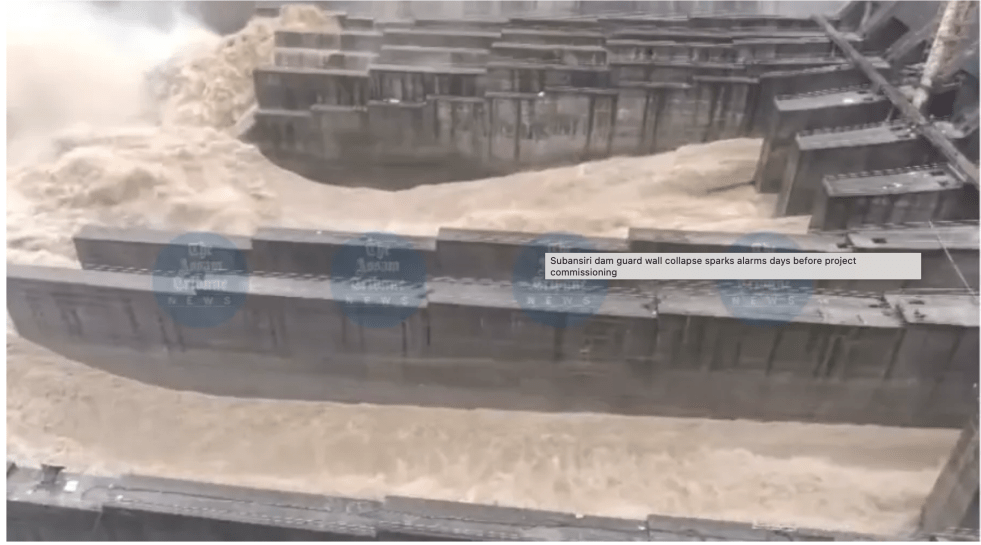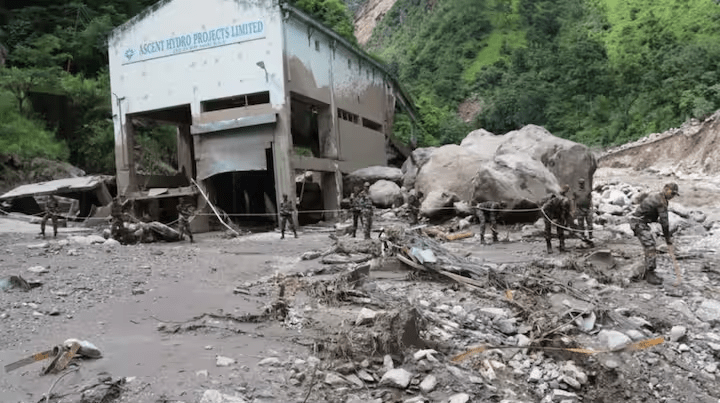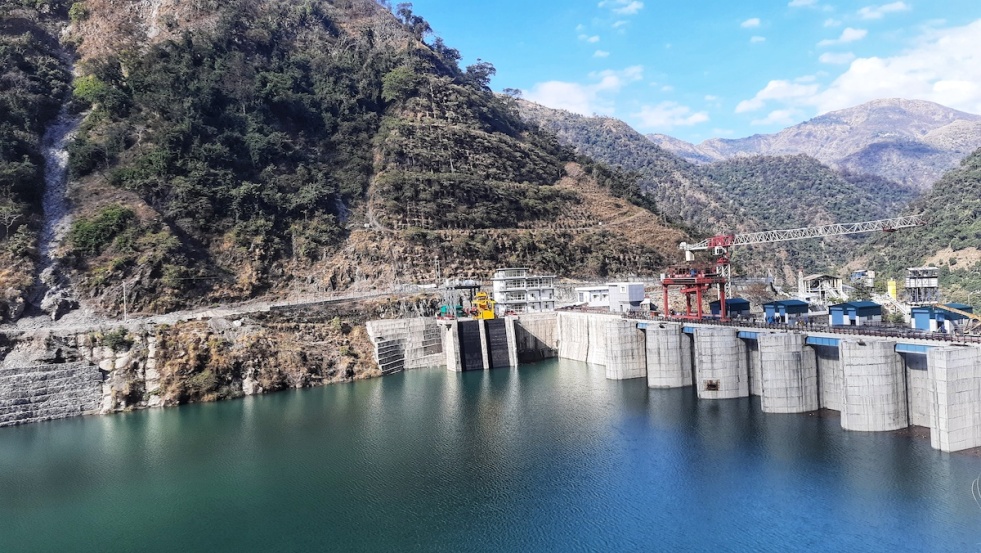
“The commissioning of the Subansiri Lower Hydro Electric Project (SLHEP) has been further delayed till May 2026” NHPC has now acknowledged. In a report filed by PTI, the project developer has acknowledged on June 12 2025 that the controversial 2000 MW Hydropower project on Subansiri River in Brahmaputra basin on Assam-Arunachal border “has suffered “minor damages” during the recent monsoon rains”. The suggestion that the damages were minor may not be accurate considering the consequences of project delay.
Continue reading “Subansiri Lower HEP faces damages in 2025 like in every year since 2019”Tag: NDSA
2024 Dam Safety
(Feature Image: Coimbatore Corporation Commissioner M. Sivaguru Prabakaran inspecting the Siruvani dam on January 8, 2025. Photo, Text Source: The Hindu)
This annual overview complies the remaining relevant reports from 2024 concerning safety of dam structures in India. As per a report, the incident of damage to Tungabhadra dam gate in August 2024, raised alarm for other aging dams in Karnataka. In fact, the Bhadra dam also witnessed jamming of a gate due to rust in June 2024. Similarly, the Kabini reservoir has been dealing with a leakage for the past three years. The report further highlights negligence in dams’ monitoring and inadequate expertise and corruption often impacting the quality of maintenance works of dams in the state. As per another report taking sou moto action, the Karnataka High Court in January 2024, banned mining and blasting activities within a 20 km radius of the Krishna Raja Sagara dam in the state.
Continue reading “2024 Dam Safety”DRP NB 200125: Whither Env Clearance Rejection rate from Expert Appraisal Committee or MoEF?
A detailed review of functioning of Union Ministry of Environment and Forests’ (MoEF) Expert Appraisal Committee (EAC) on River Valley Projects (RVP) for 2024 by SANDRP shows that the committee or for that matter MoEF has almost non-existent rejection rate. Even when a project is not cleared, when it applies again, it gets clearance, whether the application if for stage I (Terms of Reference) or Stage II (Environment Clearance- EC) clearance. Even in some cases like Pump Storage Projects (PSP) in Western Ghats or the Hydropower projects in disaster prone Himalayas, including the disaster-stricken projects like the 1200 MW Teesta III projects in Sikkim, the scrutiny including field visits by the EAC Sub committees is minimal, not worthy calling even scrutiny.
Continue reading “DRP NB 200125: Whither Env Clearance Rejection rate from Expert Appraisal Committee or MoEF?”2024: Siltation, Safety & Sustainability of Hydro, Dams in India
(Feature Image: Pune: Pavana, Mulshi, Panshet, and Khadakwasla Dams Release Water Due to Heavy Rain in Catchment Areas. Source: Pune Now News, Sept 2024)
This annual overview focusses on how siltation, muck dumping related issues are affecting the safety and sustainability of Hydropower projects and dams in India. Some of the key dams facing crisis in this regard include Bhakra, Ratle, Gangasagar, Hathnur among others. Some of the states where this issue is acute include HP, J&K, Maharashtra, Telangana, Kerala, Karnataka & Punjab.
Continue reading “2024: Siltation, Safety & Sustainability of Hydro, Dams in India”DRP NB 130125: Will Judiciary take these matters to logical conclusion?
There are at least four cases in this past week where the judiciary has used strong words or taken up crucial issues in water, dams, hydropower projects, wetlands and riverbed mining related issues. In the case related to the safety of Mullaperiyar dam on Kerala-TN border, the Supreme Court has prodded the Centre to wake up from the slumber to ensure that National Dam Safety Authority quickly forms a panel to examine the project. This case has wide ranging repercussions not only about this project, but also functioning of NDSA and other bodies under the Dam Safety Act 2021. Indeed, there is huge question mark as to what extent NDSA and DSA has made our dams any safer.
Continue reading “DRP NB 130125: Will Judiciary take these matters to logical conclusion?”2024: Climate Change, GLOF impact on Safety of Hydro, Dams in India
(Powerhouse of a hydro project ravaged by cloudburst induced flashflood in Sutlej basin Shimla, Himachal Pradesh in Aug 2024. Image Source: Social Media)
This 2024 annual overview focusses on important reports highlighting the safety and sustainability issues of the hydro and dam projects in India in 2024 in the context of Climate Change, including Glacier melt and GLOFs. The compilation shows that the climate change driven extreme weather events have become significant threat for the structural safety of these projects.
This is even more relevant in inherently vulnerable areas like the Himalayas and Western Ghats from the point of view of seismic activity, young erosion prone mountain, flash floods, avalanches and landslides. Here the impact of climate change effects like more intensified hydrological cycles, cloud bursts, reduction in snow fall, glacier melts and GLOF (Glacier Lake Outburst Flood) increase the vulnerability including landslide dams and avalanche dams.
Continue reading “2024: Climate Change, GLOF impact on Safety of Hydro, Dams in India”DRP NB 060125: Concerns about & Contradictions in CGWB’s Reports
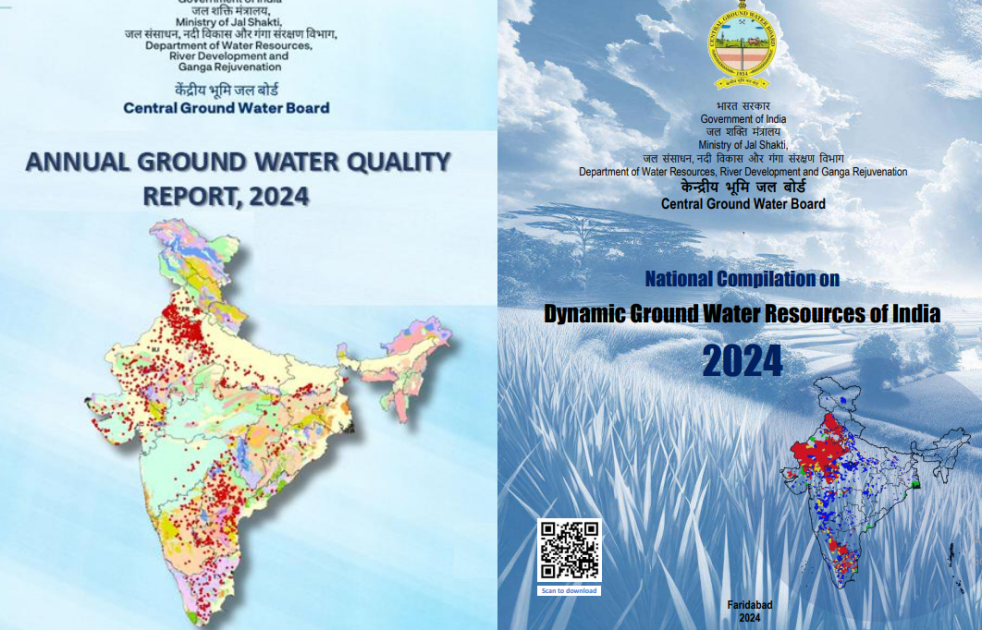
The Central Ground Water Board (CGWB) released two important reports last week. While the Annual Ground Water Quality Report 2024 reveals rise in nitrate fluoride, arsenic and uranium contimination of groundwater resource in India, the Dynamic Groundwater Resource Assessment Report 2024 claims substantial rise in annual groundwater recharge and decline in extraction of the resource.
As per the first report, the number of districts affected by high nitrate levels in groundwater has gone up to 440 (near 56% of all 779 districts in country) from 359 found in 2017 assessment which means in 7 years 81 more districts have been found having excessive nitrate levels in groundwater. This should concern us from a number of points of view.
Continue reading “DRP NB 060125: Concerns about & Contradictions in CGWB’s Reports”DRP NB 300924: Focus on River Studies
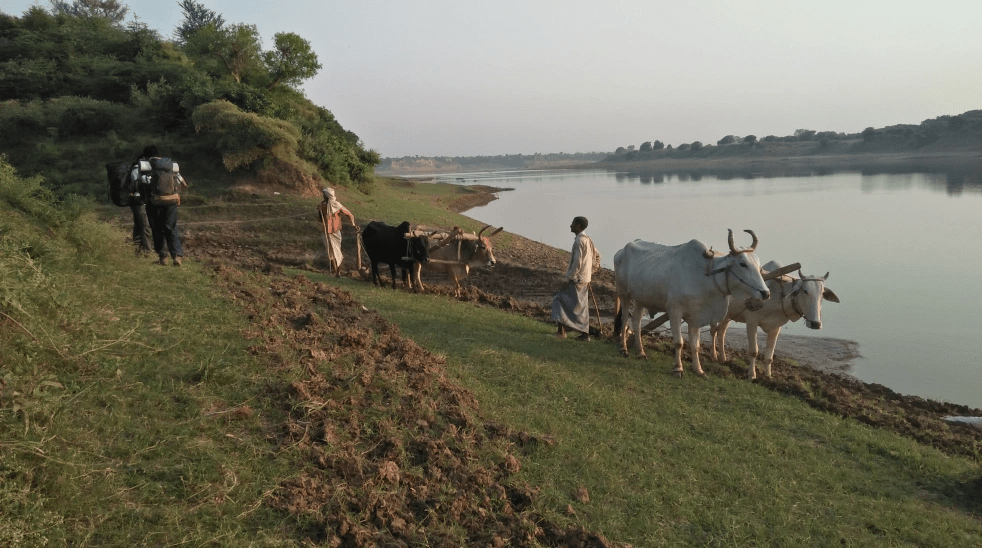
Rivers are the most important ecosystems (eco here includes ecology and economy) and yet possibly least studied entities. Some news below this week about some river studies brings the focus on need to take up many more river related studies.
Most important aspect of river related studies is the need for credible, independent studies, not influenced by the needs of the governments. Otherwise, the government is likely to not only influence the study, but also decide not to make it public as they did in case of the studies related to Joshimath town and role of Chamoli disaster.
Continue reading “DRP NB 300924: Focus on River Studies”Himachal Pradesh: Damages at Luhri-I HEP Reveals Loopholes in Dam Safety Act
(Feature Image: Screenshot of Local News India July 06, 2024 video report showing Luhri-I HEP tunnel outlet flooded after rise in Satluj water level.)
The controversial under construction Luhri Hydroelectric Project (HEP) Stage-I is being developed by Sutlej Jal Vidyut Nigam Limited (SJVNL) on Sutlej river near village Nirath village in Shimla and Kullu districts of Himachal Pradesh. The 210 MW HEP involves construction of an 80 m high concrete gravity dam with six bay gated spillways, a 567 m long horse shoe shaped diversion tunnel, two coffer dams, a surface power house, intake structure and penstocks among other parts.
The project would require 149.07 ha land including of 98.10 ha forest land and 50.97 ha private land. The project dam would create 6 km long reservoir area submerging 100.23 ha of land comprising of 63.52 ha of forest and 36.7 ha of private land. 39.47 ha of the submergence area is riverbed land.
Continue reading “Himachal Pradesh: Damages at Luhri-I HEP Reveals Loopholes in Dam Safety Act”May 2024: Questions about NDSA interim report on Kaleshwaram Dam Disaster
The National Dam Safety Authority (NDSA) Chairman Shri Anil Jain has through a letter dated May 1, 2024, sent an interim report of the NDSA committee to the Telangana govt. The 16 page interim report titled: “RECOMMENDATIONS ON THE INTERIM MEASURES AND FURTHER STUDIES/INVESTIGATIONS TO BE TAKEN UP BY IRRIGATION & CAD DEPARTMENT, BEFORE THE ONSET OF COMING MONSOON” came as an annexure to the letter addressed to Rahul Bojja, Irrigation and Command Area Department (I & CAD) of Govt of Telangana.
Continue reading “May 2024: Questions about NDSA interim report on Kaleshwaram Dam Disaster”