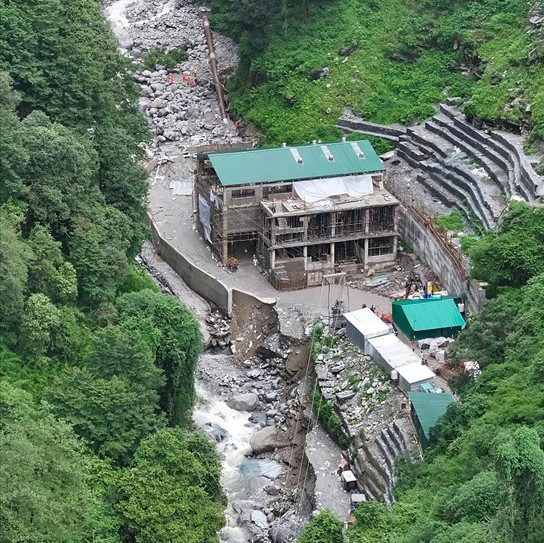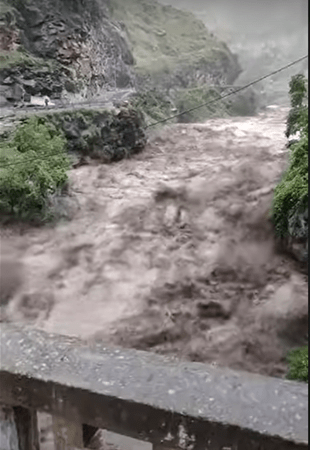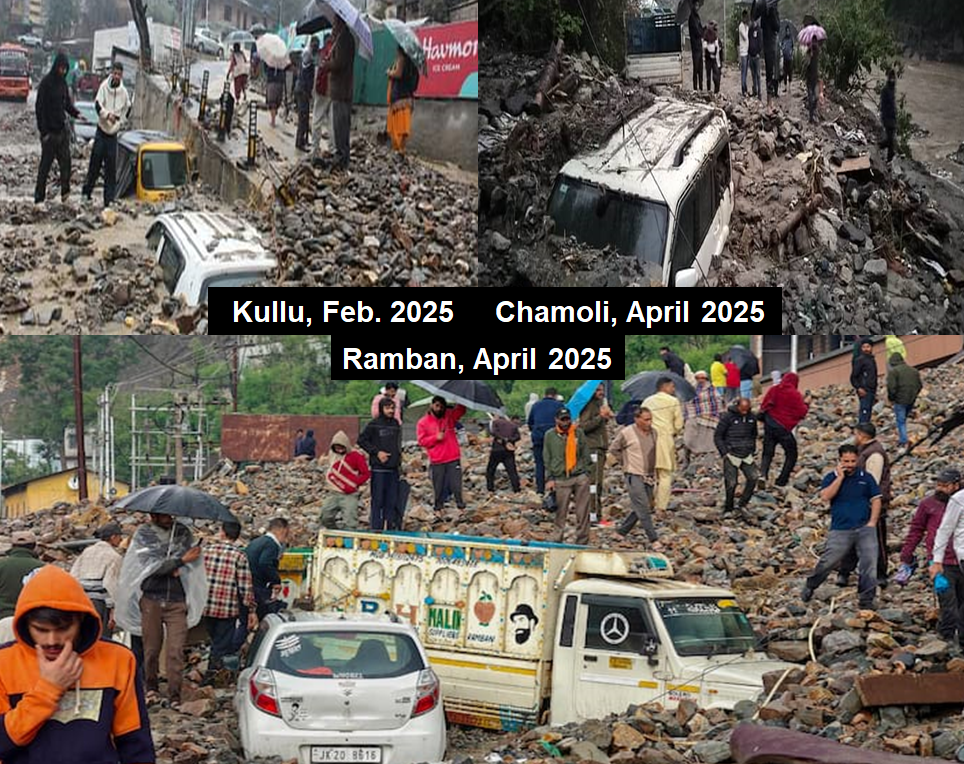
Scary visuals and messages on social media as also some of the pronouncements of the Supreme Court about Himachal Pradesh have shown that Western. Himalayan states have faced multiple flood disasters in the ongoing SW Monsoon 2025. Landscape of Himalayas is known to be vulnerable to landslides, mudslips, cloudbursts, flash-floods, GLOFs, erosion, seismicity and floods. While some floods are inevitable in the kind of climate prevailing here, how they become disasters is linked to the way we have treated the landscape, environment, regulations, people and floods.
Continue reading “2025 Western Himalayan Floods: What can be done to reduce disastrous impacts?”Tag: NDMA
CWC, IMD Need to Improve Extreme Weather Forecast Services
The rising numbers and intensity of western disturbances (WDs) in pre-monsoon months are causing excessive but short rainfall spells across the country particularly in the Himalayan states. These events are then resulting in sudden flash floods and taking a huge toll on human life and public infrastructure. However, the specific monitoring and warning services for such disasters by the Central Water Commission (CWC) & Indian Meteorological Department (IMD) are largely unavailable as these agencies are mainly forecasting floods during the monsoon.
Continue reading “CWC, IMD Need to Improve Extreme Weather Forecast Services”2024: Has NDSA made our dams any safer?
(Feature Image: Srisailam dam in Telangana. Source: Telangana Today)
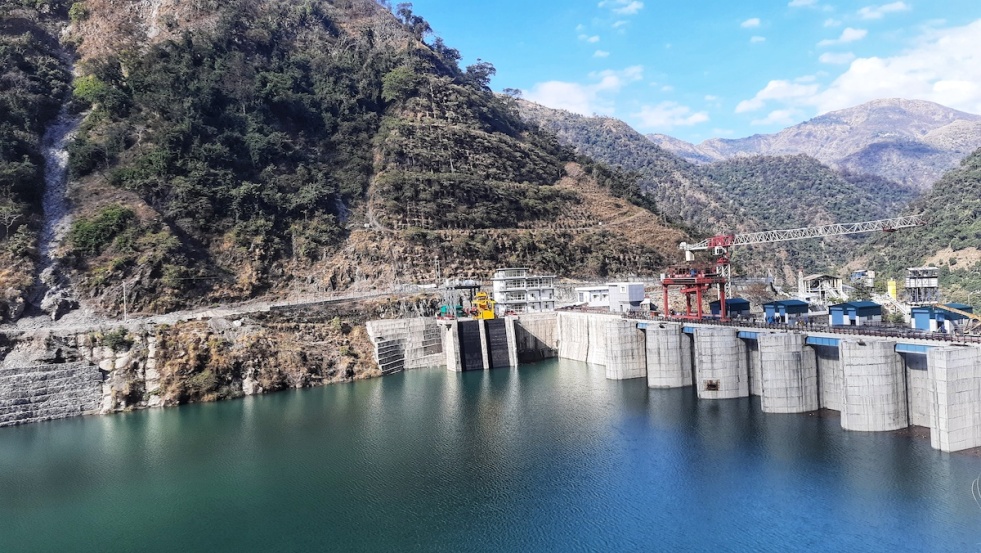
This annual overview focusses on the functioning of National Dam Safety Authority (NDSA) and related institutions in 2024 to understand if the functioning of these institutions have made Indian Dams any safer? Here functioning of Central Water Commission (CWC) is also important as CWC people head all the dam safety panels. The dam safety related institutions were formed following the passage of Dam Safety Act 2021 and hence there were promises and hopes that these institutions will make our dams safer.
Continue reading “2024: Has NDSA made our dams any safer?”DRP NB 240624: India to help Bangladesh conserve Teesta River
(Feature Image: BSF personnel patrol along the Teesta River on the border with Bangladesh near the Barun border post, 80km from Siliguri in July 2016. Image credit: AFP/ Source: Scroll In)
The news this week that India and Bangladesh have agreed for India to help Bangladesh conserve the Teesta River that flows from India to Bangladesh. We hope this development is taken to its logical conclusion soon in terms of implementation of the project as soon as possible. This has the potential to not only two nations working together on conservation and rejuvenation of the Teesta River, but also possibly other 53 shared rivers. However, it would have been better if the W Bengal government would have been briefed, taken into confidence and involved in the discussions. History tells us that the cooperation efforts do not succeed without the involvement of all the stakeholders.
The formation of Joint Technical Committee to initiate discussions for the renewal of the Ganges Water Sharing treaty 1996 that will expire in 2026. One hopes that all these happen with a benevolent disposition from India as this has the potential of creating a much stronger bond between the two countries. A good example is the 1996 Ganga treaty that was also signed with a benevolent disposition. This move can also help strengthen the relations across South Asia as both Nepal and Bhutan are hoping to export hydro-electricity to Bangladesh via India.
Continue reading “DRP NB 240624: India to help Bangladesh conserve Teesta River”2023: Safety & Sustainability Concerns On Dams & Hydro Power Projects in India
(Feature Image: Drone image from the site of the Teesta III dam in Sikkim, looking towards Chungthang town. Image by Praful Rao of Save the Hills, Source: The Landslide Blog by Dave Petley.)
In this fourth part of annual overview, SANDRP compiles the issues affecting the safety and sustainability of dams and hydro power projects in India during 2023. The report starts with governance and management issues of dams and hydro power projects as highlighted in our weekly Dams, Rivers & People News Bulletin (DRP NB) and blogs all through the year amid rising concerns and disasters on these structures across the country. It then covers some relevant judicial interventions and governments decisions on the issue.
Please also see part one of the series compiling dams and hydro projects related disasters in India in 2023; part two on peoples resistance against destructive dams and hydro projects, part three on dam induced flood incidents in 2023. In the fifth and final part, we have tracked the important dams and hydro projects related decisions taken by Expert Appraisal Committee (EAC) and Forest Advisory Committee (FAC) during 2023.
Continue reading “2023: Safety & Sustainability Concerns On Dams & Hydro Power Projects in India”2023: Accidents & Damages to Hydro, Dam Projects in India
(Feature Image: The damaged Chungthang dam on Teesta river in North Sikkim. Source: The Telegraph)
This annual overview compiles the incidents of accidents and disasters that have caused significant damages to the hydro power and dam projects and around them in India during 2023. The report also highlights the incidents of violations of environmental norms at some under construction project sites which could result in manmade disaster in future.
Continue reading “2023: Accidents & Damages to Hydro, Dam Projects in India”DRP NB 231023: Need to be a little serious about Dam Safety, Flood Forecasting, Use of Early Warnings
(Feature Image: Landslide warning board at Lakhwar dam site on Yamuna river. SANDRP, June 2015)
India need to relook the Dam Safety Act Experts say the Sikkim incident exemplifies blind spots in both legislation and implementation. The DSA does not promote risk-based decision-making and fails to incentivise transparency. Himanshu Thakkar, an environmental activist and coordinator of South Asia Network on Dams, Rivers and People, says that the frequency and scale of such disasters reveal a pattern of neglect: “It keeps happening regularly, people face disastrous consequences and we call these ‘natural disasters’. But there’s nothing natural about them.”
A robust DSA should allow different stakeholders to access information easily, but India’s framework falls short. “Dam safety is a public purpose function. Everything about dam safety, functions of all the institutions and committees and authorities, their reports, decisions minutes and agendas, everything should be promptly available to the public,” says Mr. Thakkar. “But nothing is in the public domain.” He adds that transparency is further obstructed when national and State bodies comprise government employees and engineers who worked on these projects, compromising objective decision making and lacking “people with a proven track record of taking independent decisions.”
Continue reading “DRP NB 231023: Need to be a little serious about Dam Safety, Flood Forecasting, Use of Early Warnings”Himachalis blame NHPC dams for flood disaster in Sainj Valley in July 2023
(Feature Image:- Deluge in Pin Parbati river engufling riverbank habitations in Sainj market on July 09, 2023. Source: Anil Khatri Vlogs)
The official report of what has transpired in Sainj Valley under Banjar subdivision of Kullu district during July 8-10, 2023 is still not in public domain, however the multiple media reports suggest it to be one of the worst flood disasters for the valley and have once again raised serious questions on the role the hydroelectric power (HEP) projects. Local people have specifically underlined the gross negligence by National Hydro Power Corporation (NHPC) company for turning floods into a disaster. Moreover, old media reports from the area have also highlighted that it was a disaster in the making for which the state government machinery as well hydro projects and NHPC have contributed hugely.
Continue reading “Himachalis blame NHPC dams for flood disaster in Sainj Valley in July 2023”Sikkim HC Order on Public Safety at Hydropower projects
Sikkim High Court Order on Dec 5, 2022 in the matter of death of two persons on May 23 2020 due to drowning following sudden release of water from a private hydropower project flags very important lessons that are relevant for all hydropower projects in India.[i]
Continue reading “Sikkim HC Order on Public Safety at Hydropower projects”Systemic failures at the root of Joshimath disaster
The 520 MW Tapovan Vishnugad Hydropower project of NTPC (formerly National Thermal Power Corporation Limited) has remained controversial at least since 2009 as it is again now in January 2023. This time it is in the dock over the sinking of Joshimath town in Chamoli district of Uttarakhand.
Continue reading “Systemic failures at the root of Joshimath disaster”