Dams · DRP News Bulletin

DRP: 8 May 2017 (Inspiring: How Kerala Panchayat brings a dying river back to life)

The Kuttamperoor stream in Kerala, connecting the Pampa and Achankovil rivers, had been a nearly stagnant, shrunken cesspool of dumped waste and weeds for more than a decade. Some weeks ago, it was resuscitated as a flowing river, thanks to the will of the Budhanur gram panchayat in Alappuzha district, and the commitment of 700 local men and women who worked to bring the river back to life under the MGNREGA.

The Kuttamperoor was once a full 12 kilometres long and, at places, over 100 feet wide. The river originates from Achankovil at Ulunthi, near Mavelikkara, and flows through Ennackad, Budhanur, Kuttamperoor, Mannar, and Pandanad before merging with the Pampa at Nakkida near Parumala in Pathanamthitta district.

Continue reading “DRP: 8 May 2017 (Inspiring: How Kerala Panchayat brings a dying river back to life)”
Dams · DRP News Bulletin

DRP: 24 April 2017 ( NHPC says Dams have no adverse impacts anywhere in the world! Admits, Hydro is no longer viable for private sector)

Centre Getting forest clearance is not a problem now: NHPC Chairman In an interview, taking a dig at its private peers, NHPC chairman KM Singh said that NHPC is the only company in the county that has the capability to execute hydro projects. He also said that in the NDA regime green clearances come easy, while local agitation by NGOs is the biggest threat. He further stated that there has been no negative impact of building a dam, not just in India, but anywhere in the world.

Continue reading “DRP: 24 April 2017 ( NHPC says Dams have no adverse impacts anywhere in the world! Admits, Hydro is no longer viable for private sector)”
Dams · DRP News Bulletin

DRP: 17 April 2017 (Bihar needs to launch Farakka Satyagarha on centenary of Gandhiji’s Champaran Satyagraha)

As the President of India is in Patna today (April 17, 2017) to remember the centenary of Gandhiji’s Champaran Satyagraha, we need to remember that the Central message of Gandhi’s Satyagraha was to fight injustice, atrocities and abuse, irrespective of the source of the atrocities.

During the international workshop on INCESSANT GANGA in Patna on Feb 25-26, 2017, Bihar Chief Minister Nitish Kumar mentioned that this is the centenary year of Gandhiji’s famous Champaran Satyagraha in Bihar. He also mentioned how Bihar has suffered the increasing intensity, duration and destructive floods due to Farakka Dam.

Continue reading “DRP: 17 April 2017 (Bihar needs to launch Farakka Satyagarha on centenary of Gandhiji’s Champaran Satyagraha)”
Dams · DRP News Bulletin

DRP: 27 March 2017: (WE NEED TO LEARN TO TRULY CELEBRATE OUR RIVERS)

This is about the proposed Brahmaputra Festival being planned by the Assam Govt from March 31 to April 4, 2017. The five-day festival will witness significant participation from China. Various other countries such as Vietnam and Singapore are also reported as attending the program. It is scheduled to be inaugurated by President Pranab Mukherjee.  

It is true that the word business appears four times on the opening page of this festival website, but the word flood, erosion and people do not appear even once. This is relevant since for very large sections of people of Assam, the river also means floods, erosion, displacement and disaster on regular basis and not just “lifeline of Assam” or “life-giving prosperity and countless blessings”.  

The festival website also errs in many ways, including when it claims “India’s only male river”, since there are several male rivers, including Damodar, Ajoy, Pagla, Gadadhar, among others. It is true that even the word Nemami is copied from the Nemami Gange, but that should not be such a big issue?

It is true that people also suffer when river dries up or is polluted or is encroached or unsustainably mined, and none of these issues are highlighted by the festival website. It is true that the the Assam also means all the communities, including the bodos and mishing and many others, not just Guwahati or Dibrugarh or Majuli. The festival organisers may argue that we are taking the festival to all 21 districts, but it is important to recognised all communities of Assam.

This is in addition to the fact that Brahmaputra includes all the states of North East India, and more. The Brahmaputra, 2,900 km long, is an international river with 918 km of it flowing in India, 1625 km in China and 337 km in Bangladesh.

It is true that the festival is more about attracting tourists, business and transport along the river. And so it is not even giving a comprehensive picture of the rivers of Brahmaputra basin in Assam, nor is there attempt to do anything to improve the state of the rivers. Similarly, the destruction of the rivers of Guwahati and Assam needs to be halted and reversed, and may be this occasion can be used to push that advocacy?

Continue reading “DRP: 27 March 2017: (WE NEED TO LEARN TO TRULY CELEBRATE OUR RIVERS)”
Dams · DRP News Bulletin

DRP: 20 March 2017 (South India Reeling Under Severe Drought)

The drought has extended its grip in the South, with the South-West (S-W) monsoon falling significantly short and the North-East monsoon proving a total failure. Reeling under the impact of failed monsoons, Kerala, Karnataka, Tamil Nadu and Puducherry have declared themselves as drought affected. Kerala and Karnataka, which are the worst affected, are already contemplating actions such as cloud seeding to tide over the situation.

In Kerala, the S-W monsoon deficit stood at -34 per cent, and the North-East monsoon, -61 per cent. Similarly, in Tamil Nadu, the deficits were -19 per cent and -62 per cent (North-East monsoon). For Coastal Karnataka, the shortfall stood at -21 per cent and -63 per cent, respectively. Drought-like conditions are also prevailing in parts of Andhra Pradesh and Telangana.

Water levels in key reservoirs in the region are at their lowest. The water tables have declined further even as the civic administration in many cities, small towns and panchayats has been increasingly tapping groundwater to ensure supplies. The situation is so dire that the Kerala govt has directed PepsiCo to cut down drastically on the use of groundwater for its Palakkad plant. Traders in Tamil Nadu are also boycotting these fizzy after claims that foreign firms are exploiting the country’s water resources.

Continue reading “DRP: 20 March 2017 (South India Reeling Under Severe Drought)”
Dams · DRP News Bulletin

DRP: 13 March 2017 (20 Big Hydro Projects Costing Over 30K Crore, Stalled & Stressed: Piyush Goyal)

20 hydro projects stalled or stressed  The Power Minister Piyush Goyal on March 09, 2017 in a written statement has informed the parliament that as many as 20 under construction HPPs totalling 6,329 MW are either stalled or stressed in the country and Rs 30,147.08 crore has already been spent on them. These projects include 2,000 MW Subansiri Lower of NHPC Ltd, 500 Mw Teesta VI of Lanco Teesta Hydro Power Ltd, 120 MW Rangit-IV of Jal Power Corp, 300 Mw Panan of Himagiri Hydro Energy Pvt Ltd, 850 MW Ratle of GVK Ratle HEP Pvt Ltd, 100 Mw Sorang of Himachal Sorang Power Ltd and 960 MW Polavaram of Polavaram Project Authority.

Continue reading “DRP: 13 March 2017 (20 Big Hydro Projects Costing Over 30K Crore, Stalled & Stressed: Piyush Goyal)”
Dams · DRP News Bulletin

DRP: 6 March 2017 (Farm Ponds In Maharashtra Causing Groundwater Decline)

SANDRP Blog Farm ponds in Maharashtra Causing Groundwater Decline Farm ponds recognized as a drought proofing measure have received a great push from the central Govt recently. On the flip side however serious concerns are being raised over implementation of the farm ponds and more importantly –their use. Civil society organizations like Watershed Organization Trust and also SANDRP have been pointing out that the use of farm ponds has long drifted from its objective of storing rainwater for protective irrigation. Most of the farm ponds are instead being used as storage tanks for pumped out groundwater exposing this underground resource to losses through evaporation, etc. In the process they are accelerating the rate of groundwater exploitation multi fold.

Continue reading “DRP: 6 March 2017 (Farm Ponds In Maharashtra Causing Groundwater Decline)”
Dams

Ground Water 2016: India’s water lifeline continues to bleed

Summer of 2016 saw thirteen Indian states grappling with severest drought greatly fueling the ongoing depletion of aquifers. Then the supposedly surplus southwest monsoon also fell short by 3 per cent further stressing the falling groundwater table. At the same time the pollution of surface water sources, which function as recharge point for ground water, went uninterrupted.

All through the year, Central and many State Governments unveiled several new plans and projects targeting the sustainable consumption of groundwater. The judiciary made various orders to reign in illegal extraction of the finite resource. However, the situation continued to deteriorate.

Continue reading “Ground Water 2016: India’s water lifeline continues to bleed”

Dams · DRP News Bulletin

DRP: 3 Oct 2016 (Role of Uttarakhand Hydro Projects in Kedarnath Disaster 2013)

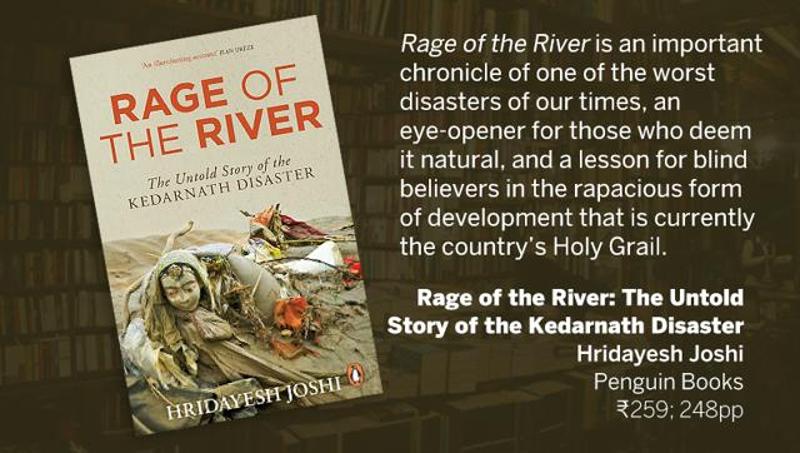
Book Review:  Rage of the Rivers: Role of Uttarakhand hydro projects in Kedarnath disaster 2013 by Hridayesh Joshi Rage of the River reads not unlike a gripping thriller. Thing is, it is not fiction. It is a true ‘story’ of a cataclysmic event, exacerbated by greed, and twisted notions of development manifested in blasting fragile hills, tunneling rivers, denuding forests, and encouraging illegal encroachments and mindless construction and tourism infrastructure. This is an important chronicle of one of the worst disasters of our times. Joshi has thoroughly analysed the role of endless, ill-planned hydel projects, but inexplicably fails to take into account the wreckage wrought by unrestrained tourism. Joshi points a finger at the unethical practices of construction companies, contractors and operators of hydel dam projects, even in the face of this monumental disaster. The officials of the Vishnuprayag project refused to listen to the pleas of the villagers to open the dam gates and allow the excess water to flow safely from under the barrage. The advice was ignored, either in ignorance of the gravity of the situation, or with an eye on the opportunity to generate more power. The rising waters broke the barrage flooding the valley and its villages.  

Continue reading “DRP: 3 Oct 2016 (Role of Uttarakhand Hydro Projects in Kedarnath Disaster 2013)”
Dams · DRP News Bulletin

DRP: 26 Sep 2016 (Victory to tribals protest; Jispa HEP calls back staff)

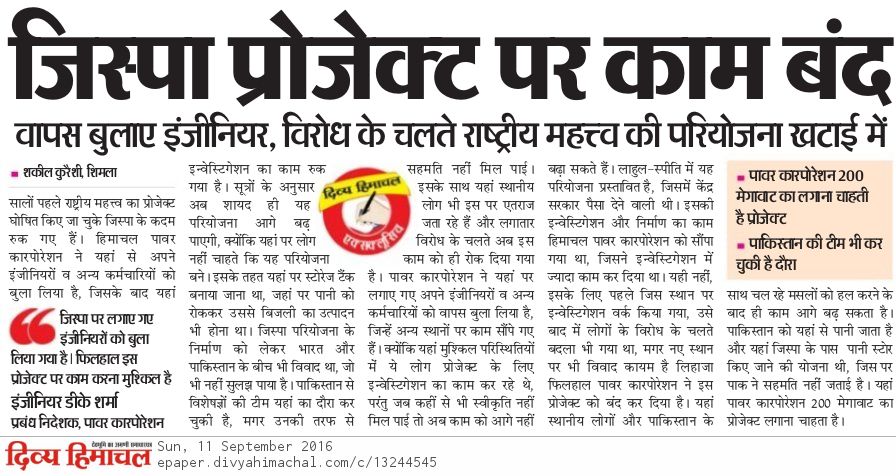
Finally, tribals struggle wins, sends Jispa HEP company packing up Facing stiff opposition from the tribal community against the construction of 300 MW Jispa Dam in Lahaul-Spiti valley has forced the Himachal Pradesh Power Corportaion Ltd (HPPCL) to suspend the project for the time being. The dam which was declared a project of national importance now has residents from 14 villages oppose it. HPPCL has invested Rs 3 crore and has stated that it would begin study work only when locals extend their support.

Since 2009, people from the Todh valley in Lahaul-Spiti district were opposing the Jispa Dam project proposed over Bhaga river, a tributarJy of Chenab at Jispa village. The government had sanctioned Rs 7,000 crore for this project but local residents did not allow officials to work in smoothly for three years now.

Confirming the development, managing director, HPPCL, D K Sharma told that some people were continuously opposing the project without realizing that construction of project could have ushered development in the area. He said constant opposition of local people had resulted into wastage of limited human resource so HPPCL board had decided to withdraw the manpower as project was only at investigation stage.

Continue reading “DRP: 26 Sep 2016 (Victory to tribals protest; Jispa HEP calls back staff)”