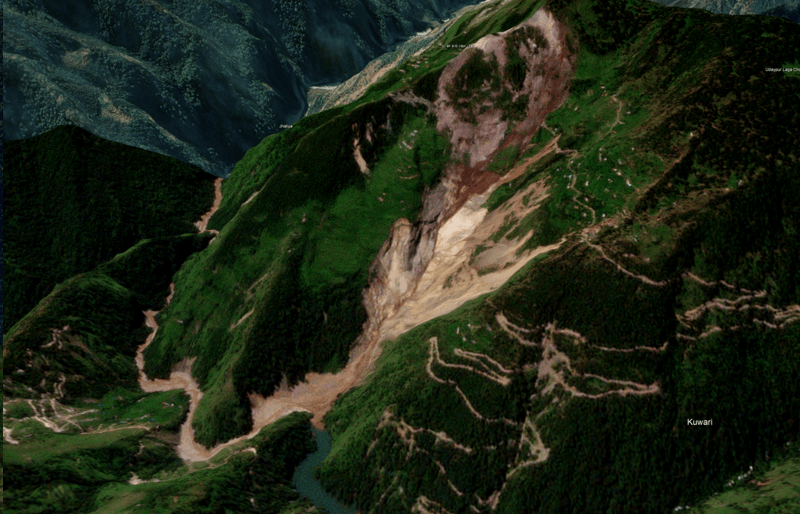
A Rapid Hazard Assessment Report by Dr Jakob Steiner a postdoc fellow at the Institute of Geography and Spatial Research, University of Graz, Austria (jakob.steiner@uni-graz.at) and Amrit Thapa a doctoral student at University of Alaska Fairbanks (aamritjnu@gmail.com). A Hindi version of this report can be seen here.
Continue reading “Pindar Valley, Uttarakhand: Potentially Dangerous Landslides Dam in Kunwari”Tag: Kedarnath Disaster

July 2024: USDMA Clueless on Flashflood Disaster at Vishnugad Pipalkoti HEP
(Feature Image: Screenshot of social media video showing flash flood imapct at HCC’s batching plant during intervening night of July 15-16, 2024.)
The batching plant at the controversial under construction Vishnugad Pipalkoti Hydro Electric Power (HEP) project site in Uttarakhand has suffered significant damages due to a flash flood incident during the intervening night of July 15-16, 2024. The plant belongs to the Hindustan Construction Company (HCC) and has been set up by the Alaknanda river downstream the dam of 444 Mw HEP project adjacent to it dumping yard at Gulabkoti in Helang area of Joshimath tehsil in Chamoli district.
Continue reading “July 2024: USDMA Clueless on Flashflood Disaster at Vishnugad Pipalkoti HEP”
DRP 190623: Ten years of Uttarakhand Flood disaster
(Feature Image: Thousands of people have been rescued but the inability of rescue teams to navigate disaster-struck areas has left over 60,000 people stranded in Uttarakhand. The Hindu, 19 June 2013)
This week marks ten years since the Uttarakhand flood disaster of June 2013, the worst recorded disaster in the state. The deaths and destruction in the disaster were unprecedented. Large parts of the deaths and destruction were due to man-made causes. Climate Change played its anthropogenic role too as the unprecedented rainfall happened even before the monsoon was set in. Even the Supreme Court took suo motu cognizance of the disaster and ordered halt to all hydropower projects and independent review of them. One of the major human causes that worsened the disaster was the lack of credible disaster prevention and management systems.
One expected that we and particularly our all powerful governments in the state and the Centre would learn lessons from such an unprecedented, such a massive destructive disaster. The first step to that would have been credible reporting of what exactly happened during the disaster, which agencies played what role and how the destruction could have been reduced. That such a report does not exist even today says a lot.
Continue reading “DRP 190623: Ten years of Uttarakhand Flood disaster” SANDRP