
New Hydro Policy: Govt unjustifiably pushing hydro through subsidies A comprehensive policy to promote hydropower generation is set to be announced by September—with viability gap funding for projects, compulsory hydropower purchase obligations for distribution companies and a set of good practices that states have to follow. The idea is to address factors that currently drive hydropower costs up way above those of other sources of power and give policy support in its market development, according to a government official, who asked not to be named. The policy being prepared by the power ministry will have provisions for viability gap funding, which will help in meeting the shortfall in project costs and reducing hydroelectricity tariffs for consumers. Hydropower is expensive and in some cases more than double the cost of power from coal-based thermal plants, which is available at Rs.3-5 per unit.The ministry will also expand the scope of power distribution companies’ renewable power purchase obligations to include hydropower from projects with a capacity greater than 25 Mw. At the moment only power from those with less than 25MW is considered renewable power. According to officials, compulsory hydropower purchase from large projects will either be made part of the existing renewable power purchase obligation of distribution companies or a separate requirement, so that its inclusion does not affect the market for other renewable sources of energy like wind, solar or biomass. Govt unjustifiably pushing hydro through subsidies in proposed new hydro policy can be lead story. It is not going to help push hydro.
Continue reading “DRP: 4 July 2016 (In Proposed Hydro Policy, Govt Pushing Hydro Through Subsidies)”Tag: Interlinking of Rivers

River Ken, as I saw it
Guest Blog by: Manoj Misra, Yamuna Jiye Abhiyaan
Rivers are often seen merely as carriers of utilizable water and little more. Such utilization could be for supply of water to meet human domestic, commercial, irrigation or industrial needs or as a motive force to produce electricity. That there could be far more to a river than water flowing in it is rarely appreciated far less investigated. The reason also is that in case of perennial rivers water flowing in them tends to hide from public view a lot residing in their interiors, including their living and non living components. So a drought, notwithstanding its adverse impacts on water dependent people and their commensals[i], is an opportunity nevertheless to easily see what is otherwise normally hidden. Continue reading “River Ken, as I saw it”

DRP: 13 June 2016(Minister Threatens Stir Over Delay In Ken-Betwa Clearances)
Uma threatens stir over delay in Ken-Betwa interlinking Water Minister Uma Bharti on June 07 threatened an agitation if there were further delays to the wildlife clearances necessary for the storied Ken-Betwa river-interlinking project. This is TOO Much! Union Minister threatening to go on Fast, demanding environment clearance to Ken Betwa link! Calling it a national crime to stop clearance to Ken Betwa link. Saying if the project is not cleared in next meeting, she will go on fast! Claiming that the link will help Marathwada!! It wont help even Bundelkhand, but the Union Minister seems to be setting completely wrong, precedent, which also ultra legal. On the other hand The Hindu has been consistently underplaying the impacts of the Ken Betwa project and over playing the official lines. Very strange to see this from THE HINDU. Before this in its June 02 meeting the expert appraisal committee (EAC) of environment ministry has deferred environment clearance for the ambitious Rs.10,000cr Ken-Betwa river linking project in its last meeting on June 2, and has sought more clarity on its wildlife & hydrological impact. The meeting could not come to a conclusion as the members of the EAC had several doubts regarding the project’s hydrological feasibility, its impact on hydrology and wildlife too and found that many serious issues related to the project are yet to resolved. In the last week of May 2016, SANDRP in a letter to EAC has written about Ken-Betwa project & why EAC should not clear this. Please help us spread the word and urgently write to EAC if you agree. Himanshu Thakkar coordinator SANDRP points out that the Ken-Betwa link, in essence, Ken-Betwa link will facilitate transfer of water from the Ken River Basin (Bundelkhand) to Upper Betwa Basin (outside Bundelkhand), so it is actually exporting water out of Bundelkhand.
Continue reading “DRP: 13 June 2016(Minister Threatens Stir Over Delay In Ken-Betwa Clearances)”

DRP: 23 May 2016 (WHY LARGE HYDRO IS NOT JUSTIFIED)
Chenab river runs its course amid spate of threats Chenab river’s money-spinner hydropower fate appears to run parallel to that of Sohni-Mahiwal – the legendary lovers who drowned into the river because their love was unacceptable. The govt as usual has shut its eyes to the needs of the river and its catchment area. There are multiple factors hidden below its surface. One is melting of glaciers sooner than anticipated. If glaciers lose their ice cover quicker, the Chenab would swell up abruptly before hitting a cruel, dried-up phase in as much deathly suddenness. There are several hydro projects coming up on the river which don’t have the approval of the Geological Survey of India. Once all the identified hydroelectric projects are installed, it will have a negative impact on the river. It may not get even a kilometre free space for running the course. At that point of time, it will not be a river, but a small stream. Meanwhile scientists have warned of large scale earthquake in J&K. The situation in Arunachal Pradesh is also grim. And yet the Parliamentary committee recommends further sops for Hydr. Misguided recommendations, to put is most charitably. There should be no question of subsidies to destructive Hydropower projects. Continue reading “DRP: 23 May 2016 (WHY LARGE HYDRO IS NOT JUSTIFIED)”
DRP: 16 May 2016 (Water conservation: Lessons from ancient India)
Water conservation: Lessons from ancient India As drought-like conditions have gripped many parts of India this year, the pressure to drill borewells in search of increasingly scarce groundwater has escalated. Many regions are in the grip of a vicious cycle of drilling causing the water table to sink further. There is an urgent need to explore what benefits water conservation can bring, whether through modern or ancient water storage structures. This report explains, ecologically safe engineering marvels of water conservation have existed in India for nearly 1,500 years, including traditional systems of water harvesting, such as the bawari, jhalara, nadi, tanka, and khadin. Even today these systems remain viable and cost-effective alternatives to rejuvenate depleted groundwater aquifers, according to experts. With govt support, these structures could be upgraded and productively combined with modern rainwater-saving techniques such as anicuts, percolation tanks, injection wells and subsurface barriers. This may be a far more sustainable approach to alleviating the water scarcity crisis across India. Ultimately, water conservation has to be a key element of any strategy to bring an end to India’s perennial swings between drought and flood.
Continue reading “DRP: 16 May 2016 (Water conservation: Lessons from ancient India)”
DRP: 2 May 2016 (Patoda: How a village in drought hit Maharashtra achieved water independence)
Patoda: How a village in drought hit State turned water self-reliant At a time when almost every village in drought-hit Marathwada is facing acute water scarcity tiny Patoda, on the fringes of water-starved Aurangabad city, is offering valuable lesson in water management conservation and harvesting. Though it is surrounded by arid villages but Patoda’s residents regard water as more precious than money. They follow strict rules about usage and strictly carry the water audits. Water meters are installed in every households and entire village recycles each drop of waste water it generates. Today no rain water flows out of the village. Percolation has recharged the aquifers and the water table has risen. So effective is its water conservation model that Patoda has now become a model for the rest of Marathwada and has won 22 state & national awards. But it did not happened over nights. In fact it is a result of over 10 years joint efforts done by villagers.
DRP: 28 March 2016(Is India facing its worst-ever water crisis?)
Is India facing its worst-ever water crisis? On 11 March first time in 30 years history power generation at Farakka power plant in West Bengal was suspended for 10 days due to non-availability of water in Ganges. Nobody is sure why but the evidence about the declining water levels and waning health of the 2,500km long Ganges is mounting. Monsoon rains have been scanty for the second year in succession. The melting of snow in the Himalayas has been delayed. Water tables have also been declining in the Ganges basin due to the reckless extraction of groundwater. The 3-month-long summer is barely weeks away but water availability in India’s 91 reservoirs is at its lowest in a decade, with stocks at a paltry 29% of their total storage capacity, according to the Central Water Commission. Thousands of villagers in drought-hit region of Maharashtra depend on tankers for water & authorities in Latur district, fearing violence, have imposed prohibitory orders on gatherings of more than 5 people around storage tanks. Tens of thousands of farmers and livestock have moved to camps providing free fodder and water for animals in parched districts. The govt has asked local municipalities to stop supplying water to swimming pools. States like Punjab are squabbling over ownership of river waters. In water-scarce Orissa, farmers have reportedly breached embankments to save their crops. Realy the waning health of the sacred river underscores the rising crisis of water in India.
Continue reading “DRP: 28 March 2016(Is India facing its worst-ever water crisis?)”
Farmers, Rivers and the Environment in Union Budget 2016-17
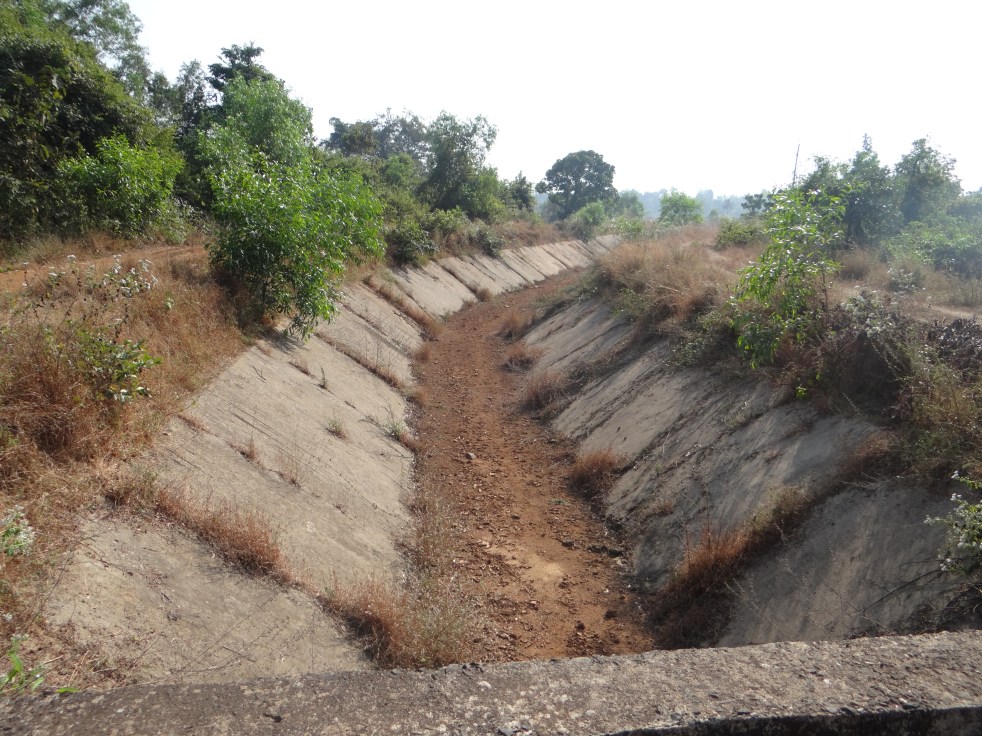
Above: Canals of Tillari Project, on of the AIBP Project supported in Union Budget 2016-17, unused and derelict Photo: Parineeta Dandekar
Massive expenditure on Large Dams will only help contractors
The Union Budget 2016-17 presented by Finance Minister Arun Jaitley on Feb 29, 2016 seems to be promising in its thrust and focus towards farmers and the farming sector of the country. For a sector which employs about 55% of the work force of the country, this priority is much needed and one which holds a promise of a number of multiplier effects. He stated, “We are grateful to our farmers for being the backbone of our food security. We need to move beyond food security and give our farmers a sense of “Income Security”.” This is particularly required when the farmers are in dire states as they are today, many of them facing four consecutive crop failures, Kharif 2014, Rabi 2015, Kharif 2015 and Rabi 2016. In 2015, on average 52 farmers committed suicide every single day in India.[1]
And hence, focus on farming is indeed a positive step. As Maharashtra State Water Resources Minister for State Vijay Shivtare once told me, “We are not very bothered about the high costs of Lift Irrigation Schemes per se. If they work well, and result in prosperous farmers, it would mean more agricultural implements, more Tractors, more vehicles, better homes etc., increasing the government’s revenue at the end of the day.” (“If they work well” was the operative part here, which has seldom materialized in Maharashtra). A Prosperous Farmer and strong farming economy can help all sectors.
Mr. Jaitley opened his budget speech with an Agenda to “Transform India”, based on nine pillars. Foremost pillar is ‘Agriculture and farmers’ welfare, with a focus on doubling farmers’ income in five years, by 2022. The total allocation for Agriculture and Farmers Welfare is Rs 35, 984 Crores.
Finance Minister rightly diagnosed that “Irrigation is the critical input for increasing agricultural production and productivity.” Out of 141 million hectares of net cultivated area, only 46% is covered with irrigation and that there is a “need to address optimal utilization of water resources, create new irrigation infrastructure, conserve soil fertility, value addition and connectivity from farm to markets.”
For ensuring this, “Pradhan Mantri Krishi Sinchai Yojana” will be implemented in mission mode through which 28.5 lakh hectares will be brought under irrigation”. A major part of this will be through “Fast tracking and Implementation of 89 irrigation projects under AIBP (Accelerated Irrigation Benefit Program) which have been languishing. These will help irrigate 80.6 Lakh hectares. These projects will need Rs 17,000 Crores next year and 86,500 Crores in next five years. 23 of these will be completed before 31st March 2017.”
So, in the coming 5 years, a whopping Rs 86,500 Crores of the taxes collected from all Indians and at least a part of the Krishi Kalyan Cess at 0.5% all taxable services will go into AIBP Projects, with over Rs 17,000 Crores being allocated in 2016-17 itself. This is highly problematic. AIBP was started by P. Chidambaram in 1996 and in two decades since then, it has not delivered anything susbstantial except huge bank balances for contractors, as also for the engineers, bureaucrats and politicians,hand in glove with the contractors. CAG reports have repeatedly highlighted this reality in case of Maharashtra, Andhra Pradesh, Gujarat and now possibly Madhya Pradesh. In fact, this was the very plank on which BJP came to power in Maharashtra. But Arun Jaitely seems to have no new ideas to offer here, except treading on the same path.
While it is clear that the government cannot abandon all incomplete projects, before it decides to spend more good money after already sunk costs on incomplete projects, it needs to halt more Major and Medium irrigation projects and undertake a credible, independent review of why the projects were incomplete for so long, what were the loop holes, what are the lessons learned from past mistakes, which projects are worth going ahead, in what form. And finally, which need to be abandoned. Without doing such an exercise, the money allocated for incomplete projects is not going to help the farmers.
- Massive Support for AIBP Projects in Union Budget 2016 17 is unwarranted
Rs 86,500 Crores over 5 years is a massive amount. Will it be able to ensure promised Irrigation? Which are these AIBP Projects? Why do they need so much support from the Center? How have they performed till now? Where are they located? Is this expenditure wise?
Here is a snapshot of some of the 89 AIBP Projects, maximum of which, 13, come from Maharashtra. Maharashtra has had enough bad publicity following the Dam Scam but more importantly, it now has a Chief Minister, also from BJP, who openly stated in the State Assembly on July 21, 2015 that “We have built Large dams everywhere without thinking of feasibility or water availability” and that “Large Dams are not the road ahead”. Devendra Fadanvis wisely separated Large Dams from actual Irrigation and said: “We pushed large dams, not irrigation, this has to change”.[2] He has spearheaded a considerably successful program that focuses on small scale interventions for harvesting and recharging water known as Jal Yukta Shivar Yojana.
With this context, it is ironic and deeply troubling that maximum Large Irrigation Projects under AIBP come from Maharashtra. The name “Accelerated Irrigation Benefit” is also ironic as many of these projects have been going on for over 2-3 decades, have seen huge costs escalations, corruption charges, question marks about their viability, desirability, optimality, quality and final effectiveness.
Out of 149 AIBP Projects across the country, 89 projects are active, out of which 46 projects have been prioritized in the Union Budget. 23 Priority I Projects are to be completed by 2016-17 and additional 23 Priority II Projects are to be completed by 2019-20. Of these 46 Projects, maximum 13 projects come from Maharashtra.
A brief snapshot of some AIBP Projects in Maharashtra:
| No. | Project | District | Issue |
| 1. | Tillari Interstate Project | Sindhudurg | Based in hilly tracts of Western Ghats, highly unviable project, very low irrigation efficiency, terrain not suitable for large dams, Protests, Land Acquisition problems, |
| 2. | Bembla Major Project[3] | Yavatmal | Huge Corruption Charges, Work ongoing since last 24 years. High cost escalations. Cracked canal Lining due to poor quality work. Enquiry ordered against Contractor for substandard work. |
| 3. | Tarali Major Irrigation Project | Satara | Whistle Blower of Maharashtra Dam Scam, then-Serving Chief Engineer Mr. Vijay Pandhare inspected construction of Tarali Project and stated that compressive strength of all 66 cores of the dam is as low as 42% when a difference in core strength by 1-2% is considered serious. This indicates corruption, use of less cement and institutionalised ill-intent. He officially wrote letter against these happenings. No action taken. |
| 4. | Dhom Balkawadi | Satara | Contract of Canal works given to a close relative of Ajit Pawar, Former Deputy CM and Minister of Water Resources. Several tendering lacuna exposed by officials. |
| 5. | Arjuna Medium Project | Ratnagiri | Massive cost and time escalations, unviable project in hilly terrain, corruption charges, rehabilitation issues not settled. |
In addition to these, cost escalations of Lower Wardha, Lower Panzara, Nandur Madhyameshwar II (which will need 3 dams in the upstream) are also well known. (Link to all projects in References below)
Across the country, but more sharply so in Maharashtra, Large Irrigation Projects have not automatically meant increased irrigated area, which is what the farmer needs. SANDRP has shown with official data that even after spending over Rs 600,000 crores on Major and Medium Dam and Canal Network between 1993-2010-11, net national canal irrigated area has been decreasing and not increasing.[4] There are several reasons for this.
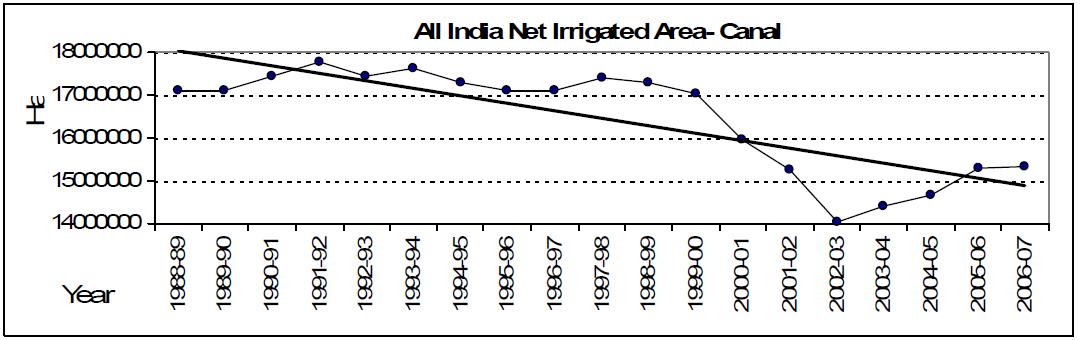
Above: Canal irrigated area declining in the country Source: SANDRP

Above: Groundwater dominates Irrigation in India, not dams and canals Source: IWMI
If Large Dam approach delivered all that it promised, then Maharashtra, with the largest number of large dams in the country would have had the highest irrigated area. The actual picture is the opposite. Maharashtra has the lowest irrigated area in the country at about 18%. This is not a coincidence. As the dam scam highlighted, more large projects with complicated, ever-changing plans, far away offices and opaque funding mechanisms meant that local people had no clue about what was happening, leaving doors open for the unholy nexus of Babus, Contractors and Engineers to eat away public funds, without ensuring irrigation. Recent example is when the Maharashtra Government told the Hon High Court that they have resolved all of the financial backlog in areas like Marathwada and Vidarbha, but the PHYSICAL backlog remains nearly the same. So is money for large irrigation projects an answer in this scenario?
While three major projects from Vidarbha (Bawanthadi, Bembla and Lower Wardha) included in AIBP will receive huge support from the Center, the Vidarbha Irrigation Development Corporation (VIDC) faces some of the most serious charges of corruption, cost and time escalations, as highlighted by a series of government appointed committees and even CAG. Jan Manch, an NGO from Vidarbha which was instrumental in exposing the scam clearly stated that problems of projects here run deeper. Money is not an easy fix.
So why are the same projects being pushed in the name of farmers when it is demonstrated in Maharashtra that farmers are NOT benefiting from these projects? Cynics would point this out as another Jumlaa! Again, in the same state, the power of small scale water harvesting structures and people’s participation have shown how quickly things can change. Maharashtra still needs to complete Anti-Corruption Bureau Inquiry against several Large Dams, it needs to work on an Integrated State Water Plan and, as per orders of the Hon High Court, it can undertake new Projects only as per the provisions of this plan, it needs to take transparent and credible action regarding its own enquiry reports, which includes Special Investigation Team Report, CAG Report on Irrigation Projects dated 2013, etc. Unless all these steps are taken, and when small scale interventions are demonstrating their impacts, what is the logic behind putting huge public resources on the same approach?
Projects in other states like Sardar Sarovar, Narmada Sagar, Omkareshwar and Maheshwar Projects in Gujarat and Madhya Pradesh have not resettled the oustees and has used repressive mechanism to still fill the dams. It has been rapped by the Courts. Local communities in Manipur have been opposing dams there and have gone to the National Green Tribunal against Thaubal Dam.
In this context, maximum allocation of funds for Large Irrigation Projects in the Union Budget is clearly, neither convincing nor beneficial to farmers.
Other Schemes included under PMKSY with budgeted expenses for 2016-17 are
- Har Khet ko Pani: Rs 500 Crores
- Per Drop more crop: Rs 2340 Crores
- Integrated Watershed Management: Rs 1500 Crores
- Some Positive water related steps in the Budget:
- A major program for sustainable management of GW with allocation of Rs 6000 Crores and proposed for multilateral finding: Although the amount budgeted is hardly comparable to AIBP Projects, when contribution of groundwater in irrigation is much larger than surface water! We do not really need World Bank funding for this, we should be able to do this on our own.
- A dedicated Long -term Irrigation Fund will be created in NABARD with initial corpus of Rs 20,000 Cores. Unfortunately, NABARD has no specific social and environmental policies and has been funding projects without attention to the key governance issues.
- 5 lakh farm ponds and dug wells in rain fed areas and 10 lakh compost pits through MNEREGA.
- Allocation for MNREGA is Rs 38500 crores, in reality this is much less than the actual demand and also less than what was actually spent last year. Last year, the actual spending on the programme was Rs 41,169 crore. The additional spending of Rs 6,470 crore is the pending liability and if adjusted the actual allocation in 2016-17 drops to Rs 32,030 crore—less than what was allocated in 2015-16. MNREGA allocation should have been higher.
- Organic farming to be promoted: Paramparagat Krishi Vikas Yojana 5 lakh acres under organic farming in 3 years with allocation of around Rs 412 crores. While more areas under organic farming is welcome, the target is more un-ambitious and allocation most meager. As Jayapal Reddy (Secy, confederation of kisan organisations) says we need aid for increasing carbon content in soil all across India.
- Incentives for enhancement of Pulse production. Rs 500 Crores under National Food Security Mission to pulses. Districts covered increased to 622. This is a specifically encouraging step taken as Pulse Farming is mostly rainfed, require low fertilizer inputs, contributes to protein security, is climate friendly. We spent about Rs 15,000 Crores this year to import pulses and a focused plan for procurement and assured MSP will be of a great help. But the FM could have been much more ambitious here. A similar scheme was needed for oilseeds too.
- Access to markets is critical for farmer incomes. Unified Agri Marketing Scheme has been announced where a common e-platform will be developed for 585 regulated wholesale markets. Amendments in APMC Acts are a prerequisite for joining. On the 14th April Birthday of Dr. Babasaheb Ambedkar, Unified Platform dedicated to Nation.
- Revised norms of assistance under National Disaster Response Fund in April 2015.
- Special focus on adequate and timely flow of credit to farmers. Against target of 8.5 Lakh Crores in 2015 16, the target of agri credit 2016-17 will be Rs 9 lakh Crores.
- Prime Minister Fasal Bima Yojana providing greater cover against natural calamities at a low premium. Provision of Rs 5500 Crores in Budget 2016-17. However, the amount originally estimated to cover all farmers was Rs 17,600 crore. Why this lower allocation?
- Where are the Rivers?
In NDA’s first budget in 2014-15, when Ganga Arati and rhetoric on Ganga cleaning were at their peak, the Finance Minister had said during his budget speech: “ Rivers form the lifeline of our country. They provide water not only for producing food for the multitudes but also drinking water.” [5]
This year however, there is no mention of Rivers, not even Ganga. However, Namami Gange Plan/ National Ganga Plan has been allocated Rs 2250 Crores in the year 2016-17. The plan itself remains unclear. A plan based on Sewage Treatment Plants alone does not hold promise for Ganga with Rs 2000 Crores budgetary support, or Rs 20,000 Crores, like the money we have spent in the past years, corresponding to declining water quality of the river.
Inland Waterways Plan: The much-talked about Plan pushed by Minister for Road Transport and Highways and Shipping Mr. Nitin Gadkari would be getting around 350 Crores in 2016-17 as the combined budget for Sagaramala (Ports project) and Inland Waterways is pitched at 800 Crores and Sagarmala is budgeted at 450 Crores. Inland Waterways Program is being pushed without a thought being given to rivers in which they will operate. It is raising some very crucial questions, elaborated here: Digging Our Rivers’ Graves?[6]
Interlinking of Rivers Plan: The Plan has not been mentioned in the budget and the scheme does not feature in the further discussions. However, the Center is pursuing the project, disregarding ecological cost, social costs, financial costs and interstate conflicts.
It looks like Budget 2016-17 has no special announcements for rivers. However, plans like 100 Urban Rejuvenation Mission (Amrut and 100 Smart Cities) have been allocated a massive Rs 7296 Crores this FY. Projects like Smart Cities, Highways Project, Inland Waterways all have a strong link and impact on life support systems like rivers and these needed to be seriously addressed. India has no policy for Urban Rivers, and this has meant that rivers are common grounds for encroachment, pollution and extraction, leading to their destruction, like the Ganga, among others.
- Environment in Union Budget 2016-17
While the Environment Minister was one of the first Ministers to official hail Union Budget as “Visionary”, it is a bit sad to see that Ministry of Environment Forests and Climate Change (MoEF and CC) does not feature in the list of Important Ministries annexed to Finance Minister’s Speech, nor does a single Scheme from MoEF and CC feature in the list of Important schemes.
MoEF and CC gets a slightly higher budget than the massively slashed budget for the past two years. However, as Down to Earth has pointed out, there is a hitch here: “The Budget document shows that allocations to the Ministry of Environment, Forests and Climate Change (MoEFCC) have continued to rise, from Rs 1,681.60 crore in last year’s budget to Rs 2,250.34 crore in 2016-17. But most of this Rs 570-crore increase has come in the form of planned revenue expenditure (salary and other operational expenses), which has risen by Rs 540 crore to Rs 1,944.75 crore this year. This leaves an increase of only Rs 30 crore divided between planned capital expenditure estimates (expenditure on schemes and programmes) and non-planned estimates. In fact, planned capital expenditure saw a dip in comparison to actual expenditure undertaken during fiscal year 2014-15.”[7]
Some Climate Change initiates like National Action Plan on Climate Change (NAPCC), have seen an increased allocation. Of the Rs 180 Crores for Climate Change initiatives, Climate Change Action Programme (CCAP) has been allotted Rs 30 crore, the National Mission on Himalayan Studies Rs 50 crore and the National Adaptation Fund Rs 100 crore. According to Down to Earth, “While this is more than the Rs 160 crore allocated last year, there is no provision to cover the revised estimates of total expenditure of Rs 136.79 crore for the CCAP and Rs 115 crore for the National Adaptation Fund.”
There has been an upward spike in the National Clean Energy Fund, constituted mainly by Coal Peat & lignite Cess, which has seen increase from Rs 50 to 100 Rs/tonne in 2014-15, further to 200 Rs/tonne is 2015-16 to 400 Rs/tonne in 2016-17. It is reported that it is this fund which will be support Inland Waterways Project, which is likely to destroy our remaining rivers. It will be hugely ironical if Clean Energy Fund levied on coal because of its environmental impact is used for Inland transport of Flyash and Coal from Rivers, as envisioned in the Inland Waterways Plan!
Budget of Ministry of New and Renewable Energy has also been increased considerably from Actual 2014-15: Rs 515 Crores, Revised Estimates 2015-16: Rs 262 Crores and Budgeted Expenditure of 2016-17 at 5036 Crores.
~
All in all, the massive thrust and support for large dam and canal network which has not delivered in past remains one of the most problematic parts of the Budget. The focus of farmers, encouragement to pulse farmers, increased decentralized procurement, increased Clean Environment Cess, increased allocations (marginal) to MoEF and CC and CC initiatives are welcome steps. Finally, a budget is as good as its implementation. A look at achievements of the last year indicates that that several schemes are still listed as under progress. While the aim of increasing farmers’ incomes by double in 2022 sounds very strong and positive, it does remind one of the BJP’s election promised of ensuring 50% profit over costs to farmers, unmet till date and now abandoned. Agricultural growth rate has not achieved more than 4% in any five year plans, and this target will need about 15% Compound Annnual Growth rate in farmers’ income, that looks nearly impossible.
It is also sobering to note, as Devinder Sharma says, that in 17 states of the country, farmers average monthly income is 1666 Rs. Doubling it in five years would mean 3332 Rs a month, nearly the same as five years back, if adjusted against inflation!
- Parineeta Dandekar, Himanshu Thakkar, SANDRP
END NOTES:
State-wise details on AIBP Projects here: http://mowr.gov.in/writereaddata/1-1-1_Completing%20priority%20projects.pdf
[1] http://thewire.in/2016/03/01/agriculture-sector-needs-more-than-just-income-security-for-farmers-23273/
[2] https://sandrp.wordpress.com/2015/07/26/we-pushed-large-dams-not-irrigation-cm-fadnavis-assembly-speech/
[3] http://www.business-standard.com/article/economy-policy/proposed-in-1992-bembla-irrigation-project-still-incomplete-112101802012_1.html
[4] https://sandrp.in/irrigation/Failure_of_Big_Irrigation_Projects_and_Rainfed_Agriculture_0510.pdf
[5] https://sandrp.wordpress.com/2014/07/10/rivers-and-water-in-union-budget-2014-15/
[6] https://sandrp.wordpress.com/2016/02/19/digging-our-rivers-graves/
[7] http://www.downtoearth.org.in/news/budget-2016-17-loose-change-for-climate-change-52973

Digging Our Rivers’ Graves?
A summary analysis of the ecological impacts of the National Waterways Bill (2015)
– Nachiket Kelkar (rainmaker.nsk@gmail.com)
Introduction: The National Waterways Bill (NWB, Bill No. 122 of 2015) was tabled by the current central government’s Minister of Transport and Shipping, Mr. Nitin Gadkari, in May 2015. This Bill plans to convert 106 rivers and creeks across India into waterway canals, purportedly for ‘eco-friendly transport’ of cargo, coal, industrial raw materials, and for tourism purposes. The primary reasons provided for this bill are that 1) inland water transport is fuel-efficient, cost-effective and eco-friendly, 2) the systematic development of waterways will create progressive economic opportunities in the country, and 3) the potential of water transport is underutilized in India. The Bill has since been examined by the Standing Committee appointed of Rajya Sabha Members and experts on the matter, who submitted their findings in Report No. 223 (Rajya Sabha Secretariat, August 2015). Recently, the Bill has been cleared by the Lok Sabha, and awaits final discussion in the Rajya Sabha within a fortnight’s time. As of now the NWB appears to enjoy support across party lines, states and political positions and agendas. There is also a belief that waterways would mean maintenance of enough water flowing in our rivers – yet the means through which this is proposed to be achieved involve capital dredging and large-scale conversion of floodplain environments and riverbanks to concrete embankments. A serious concern of observers has been that there has unfortunately been but scant debate on the high ecological and social risks the NWB poses to riverine biodiversity and local resource users through such irreversible engineering controls on our rivers. There is no discussion among politicians and administrators. Importantly, this issue appears to have barely received adequate attention even in environment and conservation circles. Problematically enough, the NWB thus emerges as a threat that may go unnoticed by conservationists and get passed without debate, deliberation or emphasis on environmental clearances to the extent required. In this article I will discuss the potentially damaging consequences of the NWB on river ecology, human life and hydrological dynamics of India’s riverscapes. My earlier article on the SANDRP blog ‘Four boats at a river crossing along Ganga’ (dated 28th December, 2015) had described https://sandrp.wordpress.com/2015/12/28/four-boats-at-a-river-crossing/) ground experiences related to the impacts of large-scale inland water transport (IWT). Continuing there I attempt to provide a point-wise discussion and critique of the NWB. Continue reading “Digging Our Rivers’ Graves?”

DRP: 15 Feb. 2016 (Govt plans National Water Commission)
Govt plans National Water Commission In one of the most significant reforms in the water sector in a long time, the govt is in the process of ordering a complete restructuring of the organisations responsible for regulating the use of water resources, with the objective of bringing in greater efficiency, better planning and increased emphasis on conservation of water. According to news report the Central Water Commission (CWC), which oversees irrigation projects, flood management and drinking water supply, and the Central Ground Water Board (CGWB) are likely to be disbanded, and a National Water Commission is proposed to be set up in their place. A few other smaller organisations with specialised mandate like data gathering and analysis are also likely to be created.
A team under Mihir Shah, a former member of the then Planning Commission of India, is already preparing a blueprint for better management of water resources. The idea of institutional restructuring is said to have the backing of this panel. It is likely to submit its report in the next two months. In the new scheme of things, more emphasis is being given to judicious use, and conservation, of ground water. It is estimated that despite elaborate irrigation projects, about 60 per cent of irrigation during the non-rainy season is still done by pumping out ground water. The large irrigation projects, meanwhile, have given sub-optimal results.
A large number of sewage treatment plants, being built as part of the Clean Ganga initiative that will eventually spread to other rivers as well, will provide a new source of water that is fit not only for industrial use but also for irrigation and many other purposes. The river rejuvenation plans, not just of Ganga but others as well, will become an integral part of overall water resources management. Apart from reducing pollution in the rivers, and maintaining a minimum ecological flow, the rejuvenation plans would also ensure that the rivers are able to adequately recharge the aquifers in its basins.
Allocation of water resources to each state is also on the agenda. But this process is likely to take time as it would involve extensive consultations with the state governments. Once a consensus emerges, a central legislation on allocation of water resources is planned to be brought in. This is aimed at reducing inter-state water disputes.
Continue reading “DRP: 15 Feb. 2016 (Govt plans National Water Commission)”
 SANDRP