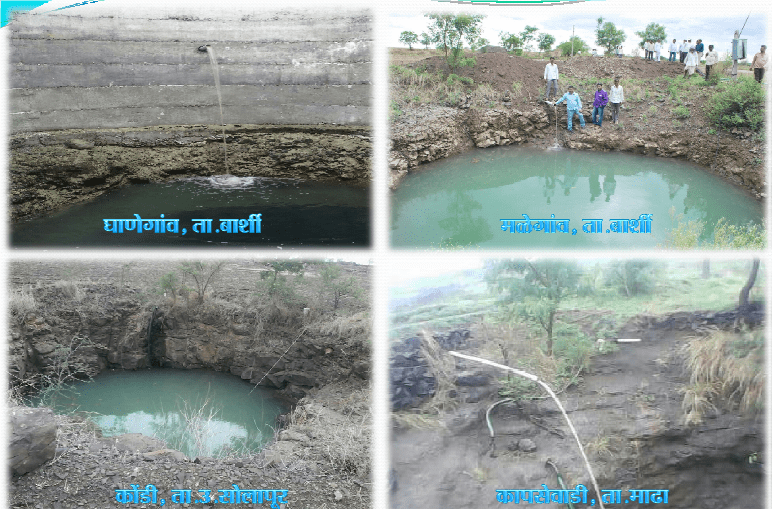
Union Water Resources Minister Uma Bharti in an interview tried to refute charges that the Centre reacted late to India’s drought crisis. Water minister makes strange statements that one cannot do any planning about drought & her govt is the first govt to provide water through tankers. However, Solapur, a chronically drought-hit district in Maharashtra was serviced with more than 200 tankers in 2013-14, even when the monsoon rainfall was better than this year. In this drought, there are only 16 tankers plying in Solapur. Drinking water sources have been secured, water from Ujani dam for and sugar cane has been disallowed. The district leads the way in Jal Yukta Shivar Program in the state, new avenues of Agricultural credit are opening, options to sugarcane are being developed, errant sugar factories are being fined for polluting drinking water sources. Will the Union Government accept its mistakes and make amends?
Tag: Ganga
DRP: 11 April 2016 (Harsh Summer: In Search of Green Pastures)
With ponds and lakes drying up, cattle in Telangana are forced to travel long distances for fodder and water. Here, buffaloes are moving towards a water source near Medipalli in Adilabad district on 09 April.
Continue reading “DRP: 11 April 2016 (Harsh Summer: In Search of Green Pastures)”
DRP: 4 April 2016 (India Water Week shows absence of fresh thinking from water resources establishment)
SANDRP Comments India Water Week continues to show absence of any fresh thinking from water resources establishment The 4th India Water Week being organized by Union Ministry of Water Resources, River Development and Ganga Rejuvenation during April 4-8, 2016 in Delhi shows continued absence of any fresh thinking from water resources establishment.
The Information Brochure of the event says: “Ministry of Water Resources, RD & GR is to organize the India Water Week -2016 between April 4-8, 2016 to use it as a platform to elicit ideas and opinions from global level decision makers, politicians, researchers and entrepreneurs in the field of water resources for mutual benefit and goodwill… This is the fourth event of its kind with the theme “Water for all : Striving together” focusing on improving efficiencies of water use across all sectors… ”
DRP: 28 March 2016(Is India facing its worst-ever water crisis?)
Is India facing its worst-ever water crisis? On 11 March first time in 30 years history power generation at Farakka power plant in West Bengal was suspended for 10 days due to non-availability of water in Ganges. Nobody is sure why but the evidence about the declining water levels and waning health of the 2,500km long Ganges is mounting. Monsoon rains have been scanty for the second year in succession. The melting of snow in the Himalayas has been delayed. Water tables have also been declining in the Ganges basin due to the reckless extraction of groundwater. The 3-month-long summer is barely weeks away but water availability in India’s 91 reservoirs is at its lowest in a decade, with stocks at a paltry 29% of their total storage capacity, according to the Central Water Commission. Thousands of villagers in drought-hit region of Maharashtra depend on tankers for water & authorities in Latur district, fearing violence, have imposed prohibitory orders on gatherings of more than 5 people around storage tanks. Tens of thousands of farmers and livestock have moved to camps providing free fodder and water for animals in parched districts. The govt has asked local municipalities to stop supplying water to swimming pools. States like Punjab are squabbling over ownership of river waters. In water-scarce Orissa, farmers have reportedly breached embankments to save their crops. Realy the waning health of the sacred river underscores the rising crisis of water in India.
Continue reading “DRP: 28 March 2016(Is India facing its worst-ever water crisis?)”
DRP: 21 March 2016 (‘Towards Noyyal’ A people’s initiative to restore a river’s glory)
Tamil Nadu A people’s initiative to restore a river’s glory The Noyyal River Restoration Federation will launch ‘Noyyalai Nokki’ (Towards Noyyal), a people’s initiative to restore the Noyyal river system on 26 March. Social activist Anna Hazare will launch the project at Kooduthurai in Alandurai in Coimbatore district. The river originates in the Western Ghats and runs through the four districts to join the Cauvery at Noyyal village. Known as Jungle stream, in olden times as many as 34 streams used to feed water into it and the river would flow throughout the year with two or three annual flood spell. But now, just 4 or 5 streams feed the river. In many places, the river is encroached upon, sewage is let into it, or the river needs to be desilted. The river is all set to regain its glory with the ‘Noyyalai Nokki’ initiative. What is encouraging is the willingness of the public to be part of it. The project proposes to divide the river into segments of 500 metres for restoration and maintenance. Ownership groups will be formed for every 500 metres and it will consist of the local people, experts and patrons (divide-distribute-develop model).

DRP: 29 Feb. 2016 (4 decades on, Siruvani dam displaced tribals wait for justice)
Kerala 4 decades on, Siruvani dam displaced tribals wait for justice During 1970s, of Muthikulam triblas of Siruvani hills in Kerala were forced to relocate themselves to Chingampara forests area. This was how a settlement constituted 24 Muduga tribes families facilitated the construction of the Siruvani dam, a major source of drinking water for Coimbatore city and its surrounding areas in Tamil Nadu. Four decades later, the Muduga tribe has volumes to talk about the breach of official promises. Their houses are in ruins and the tribal people have to walk about 3km to fetch water from the reservoir as the decades-old water supply mechanism stopped functioning years ago. Most of the children in the Chingampara colony do not attend school as the nearest school is about 20 km away. The old school at Muthikulam got submerged in the dam waters. Now the colony has only an Anganwadi. Rajan, a differently-abled member of colony reported that the new reservoir came up in the area from where our families had been forced to move out. The dam was commissioned in 1984, but our settlement remains neglected. The tribals are still awaiting justice even after four decades. Except for the once-in-a-week visit of a junior public health nurse, there is no health care facility for the people. Biju another affected stated that in 1971 we were promised pucca housing with water and power connections and toilets, besides compensation of Rs.10,000 but nothing happened. He felt that their rehabilitation was a mockery and they deserve a decent rehabilitation as compensation.
Continue reading “DRP: 29 Feb. 2016 (4 decades on, Siruvani dam displaced tribals wait for justice)”
DRP: 22 Feb. 16 (Unprecedented water crisis in Delhi due to Jat quota stir)
Unprecedented water crisis in Delhi due to Jat stir Terming the water crisis in the national capital as “unprecedented”, Delhi minister Kapil Mishra has warned that the situation might worsen in the next few days if the supply from Haryana is not immediately restored. He said the Delhi Jal Board (DJB) had almost run out of water and advised people to use water judiciously. Delhi gets its bulk of water supply from Haryana and the stir has affected 65% of water supply in Delhi has been cut with the shutting down of seven water treatment plants— Wazirabad, Chandrawal, Dwarka, Okhla, Haiderpur, Nangloi and Bawana which provide around 500 million gallons per day (MGD). In all Delhi has nine water treatment plants which together produce 820 MGD of potable water. Of these, only two Sonia Vihar and Bhagirathi fed by water from Uttar Pradesh are operational. The current production is only 240 MGD. Among the areas affected were Dwarka, Janakpuri, Munirka, Palam, Rajouri Garden, Punjabi Bagh, Vasant Kunj, Saket, Green Park and Lodhi Colony, where residents complained of little or no water. In another news report DJB is reported to have made 140 water filling points functional to feed tankers which would be sent across the city, reeling under an unprecedented water crisis. Water Minister Kapil Mishra reviewed the contingency plan for water management in West, North, North-west, Outer and Central Delhi and said tankers will deliver water at 663 points to partially meet the shortage of 480 MGD. These points will keep rotating. Plan is to cover around 2,000 points by Monday evening. The DJB supplies around 900 MGD of water daily out of which around 600 MGD of raw water come from Munak Canal. Even if Haryana releases water immediately, it will take at least 24 hours to restore the supply. Meanwhile Supreme Court on 22 Feb.16 scolded Delhi government. for approaching the court instead of resolving the water crisis with Haryana. The Kejriwal government had approached the top court on in view of the severe water crisis in the national capital after Jat protesters blocked water supply through Munak canal in Sonipat. During the hearing on government’s plea, the court took strong objection to Water Minister Kapil Mishra’s presence inside the courtroom. On the other hand, the minister accuses Haryana & Central Government for providing no official information on the crisis He said the Delhi government was “repeatedly trying to communicate” with the two governments to find out when will the supply resume, but without much success. Also see Jat quota stir: Water supply cut, Delhi may go dry
Continue reading “DRP: 22 Feb. 16 (Unprecedented water crisis in Delhi due to Jat quota stir)”

Digging Our Rivers’ Graves?
A summary analysis of the ecological impacts of the National Waterways Bill (2015)
– Nachiket Kelkar (rainmaker.nsk@gmail.com)
Introduction: The National Waterways Bill (NWB, Bill No. 122 of 2015) was tabled by the current central government’s Minister of Transport and Shipping, Mr. Nitin Gadkari, in May 2015. This Bill plans to convert 106 rivers and creeks across India into waterway canals, purportedly for ‘eco-friendly transport’ of cargo, coal, industrial raw materials, and for tourism purposes. The primary reasons provided for this bill are that 1) inland water transport is fuel-efficient, cost-effective and eco-friendly, 2) the systematic development of waterways will create progressive economic opportunities in the country, and 3) the potential of water transport is underutilized in India. The Bill has since been examined by the Standing Committee appointed of Rajya Sabha Members and experts on the matter, who submitted their findings in Report No. 223 (Rajya Sabha Secretariat, August 2015). Recently, the Bill has been cleared by the Lok Sabha, and awaits final discussion in the Rajya Sabha within a fortnight’s time. As of now the NWB appears to enjoy support across party lines, states and political positions and agendas. There is also a belief that waterways would mean maintenance of enough water flowing in our rivers – yet the means through which this is proposed to be achieved involve capital dredging and large-scale conversion of floodplain environments and riverbanks to concrete embankments. A serious concern of observers has been that there has unfortunately been but scant debate on the high ecological and social risks the NWB poses to riverine biodiversity and local resource users through such irreversible engineering controls on our rivers. There is no discussion among politicians and administrators. Importantly, this issue appears to have barely received adequate attention even in environment and conservation circles. Problematically enough, the NWB thus emerges as a threat that may go unnoticed by conservationists and get passed without debate, deliberation or emphasis on environmental clearances to the extent required. In this article I will discuss the potentially damaging consequences of the NWB on river ecology, human life and hydrological dynamics of India’s riverscapes. My earlier article on the SANDRP blog ‘Four boats at a river crossing along Ganga’ (dated 28th December, 2015) had described https://sandrp.wordpress.com/2015/12/28/four-boats-at-a-river-crossing/) ground experiences related to the impacts of large-scale inland water transport (IWT). Continuing there I attempt to provide a point-wise discussion and critique of the NWB. Continue reading “Digging Our Rivers’ Graves?”

DRP: 15 Feb. 2016 (Govt plans National Water Commission)
Govt plans National Water Commission In one of the most significant reforms in the water sector in a long time, the govt is in the process of ordering a complete restructuring of the organisations responsible for regulating the use of water resources, with the objective of bringing in greater efficiency, better planning and increased emphasis on conservation of water. According to news report the Central Water Commission (CWC), which oversees irrigation projects, flood management and drinking water supply, and the Central Ground Water Board (CGWB) are likely to be disbanded, and a National Water Commission is proposed to be set up in their place. A few other smaller organisations with specialised mandate like data gathering and analysis are also likely to be created.
A team under Mihir Shah, a former member of the then Planning Commission of India, is already preparing a blueprint for better management of water resources. The idea of institutional restructuring is said to have the backing of this panel. It is likely to submit its report in the next two months. In the new scheme of things, more emphasis is being given to judicious use, and conservation, of ground water. It is estimated that despite elaborate irrigation projects, about 60 per cent of irrigation during the non-rainy season is still done by pumping out ground water. The large irrigation projects, meanwhile, have given sub-optimal results.
A large number of sewage treatment plants, being built as part of the Clean Ganga initiative that will eventually spread to other rivers as well, will provide a new source of water that is fit not only for industrial use but also for irrigation and many other purposes. The river rejuvenation plans, not just of Ganga but others as well, will become an integral part of overall water resources management. Apart from reducing pollution in the rivers, and maintaining a minimum ecological flow, the rejuvenation plans would also ensure that the rivers are able to adequately recharge the aquifers in its basins.
Allocation of water resources to each state is also on the agenda. But this process is likely to take time as it would involve extensive consultations with the state governments. Once a consensus emerges, a central legislation on allocation of water resources is planned to be brought in. This is aimed at reducing inter-state water disputes.
Continue reading “DRP: 15 Feb. 2016 (Govt plans National Water Commission)”
DRP: 8 Feb.2016 (Hiding Environment Information-Against Sabka Sath, Sabka Vikas?)
SANDRP Open Letter to MoEF&CC Is Not Hiding Environment Information Against Sabka Sath, Sabka Vikas? Even as the Ministry of Environment, Forests and Climate Change has been sanctioning cascades of hydro power projects on here-to free flowing rivers in the Himalaya and North East India, Cumulative Assessment of the Impacts of these projects became a crucial area of concern. The cumulative impacts of these projects on the hydrology, downstream flow, sudden water releases, deforestation, muck disposal, influx of migrant workers, seismicity of the region etc. is huge as compared to individual impacts. The projects together stand to change the social and ecological fabric of these regions.
Cumulative Impact Assessment (CIA) studies are a part of the Environment Impact Assessment Process under the EIA Notification (2006) and Environment (Protection) Act 1986. The documents of these CIAs have been uploaded on the Environment Clearance website in the past, as was required under number of laws. However, as the EAC is slated to consider whopping 4 CIAs in its upcoming meeting on the 8 and 9th Feb, not a single CIA-related document is available on the MoEF and CC website! We are told that these may not be made available in the future.
Continue reading “DRP: 8 Feb.2016 (Hiding Environment Information-Against Sabka Sath, Sabka Vikas?)”
 SANDRP