DRP News Bulletin

DRP NB 030423: IRENA confirms bleak future of Large Hydro globally

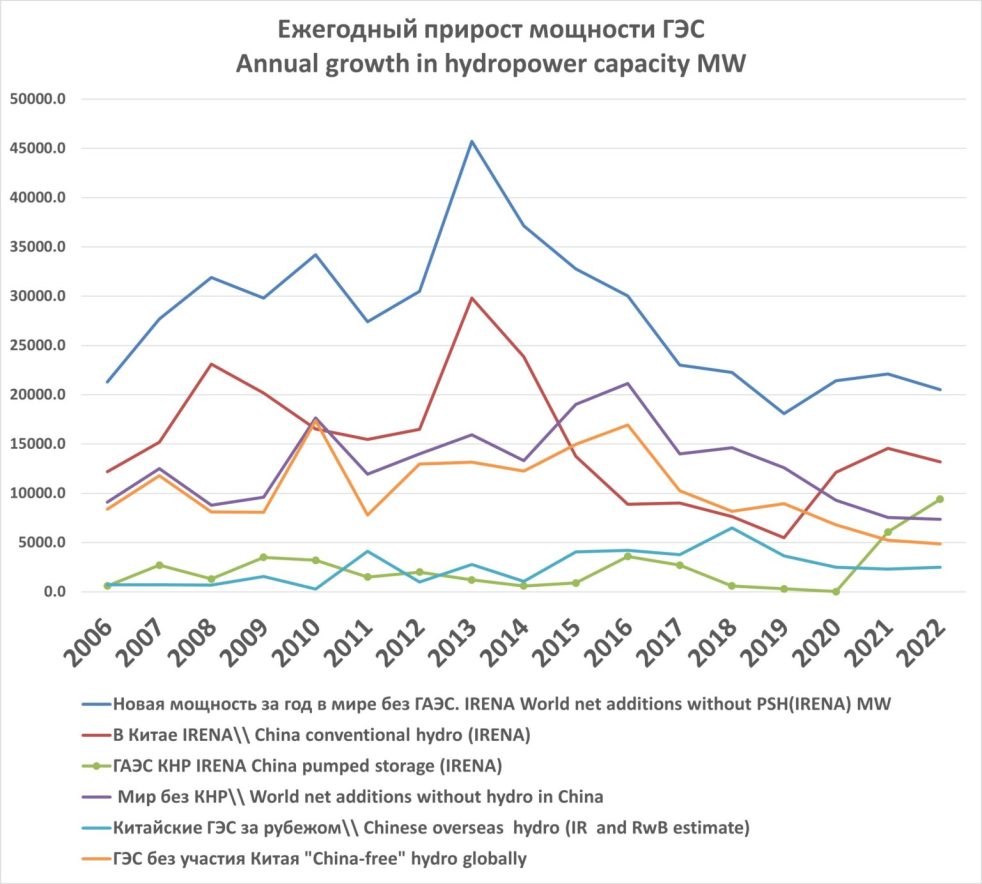
(Feature Image: Graph showing annual growth in hydro power capacity in MW. Source: Rivers Without Boundaries, April 01, 2023)

The annual Renewable Statistics 2023 report from IRENA (International Renewable Energy Agency) says that globally, only 1.6% was added to the hydropower capacity in 2022, that too two thirds in non-democratic China. The capacity added in rest of the world outside China in 2022 was 7.3 GW, lowest figure in last 15 years. Similarly 99% of additional capacity added in pump storage projects in 2022 was in China. The report from IRENA also says that 97% of hydropower finance comes from public or government sources and private sector seems to have little enthusiasm for this sector. The projections for future painted in the report is no better. This is broadly in line with our lead story in DRP News Bulletin last week (dated March 27 2023) painting bleak future of large hydropower projects.

Continue reading “DRP NB 030423: IRENA confirms bleak future of Large Hydro globally”
DRP News Bulletin

DRP NB 270323: Bleak future of Large Hydro

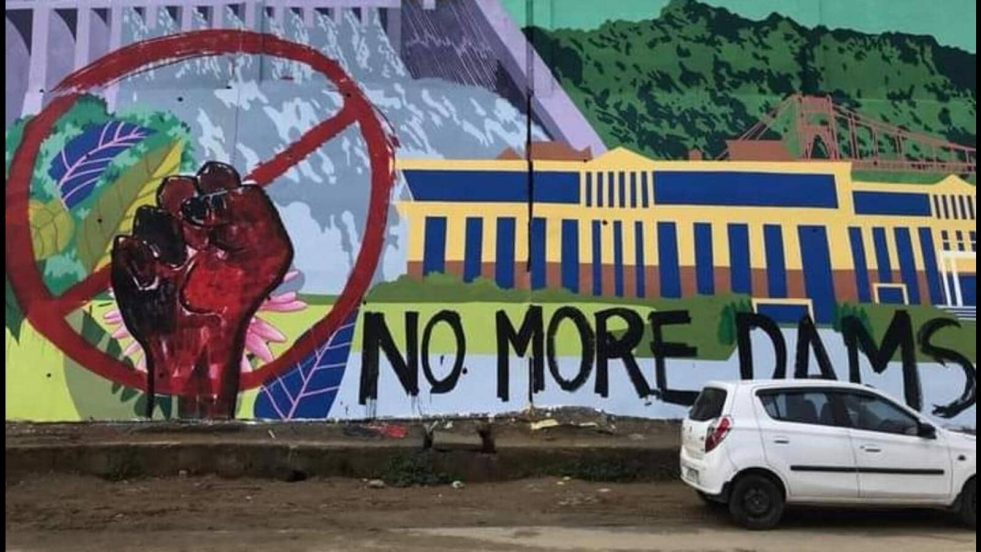
(Feature Image: Anti dam graffiti on the wall of the civil secretariat building in Itanagar, Arunachal Pradesh in July 2022. Source: Social Media)

Large Hydropower projects have bleak future as number of reports this week suggest, including the following Video. The large hydro is not renewable, sustainable or green or people friendly. In fact, it is increasingly seen as invitation to disasters. Much better options exist. In the changing climate situation, the destruction that hydropower projects bring about becomes even more relevant when we need the Rivers, Forests, the biodiversity and less disaster prone options. Earlier our governments see this writing on the dam walls from across the world, better it will be for all concerned.

Continue reading “DRP NB 270323: Bleak future of Large Hydro”
DRP News Bulletin

DRP NB 270223: How much Pump Storage Hydro capacity is required in India?

(Feature Image: State steps up pumped hydro storage projects amid coal crisis. Source: EQ Mag Pro/ May 2022)

On Feb 15, 2023, Union Ministry of Power issued draft guidelines for Pump Storage Projects, inviting comments from stakeholders in 15 days to the email id – hydro2-mop@gov.in. The guidelines say that more Pump Storage Projects (PSPs) are required in view of increasing solar and wind power capacity connected to the grid, to stabilize the grid, store the power to make it available during non-solar and non-wind power hours and for peaking power, reactive power, etc. It describes the PSP as “clean, green, safe, and non-explosive” and “environment friendly” option. No studies or basis are provided for this sweeping conclusion.

Continue reading “DRP NB 270223: How much Pump Storage Hydro capacity is required in India?”
DRP News Bulletin

DRP NB 130223: El Nino set to endanger 2023 SW Monsoon rains

After four years (SW Monsoons of 2019 [110.4%], 2020 [108.74% compared to normal rainfall], 2021 [99.3% or almost normal rainfall], 2022 [106.5%]) of normal or surplus monsoon rainfall, SW Monsoon 2023 could face rainfall deficit and uncertainties as per US Govt weather agency NOAA and also India’s IMD. El Nino conditions are many times associated with poor monsoon rainfall in India. Since SW Monsoon provides more than 75% of total annual rainfall of India, this can be critical for India. The shift from particularly prolonged La Nina conditions to El Nino conditions should be a warning sign for India. IMD DG has said that the department will come out with an update on Feb 28, which should be sufficient advance notice to take necessary steps to tackle its possible impacts on upcoming Summer and SW Monsoon. We hope the government is ready to take the necessary steps to tackle any eventuality.

Continue reading “DRP NB 130223: El Nino set to endanger 2023 SW Monsoon rains”
DRP News Bulletin

DRP NB 060223: Wetlands in India face damages, threats and Govt Apathy

(Feature Image:-Nayapakkam a lake near Chennai and a bird hotspot. 190 species have been recorded here and is a refuge for migratory harriers. https://ebird.org/hotspot/L3396760 Excavators were filling one end of the lake yesterday. Allegedly the ACS group is building an International school over it. M Yuvan, 05 Feb. 2023)

On the occasion of World Wetlands Day 2023 on Feb 2, 2023, SANDRP brought out five overviews about state of India’s wetlands. These included overview related to: 1. India’s Ramsar Wetlands 2. General overview of India’s wetlands 3. Top Ten stories about govt actions about wetlands 4. Top ten stories about judiciary actions about wetlands and 5. Positive stories about India’s wetlands. The links to the five overviews are available below.

The first thing that strikes from these overviews is that state of wetlands in India is bad, getting worse, they continue to face systemic neglect, damages, threats and govt apathy including Ramsar wetlands, which are supposed to have better protection than other wetlands, which is unfortunately not true. The nameplate of Ramsar wetland has now been given to 75 wetlands, but that provides no additional protection to them. in the name of information of Ramsar sites, there is only a combined interactive map apart from two separate pdf file links with location map and state wise listing Ramsar wetlands on Wetlands of India portal by MoEF&CC. The govt has neither prepared any concrete plan to address the threats nor has it developed credible monitoring mechanism which clearly shows it has no intention to improve the governance of these sites.

Continue reading “DRP NB 060223: Wetlands in India face damages, threats and Govt Apathy”
Dams · Wetlands

WWD 2023: India’s Ramsar Wetlands face Damages, Threats & Govt Apathy

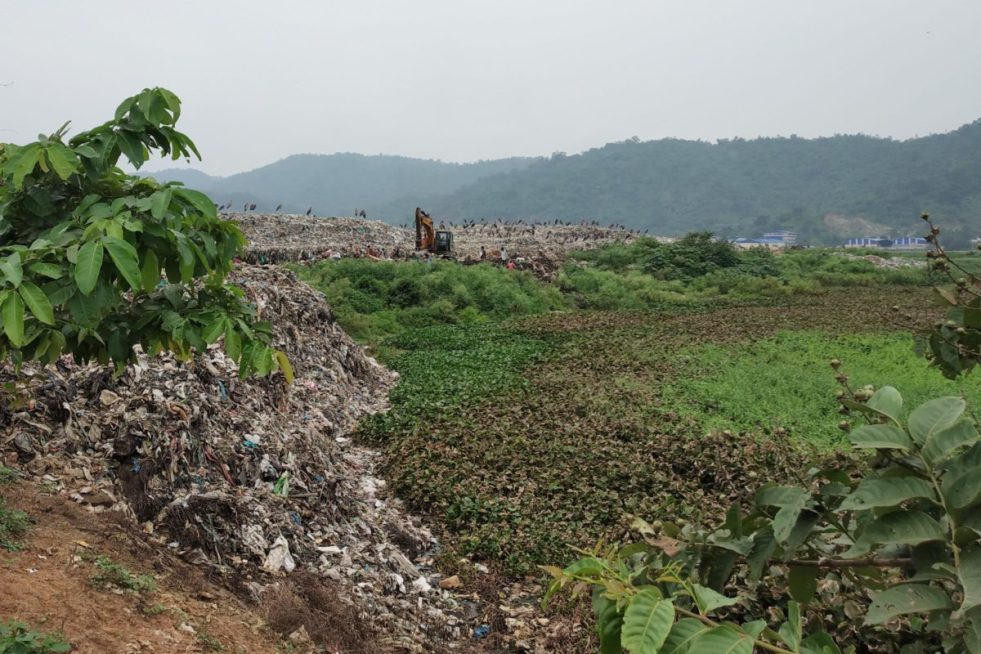
(Feature Image: The dumping ground is adjacent to the Deepor Beel wetland. Photo by Surajit Sharma./ Mongabay India, Aug. 2022)

Marking the World Wetlands Day 2023, this fourth overview by SANDRP compiles reports from 2022 revealing the worsening situation of Ramsar wetlands sites in India. In past few years, the government has shown great hurry in getting Ramsar tag for 75 wetlands from 26 in the country to symbolically mark 75th anniversary of Independence without showing any interest in resolving the existing and looming threats including increasing pollution, siltation, encroachments and climate change threats over old and even new Ramsar wetlands.

The ground reports show that the sole focus of the government is on pushing destructive and ornamental projects in the name of tourism and beautification on these wetlands which are only seen damaging their remaining eco-systems and threatening the livelihoods of dependent communities as an additional threat which only underlines that Ramsar tag does NOT help in wetlands protection and conservation. Experts, citizen groups have been raising this fact for years but in vain. Furthermore the process for seeking Ramsar recognition lacks consultation and participation of primary stakeholders and concerned citizens.

Moreover, in the name of information of Ramsar sites, there is only a combined interactive map apart from two separate pdf file links with location map and state wise listing Ramsar wetlands on Wetlands of India portal by MoEF&CC. The govt has neither prepared any concrete plan to address the threats, nor has it developed credible monitoring mechanism which clearly shows it has no intention to improve the governance of these sites.   

Continue reading “WWD 2023: India’s Ramsar Wetlands face Damages, Threats & Govt Apathy”
DRP News Bulletin

DRP NB 160123: Top Court appeals for EIAs for Urban Development: Welcome, but…

The Supreme Court of India, while disposing of a petition related Chandigarh, in its order on January 10, 2023 has said: “Before we part with this judgement, we observe that it is high time that the legislature, executive, and the policymakers at the centre and state levels take note of the damages to the environment on account of haphazard development and take a call to take necessary measures to ensure that the development does not damage the environment… We therefore appeal to the Legislature, the Executive and the Policy Makers at the Centre as well as at the State levels to make necessary provisions for carrying out Environmental Impact Assessment studies before permitting urban development.”

This is most welcome. And urgently required. That India’s urban development is happening at the cost of life sustaining environment resources including rivers, water bodies, forests, wetlands among others is well known. That the government sees all requirements of environmental scrutiny as road blocks is also well known. The consequences of this are clear for all concerned, not only in case of Bangalore as cited by the Supreme Court Bench, but also in case of Ahmedabad, Bhopal, Chennai, Delhi, Ernakulam, Faridabad, Gurugram, Hyderabad, Indore, Joshimath, Kolkata, Lucknow, Mumbai and so on. So is there a good chance that the apex court suggestion will be followed either in letter or in spirit? Unlikely. So what is clearly required is that the apex court emphatically directs the centre and states in this regard and follows it up with ensuring its implementation.

Continue reading “DRP NB 160123: Top Court appeals for EIAs for Urban Development: Welcome, but…”
DRP News Bulletin

DRP NB 090123: Atal Bhujal Yojana just chaff without any wheat?

According to this detailed report, possibly the first independent review of the Atal Bhujal Yojana, a 5-year program of the Union govt for management of groundwater, India’s water lifeline, with over half of the project period completed, seems bereft of the fundamental aspects that the scheme itself says are necessary for any sound foundation of the scheme. The review describes it as a dish full of chaff, without almost any kernels of wheat for some sound reasons. It says hardly 18% of allocated money has been spent on Gram Panchayat level community-led Water Security Plan. Only 4% of the planned Gram Panchayat level trainings have been held, with Gujarat and Haryana holding none. Only 27% of money allocated for Gram Panchayat level Hydrogeological monitoring network has been spent. The data gathering instruments that were required from the beginning of the program have not been installed in over half the planned locations. On Information, Education and Communication activities, only 16% of allocated amount is spent.

More detailed independent review of the program implementation will help, but from the available information so far, the signs do not look particularly promising. Is it due to ineptness or lack of intention? Only time will tell.

Continue reading “DRP NB 090123: Atal Bhujal Yojana just chaff without any wheat?”
DRP News Bulletin

DRP NB 191222: Question marks over viability of pump hydro projects

(Feature Image: 1772 Mw PSHPs Spain. Photo courtesy of Iberdrola/ ENR)

The question marks over viability of huge number of pump storage hydro projects (PSHP) being pushed forward in India currently were flowing in the rivers for long. This week, Moody’s investors Service (MIS) seems to have strengthened this after it downgraded Greenko Energy Holdings’ corporate family rating. It may be noted that Greenko is the biggest investor in PSHPs in India from private sector and a major part of Greenko’s new investments are in PSHP.

This makes the implications of MIS’s downgrade all the more interesting. MIS has noted that PHSPs are capital intensive and each PHSP will generate cash flow only after at least 2-3 years of construction (in reality it can be much longer than 2-3 years, the operative phrase here is at least). It also noted that the additional debt to be raised from Greenko’s capital spending, coupled with a rising interest environment will put further pressure on “GEH’s already weak financial metrics” and that Greenko’s high financial leverage due to its substantial capital spending program will keep its financial metrics below its downgrade trigger “for an extended period of time”.

Continue reading “DRP NB 191222: Question marks over viability of pump hydro projects”
DRP News Bulletin

DRP NB 121222: Green Hydrogen from Hydropower is false solution

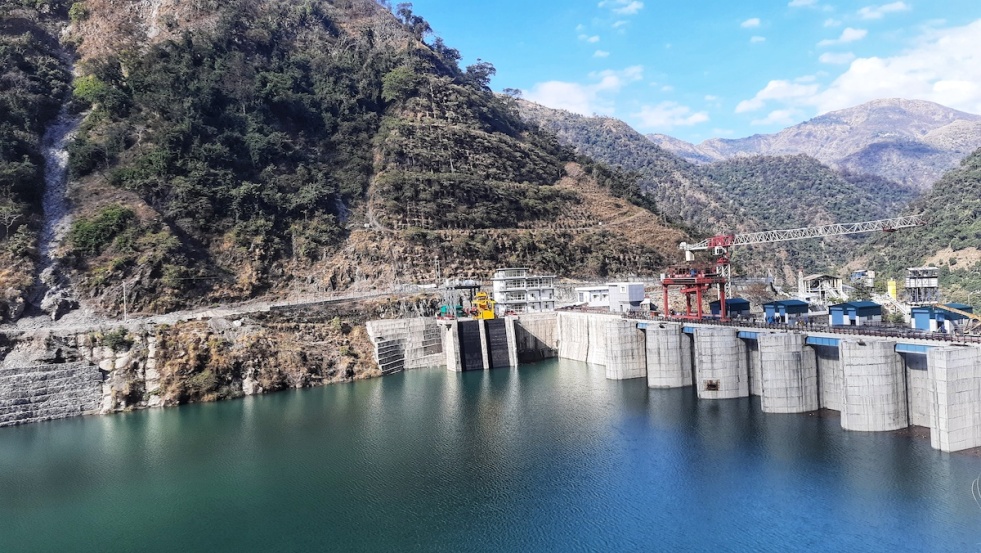
(Feature Image: Reservoir of Vyasi hydro project dam on Yamuna river in Dehradun. Credit: Varsha Singh/The Third Pole.)

A section of the hydro lobby has been trying to push hydropower in the name of producing green hydrogen as an alternative energy source. However, it has been known for a long time that this is a false solution. There cannot be green hydrogen when sourced from hydropower as not only hydropower projects have huge social and environmental footprint, they also have huge carbon footprint as the following article shows. It would be best to out rightly reject any such claim of green hydrogen when sourced from hydropower project.  

Continue reading “DRP NB 121222: Green Hydrogen from Hydropower is false solution”