DRP News Bulletin

DRP NB 17×22: SSP Fails To Provide Promised Water, Rehabilitation: Former Gujarat CM from BJP 

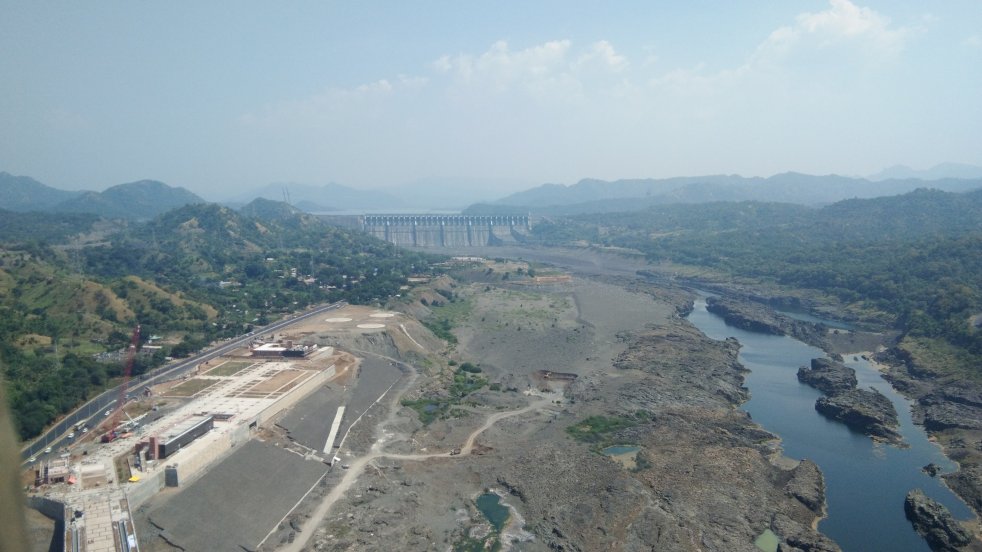
(Feature Image: An aerial view of Narmada river downstream Sardar Sarovar Project in Oct. 2018. Source: CMO Gujarat twitter handle)

With Gujarat state assembly election round the corner, Bhartiya Janta Party (BJP) the party ruling the state and Centre has been evoking the Sardar Sarovar Project as a big achievement in the face of contrasting ground realities as suggested by no less than former Gujarat Chief Minister of BJP Shri Suresh Mehta. The project has failed to provide promised irrigation water to farmers of Kutch and Saurashtra in whose name the dam was pushed as the canal system remains not fully built. The people of Kutch, in whose name Gujarat got 9 Million Acre Feet of water, disproportionate to its catchment area at SSP, were incidentally last to get the water and not first as it should have been. Kutch canals remains largely unfinished and command area largely unirrigated. Who stopped this area to get the water over a decade after the water started flowing from the dam is a question, Gujarat rulers refuse to answer.

Similarly, thousands of project affected people continue to struggle for rehabilitation and compensation despite court orders. The Gujarat rulers have gone silent over unending and unfolding ecological and hydrological impacts of the dam on Narmada river system downstream from the dam including delta area. Thousands of villagers living in miserable conditions submerged in backwater of the dam but have not been officially recognized as project affected people. At this moment, the timely, just rehabilitation and compensation of these villages and project affected families should be top priority of concerned governments including the Central government.

Continue reading DRP NB 17×22: SSP Fails To Provide Promised Water, Rehabilitation: Former Gujarat CM from BJP 
DRP News Bulletin

DRP NB 10×22: All Pervasiveness of Climate Change and Anthropocene Impacts

(Feature Image:- Odisha: 10 stranded in flash flood after sudden release of water from Gohira dam. Source: TNIE )

A large number of reports in this week’s news bulletin from SANDRP are tied by a common threat. The report in NYT about how the South Asian Monsoon is becoming more intense. How the droughts like the one in western US are becoming more likely.

In Bengal people killed in October rains while they were doing visarjan of Durga idols and in Odisha people stuck by sudden release of water from a dam. In these cases of W Bengal and Odisha, strangely, there was no warning and no one is even asking why. In both cases it is the destruction of the river in the that led to create the crisis, but again no questions are being asked.

The report of death by avalanches, the more frequent landslides in monsoons are also in the same league. The SW Monsoon is officially over as per India Meteorological Department, but even as we write, the extreme floods in Uttarakhand, Uttar Pradesh and Madhya Pradesh are breaching the Highest Flood Levels in several rivers.

Continue reading DRP NB 10×22: All Pervasiveness of Climate Change and Anthropocene Impacts
DRP News Bulletin

DRP NB 031022: Great Victory of People: MP govt scraps all contracts related to Maheshwar Dam

(Feature image: A protest by Narmada Bachao Andolan in Nov. 2006. Source: @Sripadmanthan)

On Sept 27, 2022, the Madhya Pradesh Government cancelled all contracts related to the Maheshwar Dam Project on Narmada. This massive dam on Narmada River in Madhya Pradesh upstream of Sardar Sarovar Project and downstream of the Omkareshwar Project was to be a multi-purpose project with a 400 MW hydropower component and water supply component among others. It was opposed by the people’s movement lead by Narmada Bachao Andolan for over two decades now. The project being implemented by the private textile company S Kumars showed no will or intention of taking care of the social or environment impacts of the project. Madhya Pradesh government so far was trying to push ahead with the project by hook or by crook, but finally had the sense to realise that this is going to be a massively costly affair at estimated Rs 42000 crores and the state and the people of state are only going to suffer costs and adverse impacts. The cancellation of all the contracts for the project signals a major victory of the people’s movement.

While congratulating the state government for cancelling the contracts, we would also suggest that the government needs to quickly decide about decommissioning of the dam, so that it does not pose safety risk to the people upstream and downstream and also perpetuates unnecessary adverse social and environment impacts. Earlier the dam is decommissioned, quicker will be the relief from these impacts. Moreover, the MP government should also not let the private company go scot free and all attempts should be made to recover the money spent and also penalise them for breach of the contracts. The private company should also be made to pay for the decommissioning costs.

Continue reading DRP NB 031022: Great Victory of People: MP govt scraps all contracts related to Maheshwar Dam
DRP News Bulletin

DRP NB 260922: Need for new credible Polavaram backwater study

(Feature Image:- The construction of the Polavaram dam across the Godavari river has posed a big threat to the Pulasa fish, as its movement to the upstream of the river could be curtailed. HT PHOTO).

Telangana state has demanded fresh backwater study for the Polavaram dam based on a number of grounds including the higher spillway capacity and outdated river cross sections of 1990s used in the old study. The changing rainfall pattern and resultant changing river flow pattern, both due to changed rainfall and changed state of catchment area also should be a reason for such a fresh study. However, more importantly, the study needs to be done in a credible way involving independent experts, not just state or central govt officials or academics from govt run institutions. Moreover, the study and all the information related to it has to be completely and promptly in public domain as these studies are required for the affected people and affected area. Normally Central Water Commission does such studies and refuses to make it public. What is the use or reason for backwater study to be secret? Possibly CWC is not confident of the quality of the study and that is why it is very important to have experts in the study team who are known to take independent stand. It is useful not only for the states of Telangana, Odisha and Chhattisgarh, but also for the people of Andhra Pradesh too. And earlier this is done, better it will be for all concerned.

Continue reading DRP NB 260922: Need for new credible Polavaram backwater study
DRP News Bulletin

DRP NB 190922: Dams bringing unprecedented changes to the World’s Rivers

A new study published this week once again highlights not so well known impact of large dams on the rivers: role of rivers in building, supplying sediment, nutrients to floodplains, deltas, coastlines, estuaries, oceans and supporting so much biodiversity and how large dams are majorly adversely impacting this role of rivers. The study by scientists at Dartmouth using images from the NASA-US Geological Survey for 414 of the world’s largest rivers show the unprecedented changes the dams are bringing to World’s rivers, the impacts that in many cases are outweighing the impacts of climate change. This is particularly true of the northern hemisphere that includes India, World’s third largest dam builder.

Unfortunately in India, there is very little appreciation or acknowledgement of this role of rivers and how dams are affecting it. The least one can expect is that the Government of India should urgently initiate a study to document and understand this phenomena and also highlight what needs to be done about it. The study should be done by an independent team of multidisciplinary experts.

Continue reading DRP NB 190922: Dams bringing unprecedented changes to the World’s Rivers
Dams · DRP News Bulletin

DRP NB 050922: Corruption in Large Dams & pro dam media Mughals

(Feature Image: Sardar Sarovar Dam on Narmada river. Source: Central Water Commission 30.08.2022)

As this article on corruption in large dams in India shows, it is open secret that large dams involve massive corruption, kickbacks and political funding. But the politicians from PM downwards across the party lines have understandably no interest in this issue.

But unfortunately, the large dams-corruption is not limited to politicians. The corruption in various forms plague even the media Mughals like Swaminathan Ankalesaria Aiyer and Shekhar Gupta, both known for their fundamentalist pro dam views. They too have no  interest in corruption in large dams. In fact some of them have no qualms accepting sponsorships of dam contractors for their media awards! They are however, ever ready to criticize Narmada Bachao Andolan and Medha Patkar, though they have no clue about the issues they are talking about and keep using some flawed study whose reply (by Nandini Oza and Shripad Dharmadhikary) is already out in public domain. It is interesting that they have launched this fresh attack on dam critics just when Gujarat Chief Minister and country’s Home Minister have also launched attack on the NBA. Neither Gujarat CM, PM or HM is replying as to why Kutch, the main justification for Gujarat getting disproportionate share of Narmada waters, were the last to get their share of the water (even now not fully as the canal distribution system is still incomplete), almost two decades after the water rich Central Gujarat started getting Narmada waters. Nor are the pro dam media Mughals bothered about this.

Continue reading DRP NB 050922: Corruption in Large Dams & pro dam media Mughals
DRP News Bulletin

DRP NB 1 Aug 2022: Dams reduce sediment load in rivers leading to higher coastal erosion

(Feature image: Delta Land Loss Mechanisms. Source Wikimedia Commons)

A new study this week has reminded us what has been known for long. Dams not only store water but also trap the sediment flowing in the river. Whatever smaller quantity of water flow from dams to downstream areas, has much lower or no silt. A lot of that silt was supposed to reach the coast, helping fight against the erosion of the coast due to sea tides and waves. With drastically lower sediment reaching the coasts, higher coastal erosion is the result. While climate change is definitely contributing to the increased coast erosion due to more frequent and higher intensity storms from the sea, the role of dams tend to work as force multiplier in increasing the coastal erosion due to less sediment reaching the coasts from river.

While a new study by a Pune University has highlighted this phenomena in case of Godavari river, peninsular India’s biggest river, this is also happening at most other rivers and where they meet the coasts. As in case of Farakka, closer the terminal dam is to the coast, greater is its effectiveness to trap the river sediment and higher is its contribution likely to be to the increase in coastal erosion.

Continue reading “DRP NB 1 Aug 2022: Dams reduce sediment load in rivers leading to higher coastal erosion”
Urban Rivers

Top Ten Judicial Actions on Urban Rivers 2022: Executors Deliberately Delaying, Diluting, Defying orders

(Feature Image: The order is subject to the orders of the SC which is pending. NGT on Nov. 24, 2021ordered the BMC to deposit within three months an environmental penalty of ₹28.20 crores to the CPCB for discharging raw sewage into the city creeks, rivers and drains. HT Photo)

During past one year, the judicial bodies including National Green Tribunal, Supreme Court, various High Courts have passed several orders and made critical observation while dealing with multiple issues afflicting Urban Rivers in India. This report highlights top ten such judicial interventions across India. The stories underline that the responsible agencies particularly pollution control boards and district, state and union governments have been failing miserably in timely and efficient implementation of these judicial orders, some of which are quite remarkable. If the executive bodies do not show right spirit and seriousness in enforcing the existing rules and court orders the state of India’s urban river only go downhill.    

Continue reading “Top Ten Judicial Actions on Urban Rivers 2022: Executors Deliberately Delaying, Diluting, Defying orders”
DRP News Bulletin

DRP NB 040722: Stalled, delayed, cancelled Hydro in Bhutan

(Feature Image: Stretch of Punatsangchu River that will be diverted through the tunnel when the dam is commissioned Photo: SANDRP)

Puncturing the prevalent notion about India Bhutan Cooperation on hydropower projects, there is news this week (in fact the news on this score has been coming for more than a couple of years, but Indian media seems to be practicing a self-imposed ban on putting out such stories – but that is another story as they say) that hydropower projects have been stalled, delayed, reconfigured, and even cancelled in Bhutan. This is broadly in line with the increasing economic non viability of hydropower projects.

Kuensel, Bhutan’s national newspaper, has reported about such projects quoting the National Council recommendation to the government of Bhutan to expedite the decisions about the stalled projects like the massive Punatasanchchu-I HEP and the Kholongchu HEP. It has also reported that the government of India conveying to Bhutan that India has sufficient electricity supplies, suggesting that the proposed Nu 200 Billion Sunkosh Hydropower project may not have any definite dateline and hence likely to not go forward. The happenings at the geologically unstable site selection for Punatsanchchu project involving India’s Central Water Commission, Wapcos and Geological Survey of India among others is in fact major scandal and how the whole issue has been dealt with so far. The happenings at the Kolongchu HEP being executed by the SJVN (erstwhile Sutlej Jal Vidhyut Nigam Ltd) as the first ever joint venture project in Bhutan in terms SJVN not giving the promised contracts to Bhutanese companies also does not bode well for Joint Venture projects in future. Both Punatsanchchu and Kholongchu HEPs are stalled and delayed for long, increasing the cost of the projects and power from the projects. While all this is broadly in line with increasing economic non viability of hydropower projects, a lot of this can be avoided by increasing transparency and accountability in governance of these projects.

Continue reading “DRP NB 040722: Stalled, delayed, cancelled Hydro in Bhutan”
DRP News Bulletin

DRP NB 270622: There are many man made factors behind Assam Floods, Mr CM

(Feature Image:- DDMA, UNICEF and Oxfam have innovated boat-mounted water treatment units to provide life-saving water to the people in need within Silchar & its peripheral areas. Source:- Assam State Disaster Management Authority )

The Assam Chief Minister has called the unprecedented floods in Silchar town along Barak river in South Assam as man-made floods. The reason given is that the breach of embankment along the Barak river in the town was created by some people. It is good to see that the Assam CM Mr Himanta Biswa Sarma has recognised that some of the floods can be due to man made factors. And indeed, investigation followed by action is required in all such cases. But the CM should not limit this to just the breach of Barak embankment or the role of some of the people who may have breached the embankment earlier in May to provide outlet to one of the lakes. The investigation must also look into the role of the water resources department as to why they did not swing into action earlier, both in terms of repair and investigation. .

In fact, according to reports so far, no less than 297 embankments have breached during this monsoon so far already. Many or rather most of them have happened due to systematic neglect and lack of proper maintenance by the water resources department and needs proper investigation and action. There is also an urgent need for assessment of cost benefit and efficacy of the embankments in Assam.

Continue reading “DRP NB 270622: There are many man made factors behind Assam Floods, Mr CM”