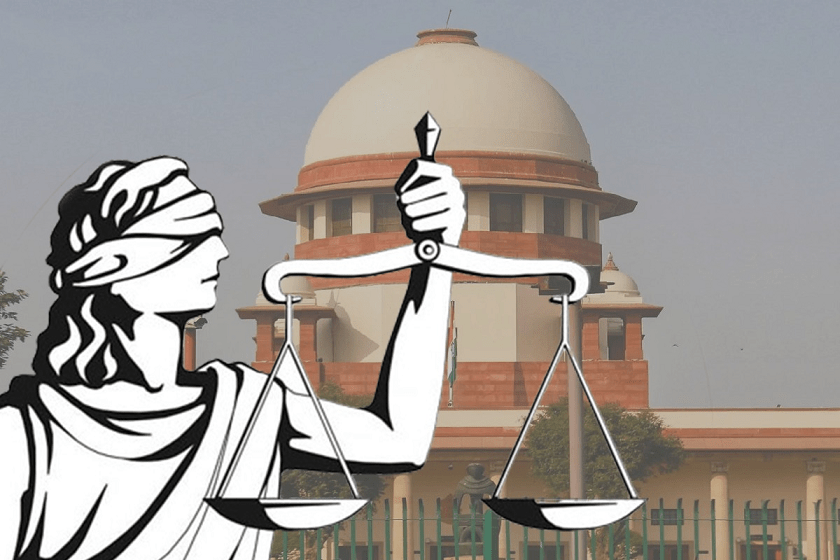
There are at least four cases in this past week where the judiciary has used strong words or taken up crucial issues in water, dams, hydropower projects, wetlands and riverbed mining related issues. In the case related to the safety of Mullaperiyar dam on Kerala-TN border, the Supreme Court has prodded the Centre to wake up from the slumber to ensure that National Dam Safety Authority quickly forms a panel to examine the project. This case has wide ranging repercussions not only about this project, but also functioning of NDSA and other bodies under the Dam Safety Act 2021. Indeed, there is huge question mark as to what extent NDSA and DSA has made our dams any safer.
Continue reading “DRP 130125: Will Judiciary take these matters to logical conclusion?”Tag: Cauvery
DRP 020924: HYDRA to protect water bodies in Hyderabad – a landmark move?
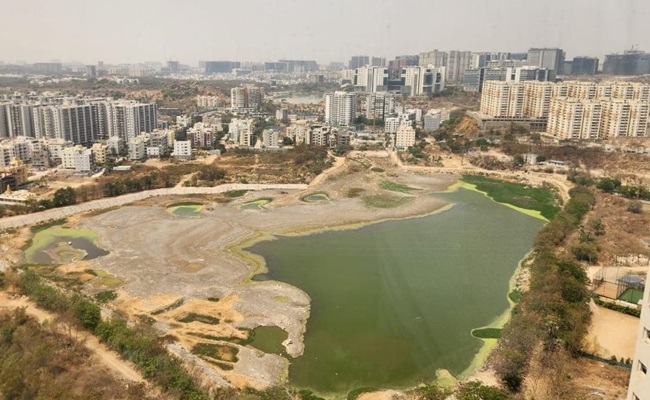
(Feature Image: An analysis of satellite imaging of 54 lakes taken in 1979 and 2023, secured by the HYDRAA from the NRSA shows that 40 lakes or nearly 75 per cent of lakes have shrunk by half. (Image: Twitter/DC)
The Hyderabad Disaster Response and Asset Monitoring and Protection Agency, or Hydra was established under GO 99, dated July 19 2024. A task the agency has taken up in all seriousness is protection of water bodies in the Hyderabad Capital Region (it includes 4 districts). To begin with it has started demolition of buildings illegally built inside the Full Tank Area (FTL) and Buffer area of the water bodies.
In July, Telangana Chief Minister Revanth Reddy replaced the Enforcement, Vigilance and Disaster Management (EVDM) wing of the government with Hydra, a body mandated to tackle illegal encroachment on water bodies in the Greater Hyderabad Municipal Corporation (GHMC) limits and surrounding areas. Its strength was upgraded from around 800 to 2,200 and its officials came directly under the principal secretary, municipal administration and urban development or the CM himself. “Hydra will also ensure the protection of water bodies in and around Hyderabad,” former EVDM commissioner and Hydra chief A V Ranganath said during its inception.
Continue reading “DRP 020924: HYDRA to protect water bodies in Hyderabad – a landmark move?”
DRP 010724: Time for independent review of Polavaram Project?
(Feature Image: Work going on Polavaram Project at Polavaram in West Godavari. DC Image: Narayana Rao, Dec. 2020)
The sequence of events over the last two decades that ended this week with white paper on Polavaram project being released by the newly elected Andhra Pradesh govt underlines urgent need for an independent assessment of the multi-state Polavaram Project on Godavari River in Andhra Pradesh.
The story of the project similar to, though a bit longer than that of the ill-fated Kaleshwaram Project of the neighbor Telugu speaking state of Telangana. Both are ill-conceived, expensive, high impact projects on same Godavari River, both taken forward without sufficient studies and implemented without sufficient checks and balances.
Continue reading “DRP 010724: Time for independent review of Polavaram Project?”
DRP 240624: India to help Bangladesh conserve Teesta River
The news this week that India and Bangladesh have agreed for India to help Bangladesh conserve the Teesta River that flows from India to Bangladesh. We hope this development is taken to its logical conclusion soon in terms of implementation of the project as soon as possible. This has the potential to not only two nations working together on conservation and rejuvenation of the Teesta River, but also possibly other 53 shared rivers. However, it would have been better if the W Bengal government would have been briefed, taken into confidence and involved in the discussions. History tells us that the cooperation efforts do not succeed without the involvement of all the stakeholders.
The formation of Joint Technical Committee to initiate discussions for the renewal of the Ganges Water Sharing treaty 1996 that will expire in 2026. One hopes that all these happen with a benevolent disposition from India as this has the potential of creating a much stronger bond between the two countries. A good example is the 1996 Ganga treaty that was also signed with a benevolent disposition. This move can also help strengthen the relations across South Asia as both Nepal and Bhutan are hoping to export hydro-electricity to Bangladesh via India.
Continue reading “DRP 240624: India to help Bangladesh conserve Teesta River”
DRP 030624: Ecological challenges before the new govts in Sikkim & Arunachal
(Feature Image: Anti dam graffiti on the wall of the civil secretariat building in Itanagar, Arunachal Pradesh in July 2022. Source: Social Media)
As the Hindustan Times Editorial today (June 3, 2024) has rightly underlined, a major challenge before the newly elected state governments in Sikkim and Arunachal Pradesh is to urgently review the existing, under construction and planned mega hydropower projects in the fragile Himalayan ecology in these border states.
These states are inherently vulnerable to large kinds of disasters including landslides, earthquakes, erosion, floods, GLOFs and also multi hazard disasters. These inherent vulnerabilities are already hugely increased under climate crisis. The large hydropower projects being taken up here are acting as force multipliers for disasters in these states as recent experience including the Oct 2023 events in both states have shown.
Continue reading “DRP 030624: Ecological challenges before the new govts in Sikkim & Arunachal”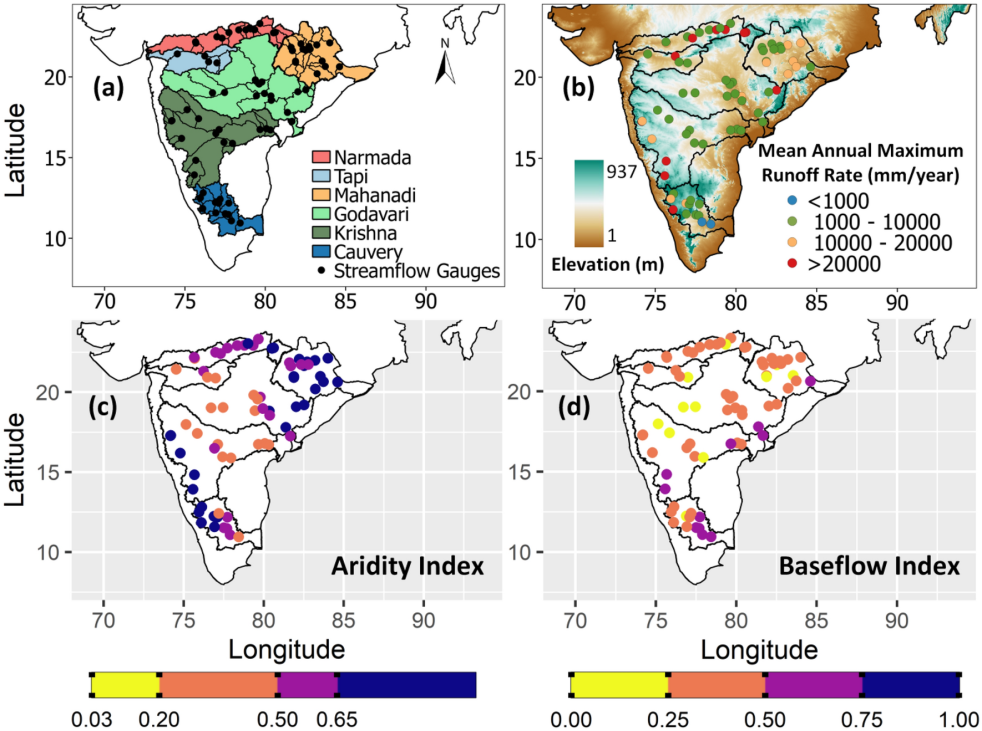
DRP 060524: Study on dam induced river flooding in Peninsular India
(Feature Image: (a) Locations of streamflow gauges with catchment boundaries in six major river basins of Peninsular India, (b) elevation map and mean annual maximum runoff rate (streamflow per unit catchment area), (c) Aridity Index (AI) and (d) Baseflow Index (BFI). The maps in first row are prepared in QGIS (Version 2.14.0 ‘Essen’ (2016), URL: http://qgis.org) and the maps in second row are generated using R (Version 4.2.2 (2022), URL: https://www.R-project.org/). Source: Baseflow significantly contributes to river floods in Peninsular India )
A recently published study, see details given below throws light on the role of groundwater contribution to baseflow in rivers and their flooding in Peninsular India’s river like Narmada, Tapi, Mahanadi, Godavari, Krishna and Cauvery. The found that while baseflow contributes more to river flows, its share in the flood event flow magnitude decreases as surface runoff accounts for a larger proportion of flood discharge on the day of the flood.
Most significant are the findings related to dam induced flood that SANDRP has been writing for long and the finding corroborate exactly what SANDRP has been saying: Sudden releases of water from a dam can raise river levels during extreme rainfall events, especially when the dam is nearly full. The impact of sudden floods is more destructive because people living in nearby areas are often unprepared. Without a dam, floodwaters rise slowly over time, allowing people to take preventive measures. However, sudden floods caused by dam releases offer little or no time to prepare, increasing the risks associated with dam-induced flood hazards. Furthermore, the construction of dams alters the natural regime of rivers, leading to changes in sediment transport and erosion patterns. These changes can heighten the risk of flooding downstream from a dam.
Continue reading “DRP 060524: Study on dam induced river flooding in Peninsular India”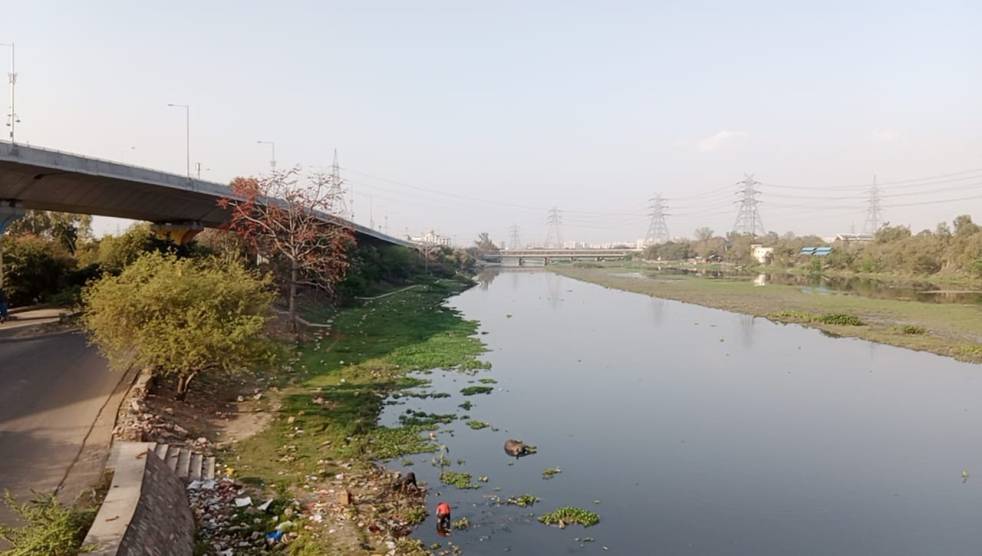
DRP 150424: Supreme Court’s order on right to be free from climate change impact is welcome, BUT…
(Feature Image: Polluted Hindon river flowing through Ghaziabad in March 2024. Bhim Singh Rawat/SANDRP)
On March 21, 2024, a case related to the Grean Indian Bustard, a critically endangered bird – numbering less than 150 individuals – has led the Supreme Court of India to expand citizens’ constitutional right to life and equality to include the right to be free from the adverse impact of climate change. The PIL filed by M.K. Ranjitsinh asked to protect the GIB from extinction. In 2021, in this PIL, the Supreme Court had passed directions restricting and regulating power lines and renewable energy projects in an area of 99,000 sq km in Rajasthan and Gujarat.
The Supreme Court’s latest order modified directions passed in the earlier judgment. Chief Justice D.Y. Chandrachud – writing for the 3-judge bench including Justices J.B. Pardiwala and Manoj Mishra – has expanded the contours of environmental jurisprudence: from the oft-repeated polluter pay principle–precautionary principle–public trust doctrine to the larger arena of climate justice, environmental inequity and gender justice. However, in the process, the protection the SC gave through earlier order has been withdrawn.
Continue reading “DRP 150424: Supreme Court’s order on right to be free from climate change impact is welcome, BUT…”
DRP 250324: Celebrating 50 years of Chipko Movement and Message
(Feature Image: A photo taken in March 1974 of people in Raini village, Uttarakhand, a few days after they protested against the felling of trees in order to make tennis racquets. Source: Varsha Singh/Third Pole report dated 30 Nov. 2022. The original photograph was taken on 30 March, 1974 by Chandi Prasad Bhatt and has been reproduced in The Third Pole with permission)
As we celebrate the golden jubilee of Chipko Movement, one of the most iconic and memorable environmental movements of India, we need to remember the key messages of the movement. It may seem gloomy situation at the place where the movement originated in Raini village in Chamoli district of Uttarakhand. In fact, as we travel from Raini to Chamoli to Uttarakhand and beyond, as far as environmental situation is concerned, there is not too much around us to celebrate about.
Continue reading “DRP 250324: Celebrating 50 years of Chipko Movement and Message”
DRP 110324: Bangalore reminds us: Ignore groundwater at your own peril
(Feature Image: People stand in a queue with water cans to get drinking water at Jnana Jyothi Nagar, in Bengaluru. Image Source: PTI/Live Mint, 10 March 2024)
One central lesson of the ongoing Bangalore water crisis is essentially that ignore groundwater sustainability at your own peril. The surface water availability in Bangalore has not decreased, it is the groundwater depletion that is leading to crisis. There is of course the expansion of the city both horizontally and vertically that is increasing demands, but simple arithmetic tells us that if groundwater levels are sustained, it can take care of these increased demands.
The Groundwater sustainability includes sustaining the groundwater recharge and ensuring that extraction does not go past the recharge. Sustaining the groundwater recharge means first understanding the groundwater recharge mechanisms, zones and protecting them. BDA has been sitting for four years on desilting of two lakes: Bellandur and Varthur, which has caused huge impact on groundwater depletion. It also means increasing the groundwater recharge through rainwater harvesting (Bangalore’s failure here is apparent from the fact that government is collecting crores of rupees as fines from those not following the mandatory rainwater harvesting requirements), groundwater recharge wells and diverting tertiary treated sewage, available in Bangalore of upto 300 Million Liters per Day, to lakes and other such recharge zones.
Continue reading “DRP 110324: Bangalore reminds us: Ignore groundwater at your own peril”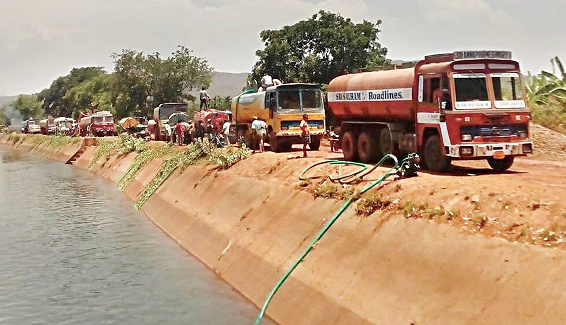
DRP 260224: Karnataka faces Drought, Farmer Distress, water scarcity
(Section 144 imposed near Bhadra Canals to stop illegal water lifting amid supply crisis. Representational image. TNIE)
As the two reports from media today shows, Karnataka is facing drought in 223 of 236 talukas, water scarcity and even farmer distress and suicides. The state government is aware of the situation and taking necessary measures. The situation could be similar in a number of states including Maharashtra, Telangana, Andhra Pradesh and even some of the eastern and northern states. The North Himalayan states have experienced hugely below normal snowfall in the ongoing winter. The Winter Rainfall at all India level for the period Jan 1 2024 to Feb 25 2024 is already 31% below normal.
There is role of global warming and El Nino in this and these factors are going to persist at least till the end of Indian Summer. So the governments both at centre and in states needs to be ready for the crisis.
The current Karnataka govt is awake to reality and seems to be taking the appropriate steps. Karnataka had deficit rainfall in SW Monsoon 2023.
Continue reading “DRP 260224: Karnataka faces Drought, Farmer Distress, water scarcity” SANDRP