Union Finance Minister Arun Jaitley’s Maiden Full year budget presented to the Parliament on Feb 28, 2015 invited a lot of hype. Let us see what his statement of account for the 2015-16 has in store for rivers, environment, Himalayas, farmers, Climate Victims or sustainable water resources development. Continue reading “India Budget 2015: Is there any hope for rivers, environment or farmers?”→
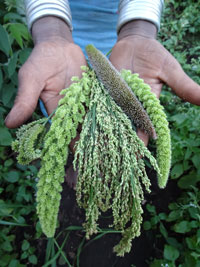
Adaptive Agriculture: A mix of Millets, Corn, Legumes and Vegetables grown by tribals in the same plot. Photo: Aparna Pallavi, Down to Earth
When the farmers were losing their crop due to less or no rain, the government was still speculating about 2014 being a drought year. Now that the damage is done, we have seen some acknowledgement from authorities of the actual situation. One wonders then why is it that the government has to wait for calamity to strike when it already knows the dangers that lie ahead. In a burst of enthusiasm, it set up the eight missions under the National Action Plan for Climate Change (NAPCC) in 2008, one of which is the National Mission for Sustainable Agriculture. But the ground situation seems to be the same with or without it.
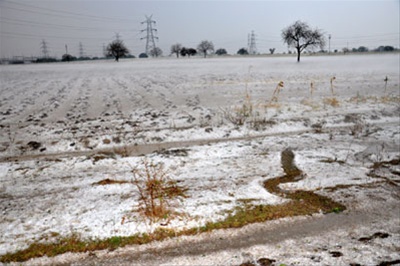
Destruction ofcrops due to untimely hailstorms in Marathwada Photo: Sakaaltimes
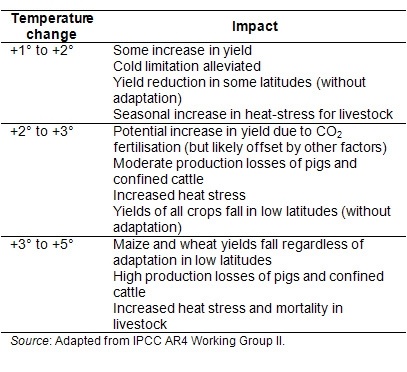
The Indian network for climate change assessment (INCCA) report suggests that there is a probability of 10-40% loss in crop production in India by 2080-2100 unless we take mitigation measures and adapt to the global warming[i]. The 5th assessment report of the Intergovernmental Panel on Climate Change (IPCC), estimates that 60% more food will be needed by 2050 given the current trends in food consumption[ii]. It is also estimated that for tropical places especially like India and China, the length of the growing season and suitability for crops will decrease as it is determined by moisture availability and extreme heat, where both are being affected as a result of climate change. This means that there will be considerable losses in agricultural productivity in India, leading to negative impacts on food security in the country. In such a situation, it is important for the government to work towards safeguarding the livelihoods of its farmers, who contribute highly to the GDP (13.7%) and form a big part of the overall labour force in the country. In its National Mission for Sustainable Agriculture, the government stated that there will be an estimated reduction in agricultural yield by up to 4.5-9% in the medium term (2010-2039), whereas a reduction of about >25% in the long term (2040 and beyond) if no measures are taken[iii].
Keeping in line with this, the IPCC report estimates that almost half of the wheat-growing area of the Indo-Gangetic Plains could experience significant amounts of stress due to heat by 2050s, along with the expansion of temperate wheat environments northwards as climate changes. ii The INCCA report said that projections indicated the possibility of loss of 4-5 million tonnes in wheat production with every rise of 1 degree Celsius temperature. i In an instance concerning wheat production in the Indo-Gangetic plains in 2004, the report sites that temperatures were higher by 3-6 degree Celsius, which is almost 1 degree C per day over the whole crop season. As a result, wheat crop matured earlier by 10-20 days and wheat production dropped by more than 4 million tonnes in the countryi.
Similar is the case with rice. In another report on Punjab, it was seen that with all other climatic variables remaining constant, temperature increases of 1⁰C, 2⁰C, 3⁰C would reduce the grain yield of rice by 5.4, 7.4 and 25.1 % respectively[iv]. The report by INCCA, in its projections for 2030, said that the yields of irrigated rice will be affected by about 10% in the coastal areas. Rain-fed rice yields are projected to increase upto 15% in many districts in the east coast, whereas they may fall by about 20% in the West Coasti. In India, rice is a widely grown crop. Its production determines livelihoods of majority of the farmers for one season. It is also the most water intensive crop. As temperatures rise, there is also increased stress on water required through the growing season. In India, 70% of our arable land is prone to drought, 12% to floods and 8% to cyclones[v]. In such cases, farmers who live with uncertainty have less money for food, farm investments and a reduced capacity and willingness to try out new technologies and practices.
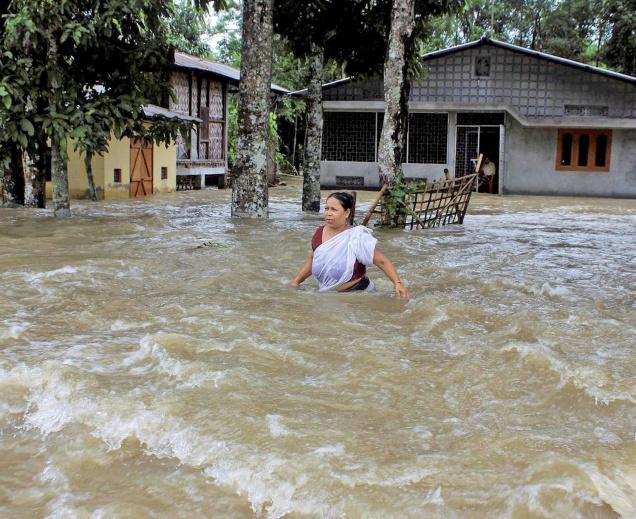
To add to the rise in temperatures, in its Summary for Policymakers, the IPCC clearly stated that it is very likely that hot extremes, heat waves and heavy precipitation events will continue to become more frequent. Thus the uncertainty is bound to increase. These climate extreme events are being witnessed in India even this year. There has been high rainfall deficit at many places through most of the monsoon season, thus leading to crop losses. There is extreme rain in the hills, which lead to the floods in Uttarakhand, Bihar, Orissa and now in Jammu and Kashmir. But the government still does not acknowledge the role of climate change in these anomalies.
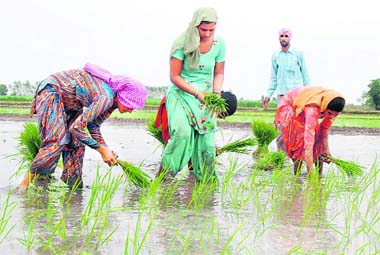
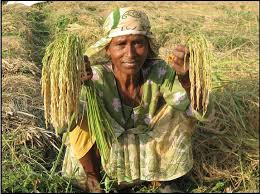
Rice Farming in Punjab Photo: The Tribune
Adapting farmers: Even though the climate is changing, the farming practices have not changed at most places. But there has been evidence that at some places farmers have adopted different techniques in the face of climate change even if they do not address it directly, but only make decisions based on impacts. The small and marginal farmers, it has been noticed, do not have the capacity to go for fresh sowing in case the crop goes bad when rains fail.
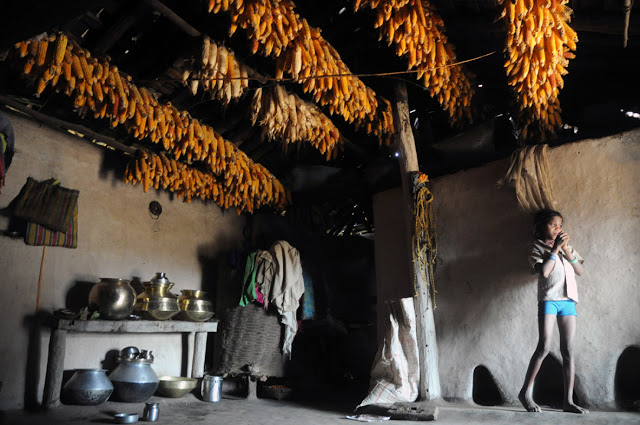
The Baiga tribe of Mandia and Dindori districts in particular have reverted back to this technique of planting multiple crops, which are resilient to environmental stress and give assured yield. The Madia tribe in Maharashtra have reverted to a similar practice of penda. This is happening because the people have suffered huge losses due to unsuccessful paddy crop because of erratic rain. These practices are being implemented with the help of an NGO, Nirman. The problem facing the people today is that the land used for this is forest land and not agricultural land, thus causing land insecurity. However, these people are making the effort to save their livelihoods with no help from the government.
A Baiga home with harvested corn Photo: Aparna Pallavi, Down to Earth
In the case of Bundelkhand region in Central India, over 70% of the population relies on rainfall for agriculture[vi]. The farmers here have started replacing wheat with barley as it is a less water intensive crop and this is a semi-arid region. It is also preferred because the input cost of barley is almost 50% less than wheat and its market price is 20% more. In this region, there have been efforts from organizations such as Development Alternatives which has formed farmers’ clubs to help the community adopt climate resilient techniques for agriculture, like drip and sprinkler irrigation, adoption of drought resistant seed varieties and integrated pest management.
Intergrating agroforestry with Wheat in Bundelkhand Photo: ANI News
In another report of a similar instance, basmati farmers in Karnal district are reverting back to an old practice of growing maize, which is a less water intensive crop[vii]. This is being undertaken even in large landholdings, as there is less water availability, with groundwater[viii] levels showing a decline in recent years. According to the National Mission for Sustainable Agriculture document, irrigation requirements in arid and semi-arid regions are estimated to increase by 10% for every 1⁰C rise in temperature[ix]. Therefore, it is very important for farmers to adopt techniques which help in its conservation.
The Consultative Group on International Agriculture Research (CGIAR) research Programme on Climate Change, Agriculture and Food Security (CCAFS), in collaboration with IFFCO India, has started the pilot for implementing climate smart agricultural technologies in three villages in Bihar. In an attempt to alter the cropping pattern, they re-introduced the sowing of mungbean, which is a short duration crop of the summer season. It is planted during the fallow season and increases soil fertility. For increasing yield, the ‘PusaVisal’ variety of mungbean is used, which is a better variety compared to the previously used one[x]. The yield from the initial trials ranged from about 0.80-1.70 t/ha as against 0.30-0.80 t/ha under farmers’ practice. The yield for the pusavisal variety was also significantly higher than that of the farmers’ variety. Seeing such results, other farmers have also expressed the desire to follow suit.
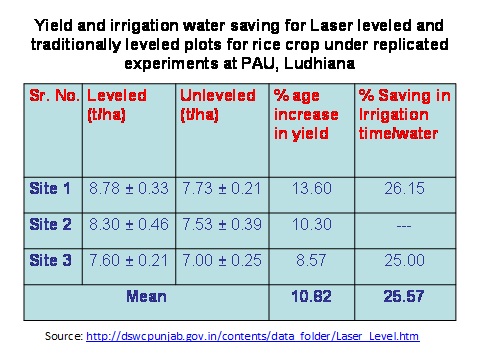
The CCAFS is also taking initiative in Haryana, where about 26 villages are targeted. Various climate smart techniques like the laser-levelling technique are being implemented here. This technique, it is claimed, helps conserve about 25-30% of the water used otherwise in rice-crop plantation[xi]. Even the way of planting rice is different in that it is directly sown in the field where it then sprouts. This is known as “direct-seeded rice”. Apart from this, there is also the practice of using crop-residue to nourish fields, which saves the cost of extra fertilizer. To optimize the use of fertilizer, farmers are being taught to use a tool called “nutrient-expert”, which judges the amount of fertilizer application required in a field. These techniques help reduce uncertainty in the crop output. The earlier maize growing practice mentioned in the case of Karnal, is also one of the climate smart techniques.
Agriculture also contributes to the emission of greenhouse gases. In fact, in 2004, agriculture directly contributed to 14% of the global anthropogenic greenhouse gas (GHG) emissions according to the IPCC[xii]. There has been an increase in CO2 emissions by about 100 ppm since pre-industrial times. Emissions of CO2 are often accompanied by ozone (O3) precursors that have driven a rise in troposphere O3 that harms crop yields. Elevated O3 since pre industrial times has very likely suppressed global production of major crops compared to what they would have been without O3 increases, with estimated losses of roughly 10% for wheat and soybean and 3-5% for maize and rice. Thus it is necessary that the government builds its capacity to better understand and measure the impact this has on agriculture and take the required steps to control it.
National Mission for Sustainable Agriculture (NMSA): The focus of this mission under National Action Plan on Climate Change (NAPCC) is supposed to be to mainly improve the productivity of rain-fed agriculture. One might ask then, why it did not promote techniques like the System of Rice Intensification (SRI)[xiii] which requires much less water than conventionally grown rice. The mission recognizes that in the event of climate change, the vulnerability of India is more pronounced because it is dependent on agriculture, places excessive pressure on natural resources and has poor coping mechanisms.
Boost of SRI Photo: India Water Portal
It estimates that most of the crops are likely to witness a decline after 2020 which is when the temperature threshold of many crops might get breached. Studies suggest a significant decrease in cereal production by the end of this century. The situation will be most critical in areas which are rain-fed and have complex cropping systems. These constitute about 60% of the net cultivated area. But acknowledging it is one thing and doing something about it is quite another. The climate smart techniques are showing results at some places, but are still not being actively adopted by the government. In a recent press release, the ministry of agriculture announced that the sowing of kharif crop has crossed the 986.59 lakh ha mark, but this is still much less than the 1020.78 lakh ha which was sown last year around the same time[xiv]. Despite this, the government has expressed hope for a positive response in crop output next season, envisaging a growth of four percent[xv], while not acknowledging the impact of huge rainfall deficit in June July this year.
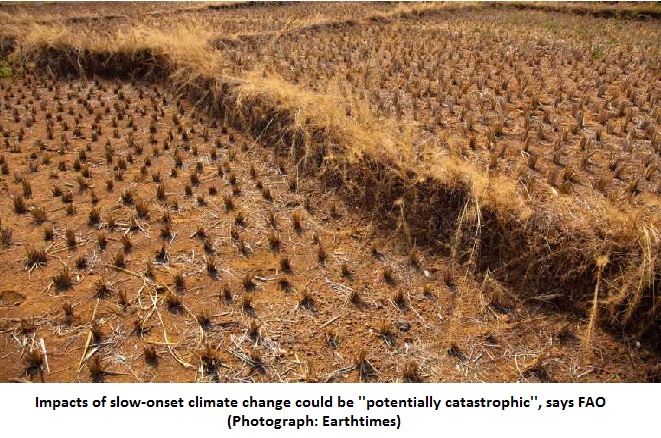
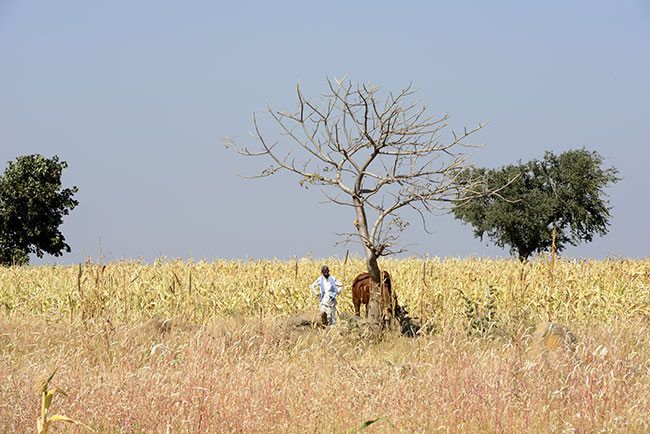
Drought in Marathwada, Maharashtra Photo: India Today
The mission acknowledges that since most of the agricultural production takes place in rural areas and engages people from the marginalized sections of the society, their coping capacity during climatic extremities are limited. But what has the government done since the inception of this plan? It has been almost 6 years since NAPCC was launched and the farmers still suffer the same fate without any compensation from the government. Even today, they are at the mercy of the weather. It will not work anymore to ignore the fact that this is now being aggravated by climate change. There is a need for more climate smart agricultural techniques in the country. The least the government can do is to acknowledge that the unpredictable weather patterns, especially the irregular monsoon is in fact a result of climate change. It will do good to also recognize that out of the 300 million undernourished in South Asia, about 250 million are in India[xvi] and any threat to agriculture is an added threat to their existence.
Daya Pawar[1] (Original marathi song Bai me dharan bandhte, majha maran kandte)[2]
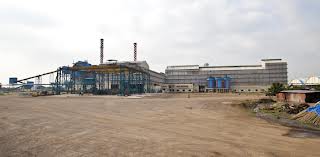
The 2012-13 sugarcane crushing season (which goes on for 160 days [3] from roughly 15th October) has recently concluded. It may be instructive to look at the figures of the sugarcane crushed by sugar factories in Solapur, one of the worst drought-hit districts in the state. Presently, Solapur has more than 200 cattle camps, one of the highest in the state, and more than 141 villages which are entirely dependent on tankers for drinking water.
Solapur and Sugarcane: Solapur has the highest number of sugar factories in Maharashtra. During 2012-13 (latest crushing figures as on 11th April 2013), 126.25 Lakh tonnes cane was crushed in Solapur district alone in its 28 sugar factories[4]. The district accounts for the maximum 18.25% of the cane crushed in the state during 2012-13. In 2012-13, a year that was called as a ‘drought year, worse than 1972 drought’, Solapur added 4 new sugar factories to its empire.
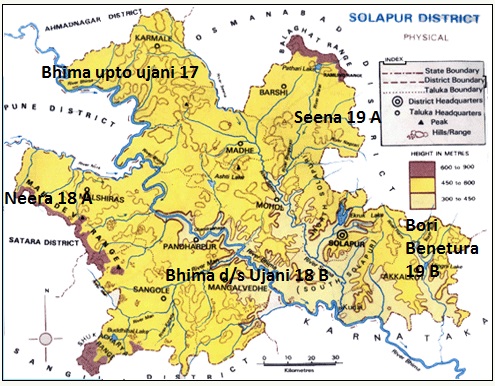
River basins of Solapur Normal monsoon (June-Oct) rainfall in Solapur district is 560 mm, in 2012 monsoon the rainfall was 412 mm[5]. Solapur belongs to five different sub basins as described by the Maharashtra Water and Irrigation Commission (MWIC) Report (June 1999). Among these five sub basins, the MWIC report describes 4 sub basins Bhima downstream Ujani (18B), Seena (19A) and Bori Benetura (19B) as highly deficient considering the water availability from all natural sources. Please see Annex1 Table 1 for details. 86.6% of Solapur district, barring parts of Karmala and Malshiras talukas, fall in this highly deficient river basins. The Commission says: “It is desirable to impose a total ban on water intensive crops like sugarcane in these deficit sub basins”. In these sub basins, “less water intensive crops only” and “less water intensive economic activities only” should be permitted, says the commission (p 138, Vol. III). Please see Annex 1 Table 2 for sub basin wise area of Solapur District.
It means that sugarcane crop and sugar factories in all talukas of Solapur district, possibly except those in Karmala and Malshiras are unviable, in violation of the MWIC report and against prudent water management. There is some addition to the water available in these basins (18B, 19A and 19B) following implementation of Ujani dam and inter-basin transfers. However, that still does not justify any crops like sugarcane or setting up of sugar factories. MWIC clears states that additional water should be spread across the talukas to benefit maximum farmers. Sugarcane cultivation clearly will not help that cause.
Rise of sugarcane cultivation in Solapur“Sugarcane is a crop which exhausts the soil and, therefore, it is not grown in the same field from year to year but is rotated in alternate years with food-crops.”
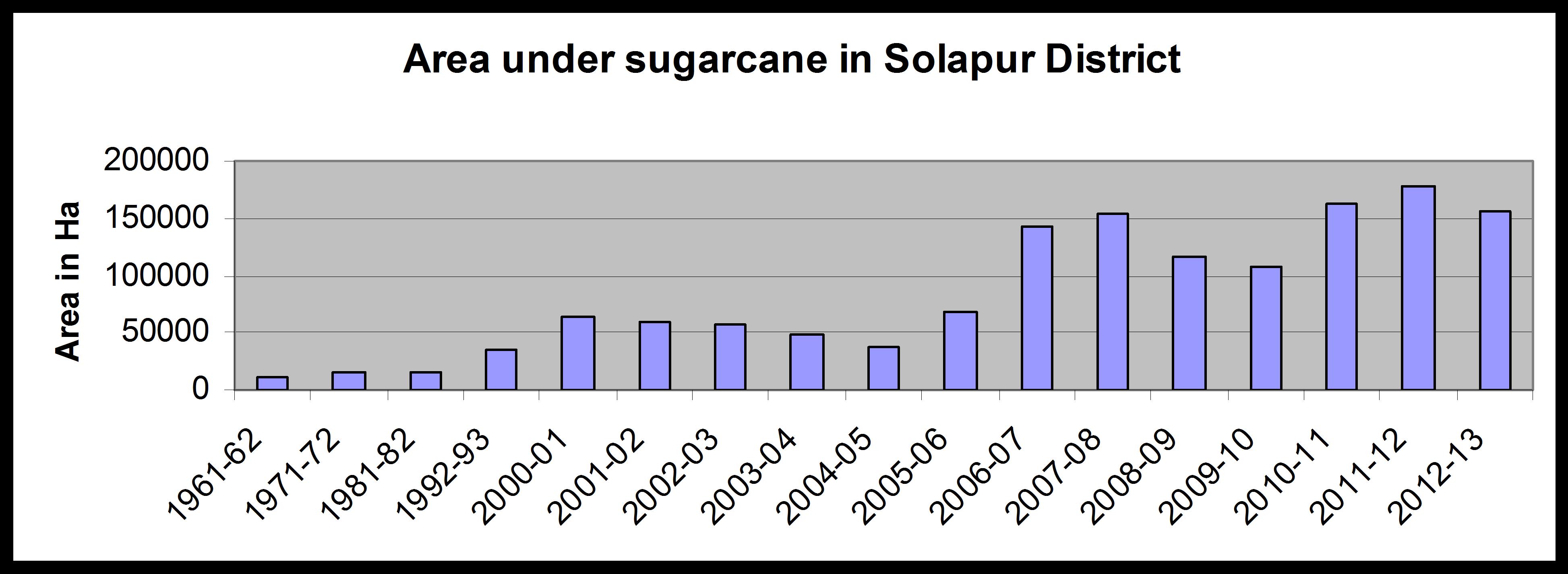
How rapidly the area under sugarcane in Solapur district has gone up can be seen from the graph (figures from official sources like http://mahaagri.gov.in and Sugar Commissionarate in Pune, 1961-62 and 1971-72 figures is from the Solapur district gazetteer and for 1992-93 from MWIC report). It is clear from the graph that the sugarcane area approximately doubled in Solapur during seventies and again during the eighties. Between 2005-06 and 2011-12, it seems to have gone up by over 160%, this is the highest growth phase for sugarcane cultivation in Solapur. That growth phase is likely to continue if we go by the number of new sugar factories that are planned to be set up in Solapur.
The area under sugarcane in Solapur at its high in recent years was 1.79 lakh ha in 2011-12, which is 19.46 % of net sown area of 9.2 lakh ha in the district (see table 3 in Annex). Of the net irrigated area of 2.52 ha in Solapur, sugarcane takes away 71.03%, way above the prudent 5% prescribed in Maharashtra. It is clear that sugarcane has been taking away disproportionate share of water of the district, at the cost of the rest of the farmers.
Water Consumption of Sugarcane and Sugar factories Considering productivity of 81 tonnes of sugarcane per hectare[7], the cane crushed during 2012-13 occupied 155 864 hectares in Solapur. Considering that ratoon type of sugarcane requires 168.75 lakh litres water per hectare at farm[8], which is the lowest water requirement among all types, (40% of sugarcane in Maharashtra is under ratoon type cultivation), amount of water required for cultivating sugarcane on 155 864 hectares of area in Solapur works out to be 2630 Million Cubic Meters. This is 1.73 times the live storage capacity of Ujani Dam (Live Storage: 1517 MCM), the largest reservoir in Bhima basin and third largest reservoir of Maharashtra. Assuming a rather high irrigation efficiency of 60% (considering that most of the water comes from surface water sources) water required from source would be 4383 MCM[9]
For crushing 126.25 lakh tonnes of cane, the sugar factories used a minimum of 18.93 Million Cubic Meters of water between October 2012 and March 2013, when drought was already severe. The live water storage of Ujani reservoir, at its highest was in October 2012 at 14% and it rapidly receded to zero in January and sub-zero levels from January to March[10] (as on 21st April, 2013, it is -32.91%).This is a very conservative estimate as per guidelines of Central Pollution Control Board (CPCB), considering 1500 litres water required to crush and process one tonne of cane[11].
According to MWIC report, even with maximum possible augmentation (from all planned schemes, many of which are not even implemented or sanctioned), Solapur district’s total share of water is 4188 MCM. But the current level of sugarcane cultivation in Solapur already seems to be using more water than the ultimate planned water allocation for Solapur.
New Sugar factories planned in Solapur!To add to this, at least 19 new sugar factories (see details in Table 4) are planned in Solapur[12]. Many of these are private sugar factories and are owned by politicians. Sakhar Diary 2013 gives the locations and capacities of these factories. Some of these factories have also received distance certificates[13] from the Sugar Commissioner’s office, Maharashtra indicating that they are at an advanced clearance stage at the state level. Together, these new factories will add crushing capacity of 85.52 Lakh tonnes of sugarcane. Madha, part of the constituency of Union Agriculture minister Sharad Pawar, is in the forefront of getting new sugar factories.It has 3 existing factories and has 5 new ones planned, 2 by politicians.
To grow this 85.52 L T sugarcane, an additional 105 580 hectares will have to be brought under sugarcane cultivation. Additional 1782 MCM of water will be required at farm to cultivate this sugarcane. Assuming even a high irrigation efficiency of 60%, this would mean requirement of 2970 MCM water at source. In addition, the Sugar factories will require 12.83 MCM of water for crushing this cane.
The new planned sugar factories will bring total area under sugarcane in Solapur to 2.685 lakh ha and the annual water consumption by sugarcane and sugar mills over 7400 MCM. This is way above the full planned allocation of water for Solapur as per the MWIC report. MWIC assessment is exhaustive including all possible planned water schemes, so there is no possibility for Solapur to get water over and above the ultimate planned schemes in Solapur. This means that by going for these new sugar factories, Solapur would possibly taking water of other regions or accelerating towards rapid exhaustion of its available groundwater.
Even as farmers from Mohol region sat on dharna in Mumbai, urging Maharashtra government to release water for Ujani dam, the same Mohol block in Solapur district has 3 existing sugar factories. These factories crushed 13.56 lakh tonnes of sugarcane this year till March 2013[14], using 20,340 Lakh Litres of water from 15 October 2012, when the drought was already severe till March 13, when farmers from Mohol were protesting in Mumbai for drinking water. So even when farmers were protesting for drinking water, all the factories continued crushing in Mohol and the district administration, sugar Commissionerate as well as the state administration did not do anything to curb fresh sugarcane cultivation.
In addition, Mohol also has one more sugar factory planned[15] by a politician, with a capacity of crushing 6,40,000 tonnes of sugarcane, which will additionally require 133 MCM water at farm and 222 MCM water at source to cultivate this sugarcane and 9,600 lakh litres of water to crush this sugarcane.
Other drought affected districts Similar situation prevails in Osmanabad, Beed, Jalna, Parbhani in Marathwada which are reeling under severe drought and where drinking water itself has becomes scarce. Osmanabad crushed 26.35 LT of sugarcane through its 9 sugar factories[16]. Significantly, here the district Collector had written a letter in November 2012 to the Sugar Commissionerate to suspend cane crushing in Osmanabad in face of drought[17]. Nothing was done about that recommendation. To top this, 10 more factories are planned in Osmanabad. In the case of Beed, in addition to the existing 8 factories, 14 are in pipeline, Ahmednagar has 20 with 8 in pipeline, Latur has 12 existing and 5 in pipeline and Satara has 11 existing and 14 in pipeline.[18] Looking at the impact of existing sugar cultivation and factories on the water supplies in drought affected regions, the impact of these additional factories is difficult to imagine. The impact of water use and pollution caused by sugar factories and distilleries manufacturing alcohol will be additional.
Absence of credible sanctioning process for new capacities How did these factories get permissions from the Sugar Commissionerate which is the nodal sanctioning authority for sugar factories in Maharashtra? What role did the district administration play? What role do the Agriculture Department as well as the Water Resources Department play in this sanctioning process? What role do the farmers and people have in this sanctioning process? Who decides these are sustainable, just decisions? These are not just rhetorical questions. If prudent answers to these questions not found, Maharashtra water crisis may only get worse in days to come.
Enslaved to sugarcane With a growth cycle of 11-17 months, sugarcane cultivation locks up the farmers, the state and the system in a vicious cycle of irrigation at any cost. On an average, sugarcane requires irrigation twice a month. Once planted, the farmers have no choice but to look for all options to irrigate it. And the sugar mills have no options but to crush the sugarcane and the downstream water consumption lock in only grows. Since the whole product cycle is so long, once the crop is in place, everyone tries to get the necessary water to run the system, irrespective of drought, water scarcity, irrespective of impact on other sections of society or on long term sustainability. The whole state machinery is a slave to the survival of the sugar manufacturing process, it seems. Even the Comptroller and Auditor General, in its report for five years ending in 2007 have reported how the Sugar Commissionarate sanctioned capacities without considering water availability.
In this situation, it is very important to have credible checks before allowing more sugar factories or expansion of existing sugar factories. However, the basic checks and balances to ensure only sustainable sugarcane crushing capacity is installed seems to have completely failed in Maharashtra. There is no acknowledgement of this reality. In absence of prudent decision making process, the repercussions are bound to be painful and far reaching, the poor and likely to be the worst sufferers.
How much do the small farmers and poor benefit from sugar boom in Solapur? It is true that large number of small farmers and agricultural labourers, including dalits and other backward classes are also benefiting from sugar boom in drought affected districts of Maharashtra. However, a number of researchers have pointed out[19] that benefits to these sections are far less as compared to other sections.Secondly, the adverse impact of allocating most of available water to sugarcane on rest of the sections is disproportionately felt. For example, farmers near Bhima river in Helli village just as Bhima leaves Maharashtra say that most of the times, there is no water in the river and their weir never gets filled due to abstraction in the upstream. What about these small holding farmers? Today there does not seem to be even an acknowledgement of the collateral damage this sugar boom in Solapur and other drought affected districts is causing. As Osmanabad collector said, currently in villages with sugarcane, there is no drinking water. And as Daya Pawar’s poem given above narrates, it is the women of the poor sections that are facing the worst adverse impacts. Moreover, no one is asking how sustainable are these benefits and what will happen when even the sugar mills bust, as they are bound to?
Women trying to collect water from the dry Seena in Madha where 5 sugar factories will come up. March 2013. Photo: SANDRP
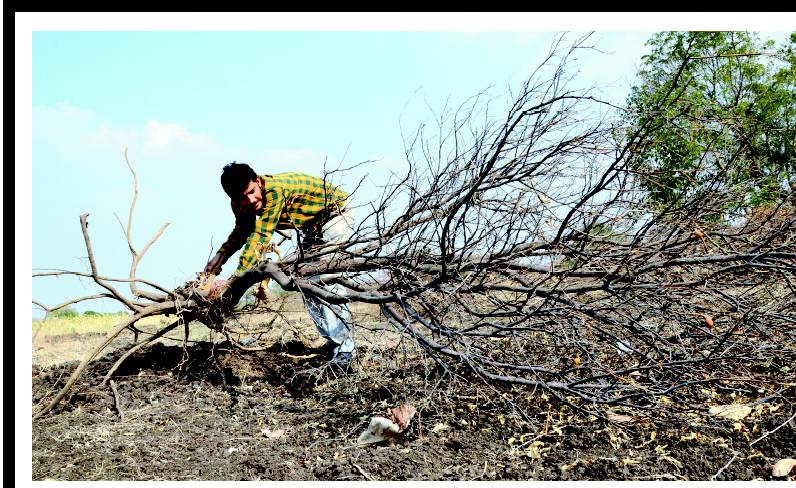
When Sweet Lime plantations over thousands of hectares died in Marathwada in the absence of water this year and when hapless farmers set their own horticultural plantations on fire as they could not bear to witness the wilting and dying trees they planted, sugarcane still continued to get water. So while there is a lobby to protect the sugarcane farmers, no such luck for other farmers.
Burnt Sweet Lime plantations in Osmanabad. Courtesy: Times of India
Once farmers have cultivated sugarcane, the sugar industries hide behind the farmers saying what will happen to the farmers if factories do not process this cane. While the risk of cultivating sugarcane and fighting for its water falls on the farmers, sugar industries are insulated from any risk, in the name of farmers and can continue crushing, using thousands of lakhs of litres of water and polluting even more water.
Is drip irrigation the ultimate solution? In the entire discourse on the costs and efficiency of sugarcane in Maharashtra, the water angle, which is of a paramount importance as demonstrated this year, is the most neglected. Institutes like Vasantdada Sugar Institute (VSI) (For every quintal of sugar generated by Sugar Factories, Rs 1 goes to VSI) and the Sugar Commissionerate seem strategically silent on this. When we contacted the drip irrigation cell in Vasantdada Sugar Institute to inquire about the area of sugarcane under drip irrigation, we were told by the person in-charge that Drip Irrigation Cell itself does not have these figures. This indicates either that this data is not available or they are not ready to share available information
Maharashtra Chief Minister and Commission on Agriculture Costs and Prices, Ministry of Agriculture have said this year that there is need to make drip irrigation mandatory for sugarcane cultivation in Maharashtra. This looks more like a band aid solution, which will continue the status quo of massive sugarcane cultivation in drought prone areas without asking if this is sustainable. In absence of such questions, drip irrigation could become a reason to continue to expand unsustainable sugar mills and sugarcane cultivation in drought prone areas, effectively using more water.
While claiming that Maharashtra has the highest efficiency of sugarcane in the country, it is forgotten that if crop duration and water consumption factors are added in the equation, Uttar Pradesh is more efficient than Maharashtra by a whopping 175%.[20] Maharashtra consumes on an average 1000 litres more water than UP to produce 1 kilogram of sugar.
In the end, while the High Court decision on releasing water for Ujani from upstream dams is welcome in one sense, the water releases from upstream dams is likely to be used up for the same unsustainable sugarcane cultivation in Solapur and along the way in Pune region. There is an urgent need to look at the bigger picture as to how in the water situation worsened so much in Solapur that the region producing most sugarcane does not have drinking water. Drought is a common phenomenon in this region for centuries, as described by the Solapur district Gazetteer. Solapur experiences drought once in every five years. In the context of climate change, rainfall will become more unreliable and drought more frequent. But if corrective steps are not taken about the unsustainable sugar boom in Solapur, we may be inviting worst disasters in future. These include encouraging sustainable cropping pattern including oilseeds, cereals and millets.
It is high time there is a public debate about why Sustainable Sugar won’t rhyme with Solapur other drought prone districts in Maharashtra. There is an urgent need to stop setting new sugar factories in these regions, review the existing ones through credible independent process and ensure that lessons learned during the 2012-13 drought are not forgotten soon.
Note: Information from Maharashtra Water and Irrigation Commission, numbers in first column as per the same report; taluka wise area figures following http://solapur.nic.in
Sub basin No
Sub Basin Name
Talukas of Solapuar in the sub basin (area of the taluka in sub-basin)
Area of Solapur in the sub-basin
Solapur area in the sub basin as % of sub basin area
Note: For some of the proposed factories where we could not get figures of crushing capacity, we have assumed it to be 2500 T/d, the normal minimum capacity. Source: Sugar Commissionarate, Pune
[1] From Staying Alive: Women, Ecology and Development, Zed books, Vandana Shiva, 1988
[7] Commission for Agriculture Costs and Prices, Ministry of Agriculture, Price Policy for Sugarcane, the 2013-14 Sugar Season Report: puts Maharashtra average productivity at 80 tonnes per hectare, Vasant Dada Sugar institute Report Dnyan Yag 2012 puts it 83 tonnes per hectare. We have assumed 81 tonnes/ hectare.
[8] Commission for Agriculture Costs and Prices, Ministry of Agriculture, Price Policy for Sugarcane, the 2013-14 Sugar Season Report: Chapter 5
[9] CACP chairman Prof Gulati clarified to us through email on April 21, 2013, the water requirement per Tonne sugarcane produced, as given in the CACP report is calculated at farm and the irrigation efficiency would depend on the source.
[12] Sakhar Diary 2013, a leading reference book for sugarcane cultivators and factories in Maharashtra.
[13] Certifying that the new factory locations are 25 km or more from the nearest existing sugar factories, as per the Dec 2012 notification from Govt of India.





 SANDRP