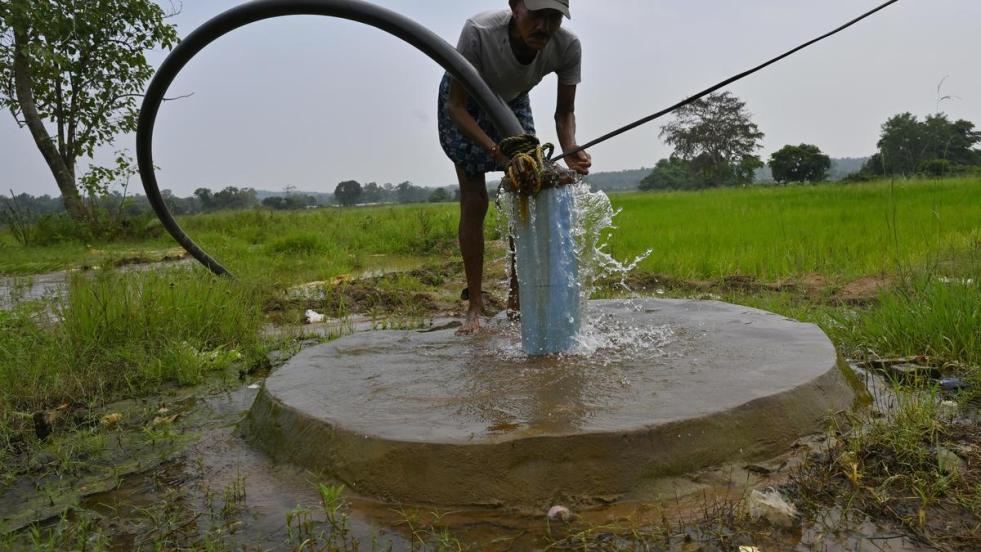
(Feature Image: Scientists call for climate‑resilient model of irrigation and food production. Credit: Nagara Gopal/The Hindu)
The reports on groundwater management in Agriculture in India in 2025, focusing on effective solutions compiled here underline the urgency to address this issue. Water-saving techniques like System of Rice Intensification (SRI), direct seeding and alternate wetting show potential but face low adoption due to non-sincere efforts from the government, reduced farm profits, while solar-powered pumps risk accelerating over-extraction, not help GW management.
Reports suggest incentive-based schemes and infrastructure improvements can help and innovative measures like converting abandoned borewells into recharge systems offer promise. However, current efforts remain skewed toward supply-side fixes, with weak focus on demand side management solutions. Broadly, the reports highlight that without crop diversification, better irrigation practices and stronger local governance, groundwater management in agriculture will remain ineffective.
Groundwater Management must put farmers first As groundwater depletes, the region must protect farmers’ livelihoods while encouraging adoption of water-saving techniques. Diesel pumps power the majority of tubewells in Nepal, Pakistan and Bangladesh (74-90%), while in India, electric pumps power around 76% of tubewells.
For sustainable groundwater management, policymakers are experimenting with alternative approaches. These include SRI, Direct Seeding of Rice and Alternate Wetting and Drying. DSR and AWD, for example, both increase weeds in fields, reducing net profits. Another approach, increasing in popularity, is powering the pumps with sunlight. Empirical assessments confirm that this increases the area under irrigation and production, the costless pumping will almost certainly encourage more pumping.
Diversify crops now, modernise irrigation For decades, experts—from the Johl Committee in 1986 to agricultural scientists today—have recommended reducing paddy, sugarcane acreage and creating stable markets for alternative crops. Farmers say they are willing to shift if the government guarantees procurement and fair prices.
Energy reform must be part of the answer. Smarter electricity pricing—paired with direct financial incentives—can curb over-pumping while protecting farmer incomes. Early results from Punjab’s ‘Paani bachao, paisa kamao’ pilot scheme show that such incentives work. They must be scaled up. Infrastructure, too, needs an urgent overhaul. With under a third of farmland receiving canal water, Punjab must remodel its British-era canal network to reduce dependence on groundwater. And in the face of worsening floods, many of the state’s 1.4 million abandoned borewells offer the rare opportunity of conversion to low-cost recharge structures to replenish depleted aquifers.
Making this water crisis national is the situation turning critical in Haryana, Rajasthan, Karnataka, Madhya Pradesh, Tamil Nadu, Uttar Pradesh, Delhi, and Puducherry, too.
Punjab’s 1.4 million abandoned bore wells can be a resource Punjab’s 1.4 million abandoned borewells offer a chance to mitigate flood damage and replenish depleting groundwater. Trials by the Indian Council of Agricultural Research-Indian Institute of Soil and Water Conservation (ICAR-IISWC) show that with some modification, borewells can become effective underground recharge systems. The process of converting a borewell into an artificial recharge system begins with preliminary hydrogeological assessment to understand the aquifer depth, groundwater quality and structural condition of the old well. After confirming that the borewell is safe and free from contamination, it is thoroughly cleaned by removing silt, debris and abandoned pump materials.
Policy correction needed in Haryana Policy responses so far have focused disproportionately on supply-side solutions — recharge structures, ponds and check dams — without addressing demand. Crop diversification away from paddy, rational pricing of electricity, micro-irrigation incentives and enforceable groundwater regulation must move to core policy. Equally important is decentralized governance. Groundwater is a local resource and its management requires community participation, transparent data and district-level accountability. Without empowering panchayats and users to monitor and regulate extraction, state-level targets will remain cosmetic. Today’s overexploitation will translate into tomorrow’s water drought. The window for corrective action is narrowing.
Scientists call for climate‑resilient irrigation & food production The free electricity driving millions of farm pumps is now responsible for an estimated 100 million tons of carbon emissions every year, while groundwater is rapidly vanishing. Policies designed decades ago to support farmers are deepening inequalities between States and communities, warn scientists. Researchers from some of the country’s leading public institutions are urging the Centre and State governments to urgently revisit the farm power subsidy and shift toward a more climate‑resilient irrigation and food production.
Can MSP Strategy Avert a Groundwater Crisis-1? This is part one of a three-part series that investigates the dominance of wheat, its consequences and whether jowar (a millet) can become a more sustainable option. A six-month investigation by contributors to Newsclick shows how wheat, fuelled by decades of State-backed incentives, dominates farmlands across India, while millets like jowar remain sidelined despite their low water requirements and outsized nutritional benefits. Over time, it faded from farms and plates. As water scarcity looms, one question persists: Can India turn back time and shift from water-intensive wheat back to millets like jowar to ensure future food security?
Part-2: Cost of wheat to Jowar shift Part 2 looks at the environmental perils of wheat cultivation and how it might reverse the fortunes of wheat and millet. Is the govt doing anything effective to incentivize farmers and consumers to shift from wheat to Jowar and other millets?
Part-3: Weak policies failed millets, favored wheat Part 3, examines why millets remain a business of loss. Major failings of the govt program to increase millet adoption include weak procurement, inconsistent incentives, and, most importantly, a lack of real financial backing.
OpinionGroundwater crisis needs more than just wells A fresh financial approach is required—one that matches the complexity and urgency of India’s groundwater crisis. First, the government must expand interest-free loans to states for capital expenditure, a policy already in place but underutilised for water conservation. Second, we must explore innovative financial instruments. Third, a pricing rethink is long overdue. Free electricity for agriculture has incentivised water-intensive crops like paddy and sugarcane, worsening GW depletion. GW governance must shift from siloed programs to an integrated institutional framework.
The 2016 Mihir Shah Committee recommended merging the Central Water Commission and the Central Ground Water Board into a single National Water Commission with multidisciplinary expertise. Nearly a decade later, this remains unfulfilled. Fragmented data collection, overlapping mandates, and lack of accountability continue to plague outcomes.
Investing in groundwater today is not a luxury—it is economic common sense. Moreover, decentralised groundwater recharge projects create rural employment and reduce climate vulnerability, offering a high return on public investment. India’s groundwater story does not have to be a tragedy. With smart financing, decentralised planning, and political will, the country can reverse the decline and secure its water future. Just as India led the world in scaling up solar power through bold financial models, it can now become a leader in sustainable water governance. Groundwater may be invisible, but the urgency to act cannot remain hidden. (Souryabrata Mohapatra & Amit Mitra)
Rethinking subsidies to drive sustainable farming Repurposing govt expenditure on paddy production and procurement or creating new incentives for millet production could encourage farmers to switch. (Amit Kapoor, Pradeep Puri and Ananya Khurana)
A critical step towards sustainability India’s groundwater story is at a crossroads. Looking for newer sources is no longer a viable solution. The way forward lies in sustainable management of the annually replenishable resource. Adopting supply side interventions like rainwater harvesting, artificial recharge, and the revival of traditional water systems. Equally critical is the need to enhance irrigation use efficiency. And adopting a cropping pattern commensurate with the local climate and terrain.
Since groundwater is a decentralised, common-pool resource, stakeholders’ involvement is a must for its sustainable management. The future of water security depends on both collective restraint and smarter planning. It’s time to treat water not as an endlessly replenishable resource, but as our collective responsibility to protect this intergenerational resource. (Bishwadeep Ghose, Dipankar Saha, Water for People India Trust)
India cannot resolve its food challenge without fixing how it uses water Water must be treated as a finite resource, not a limitless political entitlement. This requires essential reforms — rethinking subsidies, realigning procurement, pricing inputs rationally, and building trust with farmers. In an era of rising climate uncertainty, India must shift from growing crops based on political arithmetic to those based on hydrological logic and nutritional need. (Anushka Bandyopadhyay, Raktimava Bose and Saurabh Bandyopadhyay)
SANDRP

 SANDRP