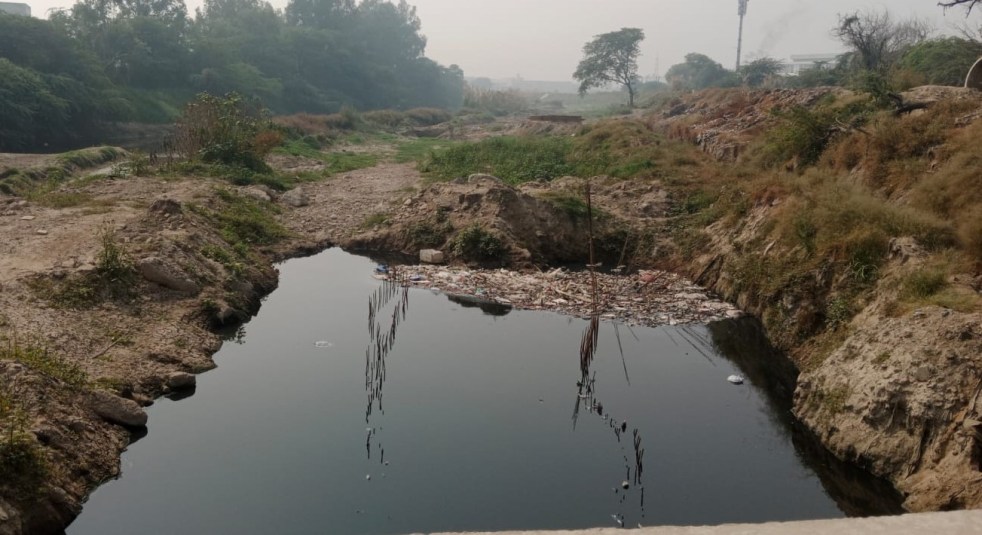
(Feature Image: A pit full of untreated effluents in Drain No. 8 in Sonipat, Haryana in Oct. 2025. Credit: SANDRP)
The annual overview compiling media reports on groundwater situation in India highlights that the crisis is only deepening across the country. Most of the reports are based on CGWB’s Annual Ground Water Quality Report 2025 revealing a dangerous mix of over-extraction and rising contamination. In agrarian states like Punjab, Haryana and Rajasthan, groundwater use far exceeds recharge, driven largely by water-intensive crops and subsidized electricity. Punjab alone extracts over 150% of its annual recharge, with most districts now classified as overexploited. Even above-normal rainfall in states like Rajasthan has failed to restore aquifers, pointing to structural failures in recharge and water management.
At the same time, there is gradual decline in groundwater quality. Punjab reports the highest uranium contamination in the country, while fluoride, nitrate and heavy metal pollution is widespread across several states. Report from Telangana shows that monsoon recharge is increasingly pushing pollutants deeper into aquifers rather than diluting them.
The impacts are already visible in terms of falling water tables, failing crops, rising farmer distress and growing public health risks. The alarming situation warns that without urgent and wide range reforms including crop diversification and better regulation to pollution control, India risks long-term, possibly irreversible damage to one of its most critical natural resources.
The essence of reports, editorials and opinions focusing on effective solutions separately compiled here also underline that agriculture continues to drive India’s groundwater crisis, with existing solutions delivering uneven results. Water-saving techniques like direct seeding and alternate wetting show potential but face low adoption due to reduced farm profits, while solar-powered pumps risk accelerating over-extraction.
It suggests incentive-based schemes and infrastructure improvements can help and innovative measures like converting abandoned borewells into recharge systems offer promise. However, current efforts remain skewed toward supply-side fixes, with weak focus on demand side management solutions. Broadly, the reports highlight that without crop diversification, better irrigation practices and stronger local governance, groundwater management in agriculture will remain ineffective.
1 Punjab ‘Early paddy transplantation likely to worsen water crisis’ The state is staring at faster depletion of groundwater with nearly 14 lakh tubewells likely to pump out billions of litres of extra water for irrigation after the government allowed paddy transplantation from June 1. The crop is cultivated on 31 lakh hectares in the state, of which 73 per cent is irrigated by tubewells. Since 2014, the transplantation of the water-guzzling crop usually started on June 15. Experts have advocated pushing paddy transplantation beyond June 20.
According to official data, every tubewell extracts 30.24 lakh litres of groundwater per week with an average eight hours of power supply. This means the 14 lakh tubewells are likely to pump out 4,385 billion litres of groundwater per week. PSPCL figures show 13.94 lakh tubewell connections in Punjab, a majority of which are located in the districts with overexploited groundwater.
Paddy sowing area continues to expand With the advancement of paddy sowing starting earlier as compared to previous years since the passing of the Punjab Preservation of Subsoil Water Act 2009, the paddy cultivation in Punjab has been completed on 22.47 lakh hectares till date (July 02, 2025), up from 18.09 lakh hectares during the same period last year — an increase of 4.38 lakh hectares. The latest data highlights that paddy acreage this year too will see an increase despite the state government’s ongoing efforts to diversify from water-guzzling crops.
In contrast, the area under maize cultivation, which the government has been promoting as a water-saving alternative to paddy, has seen only 66,334 hectares this year till July 2, 2025 as against last year’s around 80,000 hectares in the season. The sowing of maize still continues. The total maize area is around 3 per cent of the total paddy area, underlining the continued dominance of paddy in Punjab’s cropping pattern.
Maize: A double-edged sword for groundwater crisis Kharif maize is less water-intensive due to the monsoon season and needs just three to four irrigations throughout the season, making it one of the best crops to reduce Punjab’s reliance on groundwater. Despite its potential, the area under kharif maize has declined in recent years — 1.05 lakh hectares to 1.30 lakh hectares for over a decade to just around 80,000 hectares in 2024 — far below than 5.5 lakh hectares under the maize cultivation suggested by experts, including PAU scientists, as part of the state’s crop diversification strategy.
Maize, particularly in the kharif season, yields significantly less than paddy — about 20 to 22 quintals (dry) per acre compared to 30 and above quintals per hectare of paddy. Additionally, maize does not enjoy the government procurement support as does paddy. Despite heavy irrigation requirements, spring maize is gaining ground among farmers due to higher yields.
Govt forgot to start crop diversification projects In its 2024-25 budget, the government announced the Punjab Horticulture Advancement and Sustainable Entrepreneurship (PHASE) scheme with an allocation of Rs 5 crore. In its earlier budget, (in 2023-24), the government had proposed a price risk mitigation scheme titled Bhav Antar Bhugtan Yojana to cushion horticulture growers against market price fluctuations. However, neither has any work started on the ground for the two schemes nor has there been any mention of the two in the recent budget. Government sources said that a committee was to be formed to study PHASE scheme, however, to date, no such committee has been constituted.
19 districts in dark zone: MP Sandhu Raising the issue during the Question Hour in the Rajya Sabha, Rajya Sabha MP Satnam Singh Sandhu on March 09, 2026 said 19 out of the 23 districts in Punjab were classified as dark zones, meaning groundwater resources in these areas are severely over-exploited.
2 Haryana Groundwater crisis worsened by subsidised tubewell irrigation Failure of government policies meant to aid farmers seems to be making the situation worse. Subsidised electricity, poor distribution of canal water, and lack of funding for micro-irrigation means groundwater levels continue to drop as farmers drench fields in groundwater that is running out fast. Districts where subsidised electricity used for agriculture is the highest are among the most water-stressed, and also among the top 10 districts growing paddy and wheat, our analysis shows. If water use is not regulated, the state could soon run out of groundwater to meet the basic needs of the farmers.
Ground water level down 5.41m in 10 yrs Haryana has witnessed an average decline of 5.41 meters in its ground water table in 10 years from 2014 to 2024, the most in Ambala, the state government informed the Assembly on March 19, 2025 from -10.5 metres in June 2014, Ambala saw its groundwater level drop to 29.25 metres in June 2024. State irrigation and water resources minister Shruti Choudhry made a written statement to the Assembly in this regard.
The minister said: “Haryana is a water deficit state with respect to surface and ground water resources. The ground water level in the state particularly in the freshwater zone is depleting fast due to heavy exploitation and is a very serious problem. Increasing demand and scarcity of groundwater resources underlines the importance of artificial recharge and water conservation. The state average decline in water table from June, 2014 to June, 2024 is -5.41 meters.”
Groundwater extraction stands at around 136% of its annual recharge. The state has an annual extractable groundwater resource of about 9.3 lakh ham, but actual extraction is estimated at around 12 lakh ham.
Across Haryana, several districts reported severe groundwater stress. Panipat recorded one of the highest extraction levels at 217.8%, followed by Karnal at 196.9%. Other districts with high extraction levels include Fatehabad (175.3%), Mahendragarh (156.8%), Faridabad (139.6%) and Ambala (130.1%), according to the report. Some districts, however, remain in relatively safer categories. Rohtak recorded an extraction stage of 48.8%, Panchkula 62%, Jhajjar 72.7% and Nuh (formerly Mewat) 72.3%, indicating comparatively lower groundwater stress.
CGWB assessment evaluated 143 groundwater assessment units across Haryana, of which 88 (61.5%) were classified as “over-exploited”, 11 as “critical” and eight as “semi-critical”. Only 36 units (25.1%) fell in the “safe” category, according to the report.
3 Rajasthan 70% units overexploited despite record rain The CGWB’s Annual Report for 2024–25, based on data from June 2024 to March 2025, shows that 214 of Rajasthan’s 302 assessed groundwater units are overexploited, where extraction far exceeds recharge. Only 37 units, or 12.25%, remain in the safe category, while 21 are semi-critical and 27 critical, showing little improvement from the previous year and reinforcing a worsening trend.
The scale of the crisis stands out because it has persisted despite unusually high rainfall. Rajasthan recorded 678.4 mm of rain between June and September 2024, or 156% of its long-period average, making it one of the wettest seasons in recent years. August alone saw the second-highest monthly rainfall in the state’s recorded history. Even so, groundwater levels have not recovered.
The mismatch is stark at the district level. Dausa, which received the highest rainfall in the state at around 1,409.4 mm in 2024, has all five of its groundwater blocks — Lalsot, Dausa, Bandikui, Sikrai and Mahuwa — classified as overexploited. Sawai Madhopur, the second-highest rainfall district with about 1,285 mm, has four of its six blocks in the overexploited category. The figures point to a deeper problem: heavy rainfall is not translating into groundwater recharge, exposing structural weaknesses in water use and management.
Barmer’s groundwater falling despite ₹1,500cr pumped in 3 years Rajasthan’s drought-prone Barmer district has the highest number of groundwater recharge structures built under the Jal Shakti Abhiyan scheme of the Union Ministry of Jal Shakti (water resources). The 47,000 structures consisting of rooftop rainwater harvesting, trenches, ponds, tanks and check dams from 2021-2024 were constructed at a cost of Rs 1,300 crore, according to the official dashboard for the scheme. This figure stands in stark contrast with the reality: There has been no increase in the groundwater levels in Barmer district, according to the reports of the CGWB. In fact, most of the monitoring stations in the district reported a decline in groundwater levels in the last decade from 2014 to 2024.
Farmers pushed into debt, distress and migration This story was based on a decadal analysis of groundwater use from 2013 to 2023 using data from the CGWB’s Ground Water Resource Assessment. The CGWB has since released its 2024 report. Overexploitation of groundwater over decades has pushed the levels to an irreversible state, forcing many farmers to leave agriculture as wells run dry. Initiatives like micro-irrigation and farm ponds have proven too little, too late. Rajasthan, India’s largest state by area, is racing toward a groundwater crisis. While other states have slowed water extraction, as of 2023, Rajasthan was pumping 16.74 billion cubic metres annually, of which 80% was used for irrigation. Farmers face failing crops, dried-up wells, and rising debts.
– “None of these solutions — millets, farm ponds, sprinkler — will make a real difference. Let me be honest,” says the scientist from the CGWB. “The water that took thousands of years to accumulate has been drained in just 10-20 years.” Emphasising that irrigation is the main culprit, he explains, “While we regulate groundwater for housing and industry, irrigation gets a free pass. Politicians don’t want to upset farmers — even though irrigation wastes the most water and hits farmers the hardest.” He warns, “Until the water is completely gone, farmers won’t stop.”
4 Telangana Red zone of overexploited water basin increases by 36% A 22% excess rainfall has ensured that the water table in Telangana is at 10.17 metres below ground level (BGL) as against the last year’s [2024] depth of 10.51 metres (BGL) and decadal average of 10.88 metres BGL, according to Telangana Groundwater Department. While this presents a rosy picture about the ground water table, the Ground Water Resource Assessment of the State as a whole raises worrying questions. “Nearly 500 villages in the State are overexploiting the ground water resources. This is dangerous as the levels of harsher chemicals like fluoride increase in the water as the water table goes down,” said K. Laxma, Director, Telangana Ground Water Department.
The water table showed a rise in 440 mandals (72%) and a drop in 172 mandals (28%). More worryingly, deep-water level area (greater than 20m) increased by 1262 sqkm or 36%: from 3452 sq km to 4714 sq. km. Once an area is declared as having over-exploited groundwater basin, an automatic six-month ban on sinking of new borewells kicks in under the Telangana Water, Land and Trees Act of 2002: “No well shall be sunk in such areas except wells sunk for public drinking purposes or hand pump for public or private drinking water purposes.”
“Telangana has 85% land that has the subsurface of igneous rock, which is hard and has limited permeability. Only 15% land in the State has sedimentary and metamorphic rock surface with greater permeability. This is a limiting factor for the recharge of ground water. Aggravating the situation, the anthropogenic activity with road surfaces and concretisation has led to increased runoffs reducing the recharge of aquifers,” says Mr. Laxma.
Scientists call for smarter groundwater management Although the State receives an average annual rainfall of 960 mm, only about 10–15% contributes to groundwater recharge due to geological formations, land use and land cover patterns, and erratic rainfall – all of which result in a non-uniform and heterogeneous recharge scenario.
In a joint study, scientists found that the average annual groundwater recharge in Telangana is approximately 14.3 billion cubic metres (bcm). Of this, around 11.36 bcm is attributed to primary recharge from rainfall, while the remaining 3 bcm comes from secondary sources such as seepage from surface water bodies and return flow from irrigated fields.
Interestingly, the study found that even with ample rainfall in two consecutive years, recharge levels were significantly lower in the second year. Conversely, a drought year followed by favorable rainfall tends to result in increased recharge.
5 Andhra Pradesh Irrigation accounts for 86% of total groundwater extraction A groundwater resource assessment has estimated Andhra Pradesh’s annual groundwater extraction in 2024 at 7.88 billion cubic metres (bcm). The study was a collaborative effort between AP ground water dept and CGWB. The assessment indicates that irrigation accounts for 86% of the total groundwater extraction, domestic use comprises 13%, and industrial use represents the remaining 1%.
The state’s total annual groundwater recharge in 2024 was estimated at 27.8 bcm. Of this, 1.39 bcm was allocated for natural discharge, leaving 26.41 bcm as the extractable groundwater resource. Recharge from other sources, such as canal seepage, return flow from irrigation, and recharge from tanks, ponds, and water conservation structures, contributes 17.97 bcm, which is about 65% of the total recharge.
The remaining 9.82 bcm, or 35%, comes from rainfall. Seasonal data shows that out of the recharge from other sources, 39% occurs during the monsoon and 26% during the non-monsoon period. Rainfall-based recharge contributes 32% during the monsoon and just 3% during the non-monsoon season. Despite the scale of groundwater usage, the overall extraction rate remains at 29.83%, which means AP uses less than a third of its available annual groundwater resource.
In terms of groundwater volume, of the 26.41 bcm of annual extractable resources, 0.26 bcm (0.99%) are drawn from ‘over-exploited’ units, 0.066 bcm (0.25%) from ‘critical’ units, 0.89 bcm (3.4%) from ‘semi-critical’ units, and 25.05 bcm (94.87%) from ‘safe’ units.
Water gains risk drying up under cash crop pressures Farmers in Andhra Pradesh shifted from monocropping to crop diversification, with micro-irrigation reducing water use. Despite this, cash crops dominate due to market pressures and flawed government incentives. Newer ways of regulating groundwater use, like water budgeting and borewell collectives, may hold the key to addressing the issue.
6 Karnataka Depletion continues As per the latest Dynamic Groundwater Resource Assessment – 2024, 45 taluks across Karnataka have been classified as severely overexploited, with 27 of them in Bengaluru Urban, Bengaluru Rural, Chikkaballapur, Kolar, Ramanagara, and Tumakuru. Kolar topped the list with an extraction rate of 193%, followed by Chikkaballapur (164%), Bengaluru Rural (147%), and Chitradurga (144%).
The findings are part of a larger assessment covering 237 taluks statewide, where groundwater extraction has crossed sustainable limits. While 45 taluks are categorised as overexploited (exceeding 100% usage), another 15 are listed as critical (90–100%), 33 semi-critical (70–90%), and 144 fall in the safe category (under 70%). Water quality too is a major concern. The report flags contamination in 85 taluks, identifying 17 for high salinity, 41 for excess nitrate, 15 for fluoride, and 12 for traces of uranium.
Activists have long raised red flags, especially in chronically affected areas like Kolar and Chikkaballapur. “People have to dig borewells for more than 700 feet at many places in these districts and still get contaminated water. These districts have no alternative sources for drinking water,” said R Anjaneya Reddy, president of Shashvatha Neeravari Horata Samithi. Reddy alleged that the CGWB has been flagging overexploitation in these areas since 1987, but successive govts have failed to offer permanent solutions.
Responding to the findings, minor irrigation minister NS Boseraju said, “CM Siddaramaiah has allocated Rs 1,000 crore more for the minor irrigation department. We will construct more scientific check dams at logical places and introduce more schemes to recharge groundwater.”
100% plus extraction in 5 districts Five districts in Karnataka, including Bengaluru Urban, have worrying groundwater extraction levels of over 100%, even as the state as a whole has seen an improvement when compared to the previous estimation by the Union government. As per the official data accessed by DH, Kolar (193.35%) leads the districts with overexploitation of groundwater, followed by Bengaluru Urban (186.7%), Chikkaballapura (164.33%), Bengaluru Rural (147.05%) and Chitradurga (144.44%).
Groundwater: Unsafe tomorrow? Between 2022 and 2024, 150 taluks recorded an average 10m improvement in groundwater levels, followed by 70 taluks showing 5m improvement. Notably, six overexploited, four critical, and 10 semi-critical taluks have been downgraded to safer categories, indicating aquifer recovery. Minor irrigation department has constructed 8,342 water conservation structures and maintained 3,787 tanks, conserving 126 TMC (thousand million cubic feet) of water. Together, with 472 lift irrigation schemes, these efforts have rejuvenated 1,318 lakes and created an irrigated area of nearly 97,600 hectares.
Despite these gains, experts warn that recovery is fragile. Much of the improvement comes from artificial recharge and reuse schemes, which are energy- and infrastructure-intensive. They depend on continued funding, proper maintenance and community participation. Moreover, local groundwater improvements are often offset by unsustainable pumping. Without stronger regulation, digital monitoring and groundwater literacy, Karnataka’s “safe” status could quickly deteriorate.
Groundwater level declines in Chamarajanagar The groundwater table in Chamarajanagar district has fallen by 13.2 metres, raising concern among farmers and officials. The level, recorded at 11.2 metres two years ago, has continued to drop due to increased drilling of borewells for agriculture and commercial purpose, as well as changing rainfall patterns in the drylands. The groundwater level slumped 2 metres in the last two and a half years alone.
Deeper issues persist While the government claims that this increase in groundwater is the result of filling up lakes, desilting works and other projects taken under MGNREGS, experts say excess rainfall in the last five years has only ensured that the surface-level water has improved and not the deeper aquifer that could improve long-term availability of groundwater.
Groundwater Authority has just two geologists The Karnataka Groundwater Authority, against 440 sanctioned posts, currently has just 49 permanent staff and 30 outsourced workers across the state — meaning an 82% vacancy. Bengaluru residents frequently raise complaints about illegal borewell drilling and groundwater exploitation. Yet, officials say the watchdog is “functionally paralysed.” Shockingly, only two geologists serve the entire city, a number that the officials describe as “severely inadequate.” The agency currently responds only to public complaints rather than proactively monitor borewell activity; a practice that the officials admit is insufficient for a city with rapidly declining groundwater levels.
7 Tamil Nadu Groundwater level dips in 13 districts A total of 13 districts in Tamil Nadu have recorded a fall in their groundwater level in May 2025 compared to May last year, according to data compiled by the Water Resources Department (WRD) for 37 districts barring Chennai. The sharpest fall was witnessed in the delta district of Thanjavur, where the groundwater level has gone down by 2.51 metres. While the availability was at 1.9 metres in May 2024, it dropped to 4.41 metres in May this year. This is despite ample rain in the monsoon and Karnataka releasing more water in Cauvery due to bountiful rains, which ensured adequate release of water for irrigation in the delta region.
A senior official from WRD told TNIE that despite availability of river-based irrigation systems in the delta and western regions, many of the farmers still use borewells due to easy availability, leading to faster depletion of groundwater levels. In Erode and a few other western districts, officials said farmers prefer growing high-value crops such as turmeric, betel vine, banana, and vegetables, which are water intensive. As a result, the use of groundwater in these areas is very high, they added.
It may be noted that the WRD has presented a proposal to carry out village-level study of aquifers in three districts for a more granular understanding of the issue so that localised plans can be devised to tackle the issue. “To improve the situation, we (WRD) have taken steps such as building check dams, and desilting ponds, canals, and lakes to help recharge groundwater,” the official added.
V Ravichandran, a farmer from Tiruvarur, said that changing weather patterns and erratic rainfall have worsened the situation and have made farmers rely on groundwater, which is also depleting fast. He urged the state government to take effective steps to promote rainwater harvesting across the state. “It is also essential to desilt small waterbodies like ponds and lakes to improve water storage and groundwater recharge,” he added.
34% of GW overexploited Tamil Nadu is among the states worst affected by groundwater overexploitation, with 106 assessment units—33.87% of the total of 313—classified as over-exploited, according to a comprehensive report of the Central Ground Water Authority (CGWA) submitted before the NGT. The CGWA report, which was based on the data provided by every State in June 2025 in a specific format, says that, in Tamil Nadu, while NOCs for drawing groundwater in over-exploited and critical areas are restricted to domestic use, infrastructure development, and non-water-intensive industries, the enforcement of these norms has been inconsistent.
A total of 492 illegal groundwater extraction units were sealed in the state based on orders from the Madras High Court. However, unlike other states such as Punjab and Haryana, Tamil Nadu has yet to introduce provisions for pricing or environmental compensation for illegal groundwater extraction. “There is no provision for collecting Environmental Compensation under existing regulations in Tamil Nadu,” the CGWA noted. “NOCs have only been issued to water-based industries located in safe and semi-critical areas, not in over-exploited ones.” Within the State, Chennai, Salem, Coimbatore, Dindigul, Mayiladuthurai, Vellore, and Tirupattur districts are the worst affected. For instance, out of 16 groundwater assessment units in Chennai, 13 are over-exploited, which is 81.25%.
Meanwhile, the CGWA has pulled up 8 states and Union Territories—including Delhi, West Bengal, Telangana, Pondicherry, and Jammu & Kashmir—for failing to provide requested data despite multiple reminders and a clear directive under Section 5 of the Environment (Protection) Act, 1986. The CGWA has requested the NGT to issue directions to the defaulting states and stressed the need for urgent compliance.
Farmers flag reduced subsidy to build underground water tanks Farmers are aggrieved as the subsidy for constructing underground water tank has been reduced from Rs 350 per cubic metre to Rs 125. “To overcome this, the Supplementary Water Management Activities (SWMA) project has been providing subsidies for constructing underground water tanks, which are used to store water for drip irrigation. It costs a maximum of Rs 40,000 to build a tank, Rs 10,000 to lay pipes and Rs 15,000 to install a pump set. Many farmers showed interest in this project and benefited from it.
Meanwhile, this subsidy was reduced and now, Rs 125 per cubic metre is provided to construct a tank with clay or polythene sheet under the National Horticulture Mission,” he added. “If a farmer constructs a cement tank, it costs around Rs 1,000 per cubic metre, totaling Rs 4 lakh for a tank with 1.14 lakh litre capacity. The government provided subsidy of Rs 350 earlier, which was useful. But the current subsidy is very less,” he said.
8 Goa 65% increase in groundwater extraction in 12 years The report titled ‘Dynamic Groundwater Resources of Goa, 2023’ highlights that the groundwater extraction increased from 4,114 hectare-metres (ham) in 2011 to 6,775 ham in 2023. The surge in extraction is attributed to a rise in the number of abstraction structures, including borewells and other manmade systems. Bardez and Mormugao talukas have recorded the highest groundwater extraction levels compared to the availability of resources. The total rechargeable fresh groundwater resources have been estimated at 39,624.4 ham, with the annual extractable resource pegged at 31,699.5 ham. The report states that domestic use accounts for 56% of groundwater extraction (3,818.8 ham), followed by irrigation at 37% (2,484.8 ham), and industrial purposes at 7% (471.5 ham).
A comparison between 2020 and 2023 shows a 2% increase in rainfall recharge, recharge from other sources has decreased by 40%. Of the total recharge from all sources (39,624.4 ham), rainfall remains the major contributor with 35,951 ham, followed by water conservation structures (1,349.2 ham) and surface water irrigation (815.8 ham). The availability of groundwater for future use across Goa stands at 24,740.2 ham, with Mormugao taluka recording the lowest availability at 1,021.7 ham and Salcete taluka the highest at 3,040.6 ham. The report emphasizes that while groundwater availability remains sufficient for now, continuous monitoring and sustainable management practices are essential to prevent over-extraction and maintain resource balance.
9 Ladakh GW recharge dips by 22%, extraction rates improve: CGWB report According to the report released by CGWB on 31 Dec. 2024, annual groundwater recharge in Ladakh has decreased from 0.09 bcm in 2023 to 0.07 bcm in 2024, indicating a reduction of 0.02 bcm. This represents a decline of approximately 22.22% compared to the previous year. This reduction reflects challenges in natural recharge processes, likely influenced by factors such as reduced snowfall, changing precipitation patterns, or altered hydrological conditions in the region.
Despite this, groundwater extraction decreased by 33% (from 0.03 bcm to 0.02 bcm), lowering the Stage of Extraction from 37.05% to 30.93%, signaling progress in conservation efforts. Of the 18 blocks across Leh and Kargil districts, 17 are now categorised as “safe” for groundwater use. Only Diskit block in Leh is labeled “semi-critical”, requiring urgent monitoring. In addition, 90.65% (873 sq km) of Ladakh’s recharge-worthy areas fall under “safe” zones, with just 9.35% (90 sq km) deemed “semi-critical.”
10 Uttarakhand State ‘rice bowl’ hit as groundwater drops 70ft in past decade Udham Singh Nagar, the agricultural heartland, famed as the state’s “rice bowl,” is facing an escalating crisis. According to the CGWB, two areas in the district – Jaspur and Kashipur – have been classified as “critical,” with Rudrapur, the district headquarters, witnessing an alarming 4-m annual groundwater decline. Over the past decade, the water table has dropped by 70ft, as per estimates.
Spanning 3,055 sq km in the Terai region, the district produces over 4.4 lakh metric tonnes of rice annually across 1.5 lakh hectares (ha), alongside wheat and sugarcane. Yet, its 1.5 lakh farmers are battling adversities including a sharp groundwater decline, extreme weather conditions and delayed payments, which threaten their livelihoods.
Reports on GW Contamination
96 districts hit by water contamination A parliamentary panel has raised concerns over water contamination issue in the country, highlighting that 11,348 habitations in 96 districts across seven states have not been provided with short-term measures for pollutants such as iron, nitrate, and heavy metals. The committee has called for urgent and long-term interventions to safeguard public health.
Telangana Monsoon recharges pushing more pollution into GW This was a disturbing finding revealed in the ‘Groundwater Quality Year Book of Telangana State, 2025’, released by the MoJS. The report, which provides data from 2017 and 2024 for pre and post-monsoon groundwater quality for various parameters in the state, said pre-monsoon excessive fluoride levels were found in Nagarkurnool, Rangareddy, Yadadri Bhuvanagri, Jangaon, Warangal, Hanamkonda, Hyderabad, Medchal Malkajgiri & Nalgonda districts. Overall excessive levels, the report said, were predominantly found in parts of Hanamkonda, Warangal, Jagtial, Jangaon, Nagarkurnool, Karimnagar, Khammam, Rangareddy, Nalgonda districts.
It is clear that between 2017 and 2024, a significant increasing trend was observed with respect to the number of locations having fluoride more than the permissible limit. In addition to geological factors, the increasing fluoride content in groundwater in Telangana could be due to “anthropogenic (human) activities which include excess use of fertilisers, and industrialisation,” the report said. Another vital parameter — electricity conductivity — in groundwater which is impacted by presence of total dissolved solids, also showed a rise post-monsoon. Of the 363 locations from where samples were analysed for this property, it was found that this rose in 170 locations.
Andhra Pradesh CGWB report flags widespread contamination The groundwater quality alerts issued by the CGWB during June 2024–March 2025 highlighted the high incidence of nitrate, iron, fluoride, chromium, cobalt, manganese, nickel, zinc, arsenic, selenium, cadmium, lead, and uranium, with notable concerns in Andhra Pradesh and eight other States. Andhra Pradesh and some other States were found to be facing seawater intrusion in coastal aquifers, which was attributed to high levels of electrical conductivity.
Over 26% groundwater samples with high RSC levels Andhra Pradesh has recorded 26.87 per cent of groundwater samples with Residual Sodium Carbonate (RSC) levels above the permissible limit of 2.5 meq/L (milliequivalents per liter), according to the Annual Ground Water Report 2025. The State’s percentage is higher than the national average of 11.27 per cent, placing it among the most affected States along with Delhi at 51.11 per cent, and Uttarakhand at 41.94 per cent. The report evaluates groundwater quality, seasonal changes and irrigation suitability. Nationally, the assessment found that groundwater remains largely suitable for irrigation.
Punjab 62.5% Groundwater contaminated with Uranium A new national assessment reveals that 62.5% of groundwater samples in Punjab exceeded the safe limit (30 ppb) for uranium following the monsoon, 53.04% before the monsoon, the highest contamination intensity recorded across the country. Haryana also reported significant levels, with 15% of pre-monsoon and 23.75% of post-monsoon samples above the limit, followed by Delhi, Karnataka, and Uttar Pradesh. The Annual Ground Water Quality Report 2025 by the Central Ground Water Board (CGWB), places Punjab and Haryana among the states most critically affected by multiple pollutants, including heavy metals and widespread agricultural run-off.
Unsafe uranium in groundwater doubles in 6 years Figures presented in the Rajya Sabha on March 23, 2026 reveal that 53.04% of groundwater samples in Punjab in 2024 had uranium levels above the prescribed safe limit of 30 parts per billion (ppb), up from 24.2% in 2019. In a written reply, Union minister of state for jal shakti Raj Bhushan Choudhary said the spike marks a significant increase from 32.6% in 2023, underlining a worsening trend in the state. Punjab now has the highest share of uranium-contaminated groundwater samples in the country.
Haryana also reported contamination, though at lower levels, with 15% samples exceeding the limit in 2024, down from 18.7% in 2023. At the national level, 6.71% of 3,754 groundwater samples analyzed in 2024 were found to have uranium above permissible levels, up from 3.04% in 2019.
Punjab’s groundwater stress remains among the highest in the country, with extraction at 156.36% of its annual recharge — the highest nationally — followed by Rajasthan (147.11%) and Haryana (136.75%). The national average stands at 60.63%.
Alarming uranium level in Bathinda groundwater High concentration of uranium has been found in groundwater in several parts of Bathinda district, raising concerns over potential long-term health risks for resident’s dependent on borewells and hand pumps for drinking water.
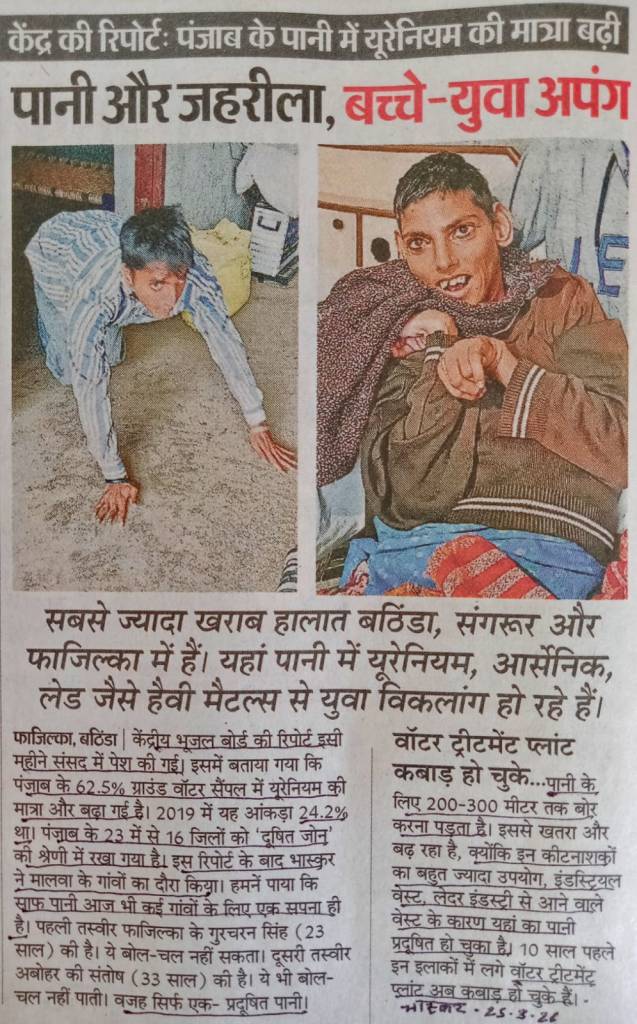
Dainik Bhaskar March 23, 2026 report referring to CGWB assessment on rise in heavy metals contamination in groundwater samples in Punjab which is affecting the affecting health of people.
Uttar Pradesh ‘Excess fluoride’ in Sonbhadra’s groundwater The issue of excess fluoride in Sonbhadra’s groundwater was first discovered in 2013. The administration has made arrangements to supply treated surface water to the affected villages via over 800 tankers. When the PM launched the Jal Jeevan Mission in 2019, the same thing was done on a large scale. A detailed study on the district’s water sources was conducted, following which 12 schemes were prepared to provide clean water to the locals, says the DM.
Bihar Severe contamination in 30, 207 rural wards: Report The report, which was recently tabled in the assembly as part of the Bihar Economic Survey (2024-25), highlighted the presence of arsenic in groundwater in 4,709 such wards, fluoride in 3,789 wards and iron in 21,709 wards. “Around 26 per cent of the rural wards in 31 districts, out of a total of 38, have groundwater sources affected by arsenic, fluoride and iron contamination beyond permissible limits,” the state’s Public Health Engineering Department (PHED) said in the study.
Madhya Pradesh Fluoride, Iron levels found in excess in many districts: Report Much to concern for public health, several locations in the districts of Alirajpur, Chhindwara, Dewas, Dhar, Katni, and Mandla have reported fluoride levels in groundwater exceeding the permissible limit of 1.5 mg/l, making it unsafe for human consumption. This is stated in report of Dynamic Ground Water Resources of Madhya Pradesh 2024. The report further states ground water from observation wells in major parts of the state shows fluoride level below 1.0 mg/l. The report also highlights concerns regarding groundwater hardness, which is mainly due to the presence of calcium and magnesium bicarbonate, sulfate, and chloride ions.
Govt ignores GW tests after UCC clean-up Environmentalists have raised concerns over the indifferent attitude of state agencies for not testing groundwater quality following the cleanup. In January 2025, 350 MT chemical waste from UCC plant was transported to Pithampur for incineration. Dr SC Pandey, environmentalist, said, “Before cleanup, multiple groundwater tests were conducted around plant site to assess water quality. It is pathetic that government is now uninterested in any tests that could build confidence and ease panic among gas tragedy survivors living nearby. This monsoon is the first after cleanup, so government should act in interest of survivors.”
Rajasthan Farmers issue 20-day ultimatum over ethanol factory The Mahapanchayat demanded the closure of Asia’s largest ethanol factory being planned in Rathikhera village of the Tibbi area. Farmer organisations allege that the ethanol factory will hurt the region’s water resources, environment, and agriculture, which has caused great anger among the local farmers. Farmers argue that the ethanol factory will lead to a decline in groundwater levels and cause air and water pollution, which will adversely impact agriculture and the local environment.
Rajasthan water risk for beverage giants In Rajasthan, global beverage companies face shrinking water supplies, strict government rules, and local anger as many residents receive piped water only once a week.
Himachal Pradesh Villagers demand closure of Pepsi plant Residents of Malot and Kandrori villages in Kangra district have stained protest against Varun Beverages Limited, the Pepsi bottling partner, alleging violation of groundwater that threatens their water security and livelihoods. The Panchayats of both villages have passed resolutions demanding urgent action, with villagers company’s operations are already reducing groundwater levels.
Residents protest against India’s first API plant over pollution claims Around 1,000 people staged a protest and rally in Nalagarh on March 23, 2026, accusing pharmaceutical firm Kinvan Pvt Ltd of causing water, air and noise pollution. The demonstrators, many of them women from 10 to 15 nearby villages, alleged that the company was violating environmental norms and demanded that the unit be shut down. Protesters claimed that wastewater from the facility had polluted groundwater and caused a persistent foul smell in the area. The company’s Active Pharmaceutical Ingredients (API) unit, which was inaugurated in 2024 in Plasda village by PM Modi, was the first of its kind in India.
Groundwater quality concerns in Baddi-Barotiwala-Nalagarh Industrial Belt This region, known for its natural beauty and biodiversity, has undergone rapid industrialization, raising questions about environmental safety. Studies indicate that contaminants from industrial activities may be affecting groundwater reserves, which serve as a critical resource for both human consumption and agricultural use. The findings underscore the need for continued monitoring of water quality to assess long-term implications for public health and environmental sustainability in the region.
Tamil Nadu Erode: Contaminated ground water, dying farms In the Perundurai region, residents say decades of industrial activity in the State Industries Promotion Corporation of Tamil Nadu estate have contaminated groundwater, ponds and lakes, forcing communities to abandon traditional farming and depend on distant water sources. In Eludhingalpatti village, a well that once sustained residents, now stands shut, bearing a warning that the water is unfit for consumption.
Haryana Tanks battle polluted groundwater In Haryana, groundwater pollution has led people to build underground tanks that are fed by expensive water tank services whose costs escalate in summer. Ashok Kumar talks to residents to understand the extent of the problem, and to government officials, who claim that piped water supply has solved the issue.
Report Hidden cost of polluted groundwater The World Bank estimates that environmental degradation, largely from polluted water and soil, drains India of nearly $80 billion each year, around 6% of GDP. Health costs from unsafe water run into billions annually, while waterborne diseases result in millions of lost working days. The link between contamination and human capital loss is especially alarming. In Gujarat’s Mehsana district, fluorosis has disabled workers, reduced their earning capacity, and plunged households into cycles of wage loss and medical bills. Across the country, diarrhoeal illnesses still kill hundreds of thousands of children under five each year. Beyond these health tragedies, the consequences represent a steady erosion of India’s most valuable resource: its people.
GW contamination is fuelling chronic illnesses Groundwater pollution is silent, invisible, and slow—but its damage is irreversible. With over 600 million people depending on it every day, this is a public health emergency, not just an environmental issue.
Some Relevant Reports on GW Depletion
Groundwater crosses ‘over exploited’ mark Delhi has one of the lowest groundwater levels in the country, trailing Haryana, Punjab and Rajasthan, according to data released by the Reserve Bank of India (RBI) in the 10th edition of Handbook of Statistics on Indian States, 2024-25. The Capital has crossed the ‘over-exploited’ mark in 2024 and 2017, and was close to it in 2023 and 2020. The CGWB categorises an area as ‘over-exploited’ when groundwater extraction exceeds 100 per cent, meaning annual consumption has surpassed recharge.
India’s groundwater is under stress A Rajya Sabha response by Minister of State for Jal Shakti Raj Bhushan Choudhary lists Punjab, Rajasthan, and Haryana as the states that extract more groundwater each year than what is available. Punjab withdraws about 56 per cent more groundwater than what is available each year, while Rajasthan uses 47 per cent more. For Haryana, it’s about 37 per cent more. Delhi draws close to its annual limit, and Puducherry uses over three-quarters of what it can safely extract. These numbers show how heavily these regions depend on groundwater for farming and daily use.
Crisis worsening The Annual Ground Water Quality Report 2025, released by the CGWB, confirms that the crisis is no longer confined to a few states or pollutants. India is now confronting a multi-contaminant emergency, with several regions simultaneously exceeding safe limits.
Maharashtra Cotton exports could threaten GW Cotton is one of India’s top agricultural exports and between 2011-12 and 2020-21, the country’s cotton exports consumed roughly 40 trillion litres of water. Top cotton-producing districts in Maharashtra, the second leading state for cotton production, extract dangerously high levels of groundwater. Experts suggest a comprehensive approach to solve the groundwater problem, including groundwater monitoring, water rationing, and policy changes to support sustainable cotton farming.
Kerala Cardamom farming turns unsustainable In Kerala, 6 out of every 10 hectares of farmland are dedicated to coconut, rubber, rice, cardamom, and other cash crops. While they have brought economic prosperity, they come at an environmental cost—depleting water resources and stripping the soil of nutrients.
Report Thirsty crops draining groundwater across country Farmers in Tamil Nadu, Gujarat, Rajasthan are growing more water-thirsty crops – rice, wheat, and onion – draining groundwater.
AI data centers feared to worsen water stress India is emerging as a key hub in the global race to scale up artificial intelligence, leading to rapid data center expansion across the country. But this infrastructure surge carries a large burden on neighboring communities in the form of water scarcity.
Invisible Employer Groundwater, long treated as a private convenience, has quietly underpinned millions of days of casual farm work across India. As water tables fall, that “employer” is showing up less at the village gate: fewer transplanting seasons, shorter harvests and less demand for daily wage labour. The result is not only ecological stress but a mounting labour-market shock for the most precarious rural workers.
SANDRP

 SANDRP