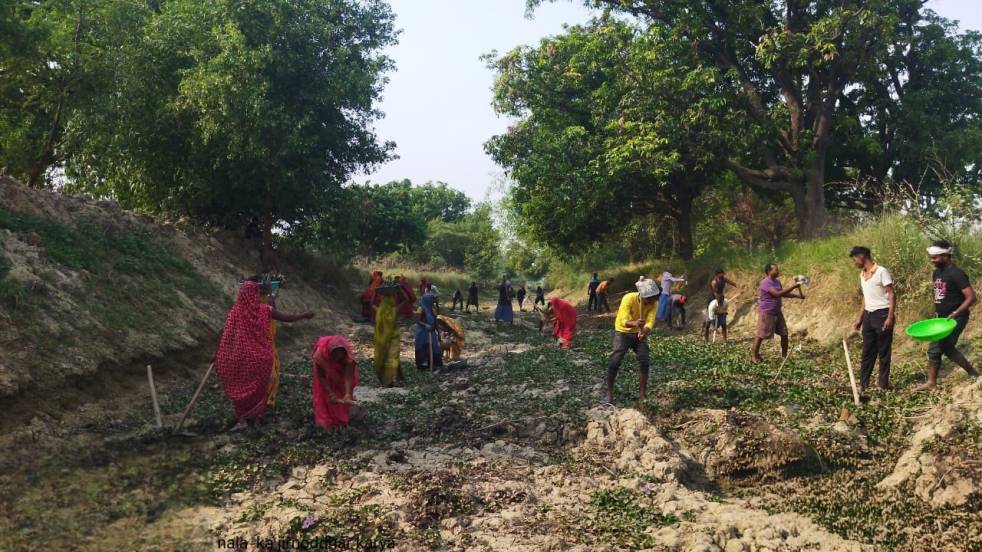
(Feature Image: Uttar Pradesh’s Matuka River Revived: How Farmers Got Their Lifeline On Course. Source: News18)
Marking the International Day of Action for Rivers 2026, this overview brings together several encouraging examples of people’s efforts to protect, revive and defend their rivers across India. At a time when rivers are increasingly threatened by pollution, indiscriminate sand mining, encroachments, dams and half-baked developmental projects, these stories remind us that citizens, communities and grassroots organizations remain the strongest defenders of the rivers.
The overview covers diverse efforts aimed at protection and revival rivers in several Indian states. In Kerala, biodiversity committees and forest officials are working to revive degraded Chithari and Kammalamkudi stream through ecological restoration and removal of invasive species. In Jammu & Kashmir, environmental activism and youth-led clean-up drives have helped protect fragile Sukhnag & Sandran streams which as tributaries of the Jhelum River support biodiversity & livelihoods.
In Odisha, people’s movements have mobilized villagers to oppose the proposed dam on the Rushikulya river and to demand urgent action against pollution affecting the Daya River. In Punjab, activists have been fighting a legal battle to defend the natural course of the Beas River from religious sect altering its flow & eroding farmlands. In Maharashtra, dedicated individuals & community groups are working to restore the Manganga & Kayadhu rivers.
In Chhattisgarh, farmers have adopted riverine agroforestry practices to restore the Lilagar River. In Uttar Pradesh villagers and administration have made efforts to revive the Noon, Sakarni, Ghurari, Manorama and Tamsa rivers through government schemes also supported by NMCG. In Arunachal Pradesh, youth organization YMCR have advocated stronger policies and legal protection for rivers. The overview also pays tribute to veteran environmental leader R. Nallakannu of Tamil Nadu, whose lifelong campaign against destructive sand mining helped bring attention to the ecological crisis facing rivers.
1 Kerala With local support, a tributary comes to life First, the members of the Pullur Periya Panchayat biodiversity management committee performed a preliminary survey of the trees, shrubs, herbs, birds, spiders, butterflies, moths, odonates, mammals, and herpetofauna along the Chithari river in Kasargod district. Following this, the committee identified a two-km stretch between the Makkaramkodu and Velloor Vayal bridges as the site for the pilot restoration project.
Part of panchayat land, unscientific river management had led to heavy degradation on the site, and floods in the past had uprooted many trees. “After the survey, we took some of the panchayat ward members on a walk through the site, showing them how invasive species, such as trailing daisy (Sphagneticola trilobata), are abundant, and that they need to be weeded out first to be able to plant anew,” says Shyamkumar Puravankara an architect and an avid birdwatcher who led the initiative.
For the next phase of the project, the committee worked with the Kanhangad Block Panchayat Agro Service Centre to prepare saplings of the 10-12 native species identified and selected for replanting. It took two years to complete the first round of planting, even though they were parallelly working on invasive species removal and sourcing saplings through the agro service centre. As per Puravankara, they will begin the next round of weeding and replanting by December, once the northeast monsoon gives way.
As for the immediate next steps, Puravankara wants to update the flora survey list. He believes many grasses and plants, especially water plants, have escaped their attention. Recently, Puravankara successfully applied for a grant with the Zoo Outreach Organisation (an NGO working on wildlife conservation in India since 1985) to develop a flora inventory along the Chithari tributary. He hopes this can lead to a commercially viable nursery that nurtures native wild plants and can cater to the needs of all restoration projects in the state.
Though the Chithari river project has been commissioned for only three years, Puravankara believes it will take another five or six years before nature can take over, and only then can they declare whether the project has been a success or not. Thubeevi is adamant they will not give up on the project even after the panchayat scheme ends in 2025. “As long as I am in office, we will continue to do what we can to protect the river,” she says.
30 years on, eco-restoration of stream a success In the midst of a sweltering summer, a stream long dormant in a tribal settlement within the Marayur Sandal division in Idukki has sprung back to life after a hiatus of 30 years. This remarkable transformation is credited to an eco-restoration initiative spearheaded by the Forest department in the area during the 2021-2024 period. Forest department officials recount that the hills within the forest division of Kammalamkudi were once covered in grasslands with active water streams until 1990s.
Embarking on a trial endeavour in 2021-22, the forest department initiated an eco-restoration project supported by the UNDP and NABARD and encompassing 38 hectares at Anchanattupara and 60 hectares at Pothadi under the CAMPA. “Exotic species were systematically removed, allowing natural grasses to flourish,” explains Marayur DFO M.G. Vinod Kumar. “With subsequent backing, the project has expanded, converting 98 hectares into thriving natural grassland.” In the locality, a once-active stream known as Kammalamkudy Thodu had vanished following the introduction of exotic species. However, post eco-restoration, the stream has been rejuvenated, now releasing 6.5 litres of water per minute even in scorching temperatures, say officials.
2 Jammu & Kashmir How activism resuscitated a small trout-bearing stream There is a large network of streams across J&K where trout is found in abundant quantities. But due to large-scale riverbed mining using heavy machinery, these freshwater streams have been looted and plundered in the last 10 years. From Kathua to Kupwara and Budgam to Baramulla, our streams and rivers have been vandalised.
As someone who has been writing and researching on these freshwater streams, trekking and hiking to the glaciers wherefrom these streams originate, it pained me a lot personally to see the vandalisation happening before my eyes. When my blogs and vlogs didn’t work, when my news reports had no response from the government, I chose to seek the intervention of the National Green Tribunal (NGT).
In the last six years, I have filed almost 12 petitions in the NGT and by the grace of God, I got some very good orders and judgements as well. Not only did I get these orders with the help of my counsels like Rahul Chowdhary, Saurabh Sharma, Kaustav Dhar and Itisha Awasthi but I also managed to get them enforced on the ground. The illegal riverbed mining in the Doodh Ganga, Shaliganga and Sukhnag was halted in the last two to three years.
In fact, the damage caused was immense in the last five years. But the further loot of minerals was halted and now, no heavy machinery can be seen working in these streams in broad daylight. On some occasions, machines are used but that too during the dead of the night. Unfortunately, the work which had to be done by the departments of mining, irrigation, flood control, fisheries or the police is now done by me, my friends and counsels with the NGT’s intervention. (Raja Muzaffar Bhat)
Youths lead the fight to save river The youth of Muniward village of south Kashmir’s Anantnag district stepped out of their homes to clean the Sandran- a major tributary of the Jhelum River, cutting through their village. Once a pristine stream originating from Verinag, Sandran was known for its fresh, clean water. However, years of garbage, plastic, and polythene waste had polluted it, turning it into a source of contamination.
Concerned about its deterioration, a local volunteer group, Khidmat Khalaq Foundation Muniward, took the lead in mobilizing residents to restore the tributary. The cleanup drive will be held every Sunday. Local mosque preachers have also joined the cause, using their Friday sermons to urge villagers to keep the water body clean and avoid dumping waste into it.
3 Odisha Padayatra to save Rushikulya river A 10-day padayatra covering nearly 100 villages along both banks of the Rushikulya River in Ganjam district concluded on March 25, 2025 with a call to halt the proposed dam. Green activists and villagers had started the padayatra on March 16 from Pipalapanka forest, where the dam is proposed to be constructed.
“The Pipalapanka forest serves as the primary water source for the Rushikulya River, a vital lifeline for Ganjam district. However, reservoirs have long been constructed on each of its key tributaries – Jarau, Badanadi, Baghua, Dhanei, and Ghodahada – preventing them from contributing any water to the Rushikulya during the summer months,” Prafulla Samantara, President of Lokshakti Abhiyan00, said. “The dam will obstruct the natural flow from Pipalapanka to the Ganjam mouth of the Bay of Bengal from November to June, causing the river to dry up completely. This will disrupt its ecology, render all lift irrigation pumps inoperative, and leave tanks and wells without water as groundwater levels decline,” said Mr. Samantara.
During past two years, people under banner of Rushikulya Suraksha Action Committee had been campaigning against the dam and illegal sand mining which had caused irreparable harm to river ecology. Since 1996, the climate change had caused erratic rainfall furthering reducing water flow into Rushikulya.
Tribal leader Bhala Chandra Sarangi said several hectares of reserve forest would be affected and several tribal villages in the nearby area would be submerged if a dam is constructed. “We want the govt to scrap the project to save Rushikulya,” he added. “We will raise awareness among the residents living along the river bank about the consequences of the Pipalapanka dam, which is proposed to be constructed to cater to the water requirement of some industries to be set up near Chhatrapur,” said Prafulla Samantra, an environmental activist.
Make Daya river pollution-free: Activists River protection activists on Feb. 06, 2025 announced to start an indefinite satyagraha in front of the residence of CM Mohan Charan Majhi if the government did not take steps to control pollution of the Daya River. The decision was taken during a meeting of Mahanadi Bachao Andolan, Daya Surakhya Abhijan, Gangua Bachao Andolan and Chilika Bachao Abhijan in view of the death of six persons in the Kanas area of Puri district due to suspected diarrhoea after consumption of contaminated water from Daya river. The activists demanded that the government initiate steps to clean the river as it is a source of drinking water.
They also demanded that the Gangua nullah be given the status of a river as it was earlier known as the Gandhabati River. The organisations urged the government to involve river experts, environmentalists and local committees in the revival of the Gangua nullah. The resolution demanded that the state government order an inquiry to find out why STPs planned for the Gangua nullah were not completed, and sought strong action against industries, apartments and other agencies responsible for polluting the water of Daya and Gangua rivers.
4 Punjab Activists fighting to protect Beas river’s course in HC For the last two decades, Punjab Lok Bhalai Insaf Welfare Society president Baldev Singh Sirsa has been running a campaign to protect the Beas River’s natural course near the Dera’s premises. The next hearing on a petition in the matter was due to come up before the Punjab and Haryana High Court on Feb 6. The high court had on June 30, 2024, directed the Punjab government to address long-standing concerns over a bandh (embankment) constructed by Radha Soami Satsang Beas (Dera Beas) along the river, which petitioners claimed was causing severe erosion of agricultural land in Kapurthala district.
The court noted evidence from Google Maps spanning from 1985 to 2022, showing how the embankment diverted the river flow to the left bank, leading to rapid erosion on the right side in Dhilwan. “We have been shown the Google Maps from the year 1985 onwards to the year 2022… as to how on account of the construction of the bandh the water has got diverted to the left side of the river and is causing rapid erosion on the other side and depleting away agricultural land,” the court had stated.
5 Maharashtra Man worked to bring back river to life On a balmy Feb noon, 77-yr-old Vaijinath Jagannath Ghongade stood on the banks of the Manganga river in Solapur dist. “I felt ashamed benefitting from the pension I got from the agriculture dept but doing nothing in return. Having reflected for several days, I decided to tour the stretch of the river on foot and study its ecosystem,” he shares. “For this river, which flows close to my village Wadegaon in Sangola taluka, and supports the livelihoods of hundreds, was slowly dying,” he adds.
The massive undertaking of cleaning the 75-km stretch of Manganga river flowing from Sangli to Solapur with public participation was started in 2016. And the man who championed the cause to bring back the river to its former glory was Ghongade. He was honoured with the Jal Prahari Samman in Dec 2023 by the Ministry of Jal Shakti.
Conservation of the Kayadhu river Jayaji Paikrao is spearheading a major river conservation campaign in the Marathwada region. He has played a pivotal role in the efforts to save two of the region’s prominent rivers: the Kayadhu and the Asna. Due to the success he achieved in conserving the Kayadhu, he is affectionately referred to as the “JP” (Jayaprakash Narayan) of the Kayadhu. Ten years ago, alongside villagers and other social activists, he took up the mission to save this river—a tributary of the Godavari—which joins the main river in the Nanded district. He notes that in this endeavor, he received support from Magsaysay Award laureate Rajendra Singh; consequently, the discharge of pollutants into the river was halted, and encroachments along its banks were cleared. The campaign to save this river continues under the banner “Chala Januya Nadila” (Let’s Get to Know the River)—a movement about which Hridayesh Joshi spoke with Jayaji Paikrao.
6 Chhattisgarh Riverine agroforestry restores the Lilagar River With roots in tradition and eyes on the future, Chhattisgarh’s farmers are restoring rivers through agroforestry. Along the fragile banks of the Lilagar River in Chhattisgarh, a detailed study has shown that planting the right trees in the right places could be the key to restoring farmland and the rivers.
The Lilagar River, a 135-km-long tributary of the Sheonath River, flows through the Bilaspur and Janjgir-Champa districts. It has long served as a lifeline for agriculture and human settlements in the region. But over the past few decades, increasing anthropogenic pressures, particularly sand mining and land-use change, have degraded its catchment and compromised its year-round flow. The researchers strongly recommend making agroforestry a central part of river and ecosystem conservation plans. This includes weaving it into existing efforts like the Namami Gange program and catchment development schemes under the Jal Shakti Abhiyan. They also urge policymakers to recognise agroforestry in India’s climate goals, such as the Nationally Determined Contributions (NDCs) and state climate action plans.
7 Uttar Pradesh Noon river runs again through parched Jalaun Farmers of Jalaun in UP’s parched Bundelkhand will not have to toil too much this season to get water for crops. They have almost revived an 81km-long local river that had dried up completely. Community members have restored the drainage basin over a 14km course of Noon river to create a funnel through which water has again entered it. The river had dried up to encroachments and poor rainfall. The revival commenced in 2021 and reached the final stage only recently, with voluntary labour contributions from thousands of local men and women. Officials said the water would start flowing through the entire course of the river in a fortnight. The river is expected to help more than 15,350 farmers.
Noon meandered across 47 villages before merging with Yamuna on the other side of Jalaun. The river was earlier a key source of irrigation over 2,780 ha, as well as for animals looking for a waterbody in the dry region. But sporadic construction activities changed the river’s contours, preventing rainwater from funnelling down into the riverbed.
Villagers toiled to bring back Sakarni river Over 30,000 people of 20 villages in three blocks of Pratapgarh district toiled for over 10 months to revive the earlier course of a seasonal river. Over the last decade, the Sakarni (Sanskrit for one who listens), a rivulet that feeds the Sai, a tributary of the Ganga, saw large-scale encroachment by farmers. Consequently, the rivulet changed its course and became shallow in stretches. A local activist, Ajay Krantikari, who heads an NGO called “Paryavaran Sena”, led a campaign to bring back the river to its natural course and first raised the issue before the district environment committee, which is headed by the district magistrate. On Oct 13, 2023, following Krantikari’s efforts, the dist authorities included the Sakarni river under the small rivers’ rejuvenation list under MGNREGS.
Over the next 10 months, nearly 30,000 people worked under MGNREGS to bring the river back to its natural 27.7km-long course. Besides, they also found employment in their respective blocks during the rejuvenation work on the rivulet. The district administration spent Rs 1.35 crore to make this happen. Shri Krishna, Pratapgarh district development officer, said: “After conducting a detailed survey and analysis, we removed all the encroachments upon the natural course of the river.”
River rejuvenation by Women water protectors In recent months a story from a remote village of Jhansi district (Uttar Pradesh) that attracted attention at the national level has been that of the efforts of about 18 women volunteers of Simravari panchayat for the rejuvenation of Ghurari river. This river has been in decline after an important check dam got damaged and there was growth of weeds. This panachayat has about 18 jal sahelis or water protector volunteers. They decided to take up the work of creating a sack bund on their own as well as cleaning weeds. In Mar-Apr, they filled up nearly 1000 sacks & placed these at a carefully selected place in the river to provide a temporary bund.
Community offers ‘shramdaan’ for Manorama river revival The rejuvenation of Gonda’s Manorama river has kicked off with a massive community-led ‘shramdaan’, reflecting the state govt’s commitment to restoring traditional water bodies. The Manorama river, stretching 115 kilometres, originates from Tirre Tal in Gonda and flows into the Kuwano river in Basti district. According to ancient texts, the river is named after Manorama, the daughter of sage Uddalak, and holds spiritual significance as it flows near Makhoda Dham, a revered site.
The campaign commenced in Sisai Bahlolpur village, Itiyathok block, where more than 200 individuals — including villagers, youth, gram pradhans, public representatives and NGOs from Pandri Kripal, Itiyathok, Rupaidih, and Mujehna blocks — participated. Their collective involvement underscored the focus on public partnership in environmental conservation. Officials stated the initiative is being structured as a community-led movement. Gram panchayats, social groups and volunteers are being encouraged to participate in what is envisioned as a campaign for water conservation, ecological revival and cultural awareness.
Matuka river revival The locals of Varanasi’s Sewapuri have revived a “lost river”, with a little help from the Uttar Pradesh district administration. Once a key tributary of the river Varuna, the 27.14-kilometre Matuka, a lifeline for over 5,000 farmers across 26 villages, had faded due to neglect and encroachments.
The revival was conceptualised over a year ago. The revival of the Matuka River was taken up as a focused water conservation mission by the Varanasi district administration. Led by Chief Development Officer (CDO) Himanshu Nagpal, the project was implemented in coordination with local gram panchayats. Desilting, clearing encroachments, and building rainwater harvesting structures were central to the plan.
To ensure the revival has long-term impact, 14 drop spillways were constructed and seven check dams are under construction. In addition to cleaning and construction work, the administration has focused on preventing future encroachments.
Tamsa River Rejuvenation Once facing challenges of siltation, waste accumulation and encroachments, the river today stands revitalized through coordinated administrative efforts and strong community participation under the Namami Gange Program. The Tamsa flows through Ambedkar Nagar, Ayodhya and Azamgarh districts before merging with the Ganga.
Delineation of River Tamsa’s floodplain zone The Irrigation and WRD, UP has initiated necessary steps for delineating River Tamsa’s floodplain zone and the process is presently underway. The department’s report filed March 10, 2026 was in compliance with the NGT order of September 22, 2025. The matter related to extensive encroachment, unauthorized construction and continuous discharge of untreated sewage and industrial effluents into Tamsa in Ambedkar Nagar district, which is a tributary of Ganga.
The executive engineer of the Flood Works Division (Irrigation and Water Resource Department) in Ayodhya, through letter dated December 9, 2025, requested NIH for the determination of the floodplain zone of Tamsa in accordance with the Ganga Rejuvenation Order, 2016 according to high-resolution digital elevation model (DEM) data and 1 metre contour data. The National Institute of Hydrology (NIH), Roorkee provided the draft proposal for floodplain zone delineation of the Tamsa / Marha / Tons river. In the proposal, NIH stated that the study will be completed in 12 months.
8 Arunachal Pradesh YMCR seeks stronger river protection measures A delegation from the Youth Mission for Clean River (YMCR), led by its chairman SD Loda, met CM Pema Khandu on July 21, 2025 to raise concerns over river conservation in Arunachal Pradesh, and to press for comprehensive policy and administrative action. The YMCR urged the govt to draft an ‘Arunachal Pradesh River Protection Act’ to address legal, administrative & community responsibilities for river preservation.
The YMCR representatives highlighted ongoing threats to the state’s rivers, including illegal extraction, changing flow patterns, and pollution. The delegation also proposed the establishment of a dedicated department or cell under the state’s Environment or Water Resources Department. This entity would monitor river health, ensure law enforcement, coordinate restoration work, and undertake public education campaigns. The YMCR noted that such a department could build upon recent measures like the Arunachal Pradesh Flood Plain Zoning Act, 2025. The group further suggested instituting a ‘Arunachal River Day’ and a dedicated conclave.
9 Tamil Nadu In memoriam: R Nallakannu, the comrade who stood guard over rivers With R Nallakannu’s passing away at 101, Tamil Nadu loses one of the last public figures who saw ecology as a moral question. R Nallakannu’s politics began with rivers. Long before environmentalism became a language of policy or climate summits, he understood something simple and elemental. When a river is wounded, the poor bleed first. Through decades of political life, he returned again and again to that truth, standing firmly against sand mining, resource plunder and projects that threatened fragile landscapes.
His campaign against river sand mining became one of the defining chapters of his public life. Tamil Nadu’s rivers were being stripped by mechanised mining. Riverbeds sank deeper, groundwater declined, agriculture suffered, and ecological balance began to collapse. He joined protests, backed legal interventions, addressed meetings across the state, and insisted that development without ecological restraint would ultimately destroy livelihoods. He believed that development had to be accountable to people who lived closest to nature.
10 Photographer captures semi-abstract human forms on rivers’ surfaces Freelance photojournalist Renjith Madhavan has been on an ambitious mission of photographing rivers. Ambitious because he captures semi-abstract images that resemble human forms on the water’s surface. He set out in December 2021, travelling to 22 rivers across 18 Indian states and took photographs that emerged are enigmatic reflections of humanoid forms. He spent days on riversides, waiting for the perfect alignment of light, shadow and movement to click. “As shadows fall on water, they create unexpected patterns, textures and forms,” says Renjith. “The water is like a canvas, reflecting images that cannot be perceived by the eyes. I like to call it Nature’s art,” he adds.
The idea struck him when he serendipitously got photographs from indistinct movements of shadows on river water. “It fascinated me. I started wandering through riverscapes and keenly observing the waters’ surfaces. At times, I could discern shapes that resembled human forms and that is when I decided I would do a photo series on these ‘water humans’,” says Renjith. Though he started with rivers around his home town in Chalakudy, he expanded his canvas, covering Rameshwaram, Dhanushkodi, Tiruchi, Mysuru, Sangli, Varanasi, Agra, Mathura, Bodhgaya, Delhi, Gujarat, Kolkata, Guwahati and Cherrapunji before proceeding to Rishikesh, Haridwar and Devprayag to Manali, Ladakh and Kashmir.
Some Relevant Court Orders
Madhya Pradesh HC pushes for ‘Social Audit’ in Swaran Rekha river revival PIL In a significant push to revive Gwalior’s historic Swaran Rekha river, the Madhya Pradesh High Court has emphasised the implementation of “Social Audit” and called for a panel of experts from diverse fields to oversee the river’s rejuvenation and associated urban development efforts. A division bench of the MP High Court at Gwalior, comprising Justice Anand Pathak and Justice Hirdesh, while hearing a PIL, filed by Advocate Vishwajeet Ratoniya in 2019, noted that despite earlier directives, substantial progress is still lacking. Citing Sections 5(54-a) and 130-B of the Madhya Pradesh Municipal Corporation Act, 1956, the court emphasised the need for civic engagement through the “Social Audit” model, allowing residents to assess urban development policies and their effectiveness.
“The river once flowed freely in its natural, unpaved form, allowing continuous water movement and playing a crucial role in recharging the city’s groundwater,” the petitioner, Ratoniya said. “But ever since the riverbed was cemented, this natural recharge process has been disrupted. Rainwater now simply runs off without seeping into the ground, causing a gradual yet alarming drop in Gwalior’s water table,” he said. The court proposed forming a panel of professionals — retired professors, engineers, administrators, judges, and doctors — to serve as independent social auditors. These individuals must be “men of integrity” and work without “fear or favour,” the court added, stressing their role as crucial in guiding urban policy.
Kerala Govtinforms HC of new river basin committee The State govt has informed the Kerala High Court that it has notified an ‘Integrated River Basin Conservation and Management Plan’ to tackle pollution in the Periyar river. A Division Bench of Justices Devan Ramachandran and MB Snehalatha was told on July 11, 2025 that multiple committees have been assigned responsibilities under the plan, with the apex committee headed by the CM.
The government assured the Bench that the issues raised by the High-Level Committee constituted by the Court, the Pollution Control Board, and local bodies regarding all rivers in Kerala would be addressed and resolved by this management plan. He asserted before us that this Management “Plan” will be in a position to take care of River Periyar, along with all the other rivers in Kerala,” the Court noted in its order.
The High Court is seized of a batch of petitions filed by NGOs, including Periyar Malineekarana Virudha Samithi, Green Action Force and others, highlighting the severe environmental degradation of the river Periyar caused by unchecked waste dumping from industries along its banks. Notably, it was the High Court that proposed the creation of a unified authority to monitor and tackle the rising pollution in the Periyar River.
After being notified about the plan, the Court expressed optimism. However, it clarified that it would continue to monitor the progress closely and warned that any further negligence would incur consequences for the responsible authorities.
Rajasthan SC reviews report on Jojari river contamination The Supreme Court on March 10, 2026 took note of an interim report submitted by a court-appointed committee in the suo motu case concerning contamination of Rajasthan’s Jojari River and expressed concern over the damage caused to public infrastructure due to stagnant polluted water. The committee was constituted pursuant to the Court’s order dated November 21, 2025.
The committee has submitted an extensive 202 page interim report. The report detailed the actions taken so far, the recommendations made by the committee, and the logistical challenges encountered during the course of its work. The bench also took note of certain logistical constraints flagged by the committee, including issues related to the availability of human resources required for completing the assigned work. The Additional Advocate General appearing for Rajasthan assured the Court that the non-availability of human resources would be addressed by the State government before the next date of hearing.
On Sep 15, the Court had initiated the suo moto proceedings and had noted that the contamination was affecting hundreds of villages along the river and rendering the drinking water non-potable for local communities. On Nov 17, the Bench had come down heavily on state authorities. The Bench had expressed strong displeasure over administrative inaction despite clear evidence of environmental degradation. “What has happened is under your nose and with the connivance of all authorities. There is no other way,” Justice Mehta had remarked.
The Bench had noted that the same environmental issues had been subject to long-standing litigation before the Rajasthan High Court and subsequently the NGT. The NGT, in 2020–2021, had constituted monitoring committees chaired by former Chief Justice Prakash Chandra Tatia, whose reports revealed rampant industrial pollution in the Jojari, Bandi, and Luni rivers due to effluents discharged by textile and steel units across Jodhpur, Pali, Balotra, and adjoining districts.
Tamil Nadu SC orders strict action against all tanneries polluting Palar The Supreme Court on Jan 30, 2025 issued a series of directives to address the severe environmental degradation caused by tannery industries in Tamil Nadu’s Vellore district, ordering that the state must recover from industries responsible for discharging untreated effluents into the Palar River the cost of ecological restoration and compensation for affected communities.
A bench comprising justices JB Pardiwala and R Mahadevan described the environmental damage as “ecocide”, “irreversible”, highlighting the catastrophic impact on water bodies, groundwater and agricultural lands, which has led to economic hardship for farmers and posed significant public health risks. It directed that compliance reports be submitted every four months and made it clear that failure to comply would result in severe consequences.
To ensure a thorough assessment of the ecological damage and the implementation of corrective measures, the court ordered the state, in consultation with the central government, to constitute a high-level committee within four weeks. This committee, to be chaired by a retired high court judge, would include secretaries from relevant Union and state government departments, environmental experts, representatives from affected communities, and other stakeholders. The court mandated that the committee conduct an environmental audit and oversee the implementation of measures aimed at reversing the damage.
The court ordered the state govt to implement a long-term restoration plan for the Palar River, which would involve the removal of pollutants, ensuring adequate water flow & executing a sustainable strategy, besides an environment audit of all the rivers in Tamil Nadu.
SANDRP

 SANDRP