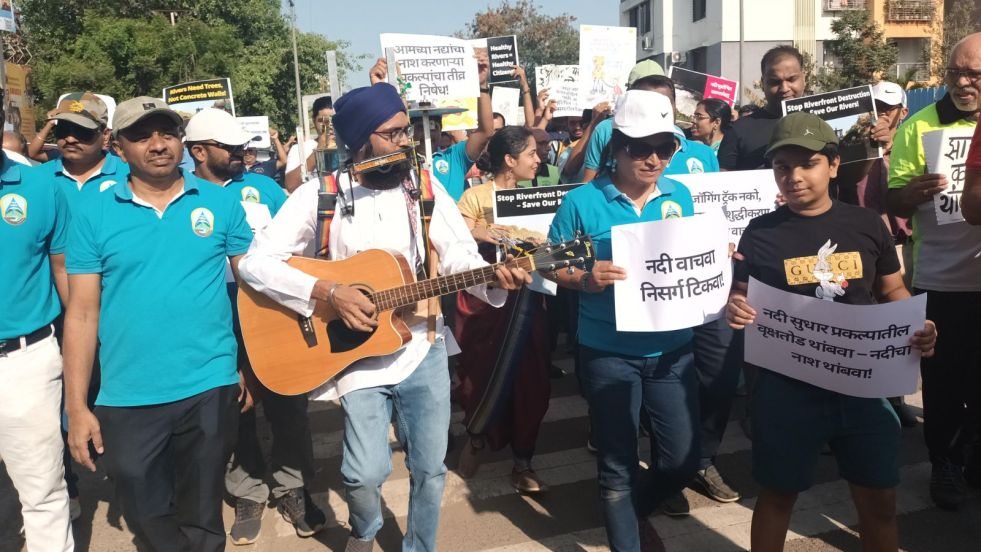
(Feature Image: Short march with a loud message: Citizens protest against Riverfront Development project in Pimpri-Chinchwad. Source: Express Photo)
On the occasion of the 29th International Day of Action for Rivers, celebrated annually on March 14 since 1997, the SANDRP highlights ten inspiring examples of citizen-led initiatives in last one year across India aimed at protecting urban rivers. The overview showcases how citizen groups and individuals are taking action to address river pollution, oppose ecologically harmful development projects and promote restoration and conservation of urban river ecosystems. These efforts demonstrate the crucial role of public participation in safeguarding rivers and ensuring that river management prioritizes ecological health, transparency and the rights of affected communities.
These examples show that the failure of government authorities to stop the dumping of untreated industrial effluents, domestic sewage, and solid waste has severely damaged the health of urban rivers across the country. Ironically, instead of addressing these urgent problems, many urban authorities continue to promote large riverfront development projects that harm river ecosystems, overlook the rights of local communities, and increase the risks of water scarcity and urban flooding.
1 Hyderabad MJA explains concerns over Musi RFD to ADB team Members from Musi Jan Andolan (MJA), a civil society group representing the communities living on the Musi river bank, on Jan. 22, 2026 met the team from the Asian Development Bank (ADB) on a visit to Hyderabad with regard to the Musi Riverfront Development project, and gave a representation seeking an appointment to meet and explain their concerns in detail.
The civil society group has already been in contact with the ADB through email, flagging issues such as lack of public consultation before taking up the project. In the latest representation, the issues raised included absence of Detailed Project Report (DPR) in the public domain, arbitrary demolitions & continued pollution of the river.
There have been no inclusive and democratic public consultations and hearings with the affected families, riverbank residents, displaced persons, farmers, civil society organisations and environmental groups, as per the letter addressed to Mio Oka, the Country Director (India). Apart from DPR, there is no comprehensive Environmental Impact Assessment (EIA), even while the demolitions displaced over 400 families including vulnerable groups such as old, women, children & persons with disabilities, without adequate prior notice, meaningful rehabilitation plans or effective livelihood restoration support, it said.
Locals oppose land surrender for Musi RFD project At a meeting on Feb. 16, 2026 residents from nearly 10 housing colonies along the Musi unanimously rejected a government notification initiating land surrender in exchange for Transferable Development Rights (TDRs). They declared they would not part with “even one inch” of land. MJA said no authenticated river boundary maps or buffer zone demarcations have been made public. They demanded free and informed consultations, noting that many families are still paying housing EMIs and would face hardship if displaced.
MJA activists alleged that the government has maintained secrecy around maps relating to the Musi river boundary and buffer zones. They also objected to the Government Order issued on Dec. 16, 2025, which exempted the Musi and related projects from the application of Chapters II and III of the RFCTLARR Act, 2013.
Residents oppose Gandhi Sarovar Project Land acquisition for the project has triggered a dispute with residents urging authorities to stop what they described as a forcible land acquisition drive. Some of the residents whose properties are affected by the land acquisition for the project said that their concerns extend beyond the impact on their properties. Farmers and flat owners raised objections over the proposed takeover of their properties. Notifications were issued this month to acquire areas of Kismatpur village of Gandipet mandal and Durgam Khalikhan village. Social activist Medha Patkar on March 10, 2026 has extended support to Musi Jan Andolan, opposing the Musi Riverfront Development Project. She urged Telangana CM A Revanth Reddy to halt the DPR unveiling, conduct public hearings, review displacement risks, and restore the original 2013 LARR Act
MJA tells Dy CM to ensure zero displacement A 12-member delegation of the Musi Jan Andolan (MJA) met Bhatti Vikramarka Mallu at Praja Bhavan on March 12, 2026 and raised concerns over the proposed Musi Riverfront Development Project, particularly the hurried unveiling of Phase-1 plans. The meeting, which lasted over two and a half hours, was attended by ministers D Sridhar Babu, V Srihari, and A Laxman Kumar. The meeting happened following a March 10, 2026 letter by prominent activist Medha Patkar urging CM A Revanth Reddy to halt the March 13, 2026 event at Taj Krishna and initiate democratic dialogue.
The delegation urged the government to suspend the unveiling event at Taj Krishna and release the complete Detailed Project Report (DPR) for the entire project in English, Telugu and Urdu, along with river boundary and buffer zone maps. They demanded at least sixty days for stakeholders to submit suggestions and objections and called for public hearings with affected communities.
Activists said river rejuvenation should focus on controlling industrial pollution rather than evicting thousands of families living along the Musi. They questioned the need to acquire about 3,279 acres in Hyderabad and argued that commercial riverfront projects and concretisation of a living river do not constitute ecological rejuvenation.
MJA activist under house arrest A vocal activist from the Musi Jan Andolan (MJA) has been detained inside his home at Chaderghat on March 13, 2026, hours ahead of the CM’s scheduled unveiling of proposed plans for the Musi Riverfront Development project. The activist, Syed Bilal, from the slum Shankarnagar on the Musi river bank, was part of the 12 member delegation from the MJA which met the Deputy CM Mallu Bhatti Vikramarka and his cabinet colleagues at his residence on March 12, 2026.
2 Pune ‘Stop RFD’: Residents demand river cleanups instead of concrete embankments In the wake of ongoing River Front Development (RFD) projects in Pune, several NGOs, environmentalists and citizen groups gathered at Chaphekar Chowk in Pimpri-Chinchwad under Pune district on March 09, 2025 to oppose tree felling and loss of natural vegetation across the river banks while demanding cleanliness drives for Mula, Pavna, Indrayani and other rivers.
“Concrete embankments under RFD have the potential to significantly harm biodiversity by disrupting the delicate ecosystem of the river banks, leading to the loss of habitat for various flora and fauna, and potentially impacting the natural balance of the riparian zone. The modification of river edges in natural ways in Siddha Peeth can be a role model for upcoming RFDs,” said Vaishali Gaikwad of the Aarambh Foundation.
“The priority is first to make rivers pollution-free by avoiding effluents and untreated output from Sewage Treatment Plants (STP) being discharged into the rivers. Every river and incoming stream needs to be rejuvenated from source to confluence. And in the case of RFD implementation, it must be done while respecting biological elements. However, such projects come at the cost of disturbing the ecosystem, leading to adverse consequences. Moreover, these projects are being carried out without studying eco-sensitive areas, and citizens are overlooked when deciding on the RFD projects, tree felling, and flood management,” said Shailaja Deshpande of Jeevitnadi Foundation.
“RFD will significantly damage the river ecology, increasing flood risks by narrowing the riverbed, and potentially leading to further environmental degradation through construction activities along the riverbanks, essentially prioritising aesthetics over the health of the river system”, said Ramesh Sardesai, 82, a participant. In response to the citizen’s demands at the protest site, Amit Gorkhe, a Member of the Legislative Council, said that he will arrange a meeting with Pankaja Munde, Minister of Environment and Climate Change, in the coming week to present the demands and would urge the chief minister to look into the matter.
Resistance to RFD Marches are the most visible form of resistance, but the movement against the RFD also involves civil society members talking to the PMC. “Rather than protesting, we started discussions with the authorities about our reservations regarding the RFD. This was around 2018-19,” says Shailaja Deshpande of Jeevitnadi, a volunteer-based organisation involved in the protests.
Sarang Yadwadkar is among those who have taken the resistance to the courts. In January, he knocked on the doors of the NGT again, this time against the environmental clearance given by the State Environment Impact Assessment Authority to the RFD. “As far as the RFD is concerned, we need to understand the situation in Pune. It is very peculiar compared to any other city. Five rivers enter the city: Mula, Mutha, Pavana, Ramnadi and Devnadi. The last two are relatively smaller rivers but bring in water quickly. Flash floods occur in both rivers. We have seven dams upstream that are nearby. There are four dams on the Mutha and one each on Mutha and Pawana, apart from the Kasarsai Dam,” says Yadwadkar.
IISER scientists are red-flagging RFD One of the main factors pointed out is that “there is very little data analysis”. “Though Pune is home to the IMD and there are a few stations in the region, it is still a very complex terrain. The IMD data is not always good enough as precipitation varies a lot over a short distance. This tells us that we have to be careful and that care is missing in case of the RFD. We have pointed this out. We don’t really have a solution but we can say that the data that exists was not looked into carefully,” says Banerjee.
The report also states that the RFD plans to replace 240 hectares of greenery, “largely with concrete without any serious evaluation of the carbon footprint associated with the infrastructure development”. “It is unclear if the damage to the ecosystem during the construction phase has been assessed. Additionally, the Environmental Impact Assessment report should be independently reviewed by scientists and experts in the city working in the relevant fields,” it states.
Musician’s unique campaign to save the Mula-Mutha River The Pune Riverfront Development Project, which aims to beautify the banks of the Mula-Mutha River through concretisation, has been one of the most debated topics in the city. Many citizens have raised concerns about its environmental impact. While the project promises promenades, gardens, and flood control measures, it comes at the cost of destroying the natural ecosystem that has existed for centuries.
Among them is Swapnil Thakur, a Pune-based musician popularly known as the ‘One-Man Symphony,’ who is using his music to protest against the project. Once a corporate employee, Swapnil’s life took a drastic turn after a bad road accident in 2018 that left him with nine broken bones and metal implants. During his recovery, he found healing by spending long hours by the Mula-Mutha River. That connection with nature became his strength and eventually his cause to fight against the Pune riverfront project. When he saw trees being cut and concrete structures rising along the Mula-Mutha riverbank, he decided to raise his voice through his art.
Activists Unite to Protect Indrayani River Following protests along the Mula River, environmental activists are now turning their attention to the Indrayani River. In opposition to river beautification projects under the guise of the River Improvement Project, a human chain protest is being organised on the banks of the Indrayani River on May 4. The event aims to raise awareness about pollution and protest the degradation of sacred rivers with the slogan: “Let’s unite at Indrayani’s shore; for the survival of our sacred rivers.”
The PCMC has started work along the banks of the Mula River near Pimple Nilakh under its River Improvement Project. Trees along the riverbanks have been cut down, and debris has been dumped into the river, narrowing its flow. The river has become increasingly polluted. The destruction of biodiversity has also impacted the habitats of aquatic and wild animals.
In response, several organisations, including the River Rejuvenation Committee of Pune and Pimpri Chinchwad, the River Protection Action Committee, and over 110 social groups, have launched a public movement. They previously held a protest march against the river project. Now, in the second phase, these environmental groups are organising a human chain along the Indrayani River to raise public awareness and protest its ongoing pollution. The organisers have called on all city residents to join the protest and support the cause.
Stop riparian tree felling The Central Empowered Committee has on Aug 21 written to the Maharashtra chief secretary seeking directions to Pune and Pimpri Chinchwad civic bodies to halt all proposed tree felling in the riparian zones of Mula, Mutha, Mula-Mutha, Indrayani and Pavana water bodies for the riverfront development (RFD) work. The panel has sought such directions till the SC order of March 4 – regarding identification and demarcation of deemed forest areas by a state-appointed expert committee – is “implemented in toto” and a compliance affidavit submitted to the apex court.
Jeevitnadi, along with Ecological Society, Nisargsevak and Devrai Foundation, had written to the SC-CEC on Aug 18, 2025. It said there was a plan to cut trees in the deemed forests located in and around the riparian zones of the Mula, Mutha, Mula-Mutha, Indrayani and Pavana rivers. The panel took note of the same while writing to the state chief secretary.
3 Ludhiana “Kale Pani Da Morcha”: A Landmark people’s movement ‘Kale Pani da Morcha”, the people’s movement against Pollution of Buddha Nallah, a tributary of Sutlej River in Ludhiana (Punjab) is a landmark movement in more than one sense. Firstly, while severe pollution of rivers is the usual story from across the country, a courageous people’s movement to address is such a rare event.
The fact that the industries association actually threatened this movement, with a counter from the industries and their workers is shocking and shows the impunity of these industries. While the state government has to take quick action to address the issue, there is also a huge role for the central government, which has abjectly failed to perform its basic duty of providing credible governance of rivers, including their pollution in India. They including CPCB and MoEF know since decades that CETPs are completely failed model, and no worthwhile action has been taken to address the failure, including by the World Bank which has funded many of them. The filthy rivers all over India are violating the fundamental rights of millions of people, without any credible action even by the judiciary.
The Buddha nala pollution issue is decades long, but the current movement started about six months back. It is also heartening to know that even affected people from downstream, from Rajasthan have also supported the movement. May this movement succeed and may there be many more such movements.
Activists hold dharna Activists from various organisations staged a dharna at Dr BR Ambedkar Chowk on Republic Day, protesting the state government’s failure to prevent water pollution in the Sutlej River caused by the polluted Buddha Nala in Ludhiana. The protesters highlighted that Dr BR Ambedkar, through the Constitution, granted fundamental rights to citizens, but both state and central governments have failed to provide clean drinking water. They pointed out that contaminated water, laced with harmful chemicals from Ludhiana’s Buddha Nala, has been causing serious health issues, including cancer and skin diseases, yet the government has not taken effective action.
Protests against non-implementation of NGT orders Members of Kale Pani Da Morcha on Jan. 08, 2026 gathered outside Punjab pollution control board office to register their protest against the alleged pollution caused by dying industry in the Buddha Nullah, also stated to be the toxic vein of Ludhiana as per this Tribune video report of Jan 8 2026. Activists are demanding the implementation of NGT orders. The protesters are demanding that untreated water being discharged from the polluting dying units must be stopped at the earliest which is causing lot of health issues in the Malwa region.
4 Vadodara How people power reclaimed Vishwamitiri From building a coalition against the Vishwamitri Riverfront Development Project to getting it scrapped – a rare success – people’s movements have interwoven passionate activism with law, science, and data. Their collective engagement and dogged sense of purpose made all the difference. Activists and experts were appointed by the Gujarat State Human Rights Commission this year to a committee overseeing the Rs 1,200-crore flood mitigation project; besides, people do on-ground monitoring, record official work, track plans and progress, and document irregularities.
State Human Rights Commission in March 2025 directed authorities to uphold environmental rights in Vadodara’s Vishwamitri River Project.
5 Delhi Activists expose corruption, inaction in Yamuna cleanup efforts While govt agencies continue to promise that the Yamuna will soon be clean enough for bathing, two independent activists working on the ground argue that pollution persists due to systemic inaction, corruption, and weak enforcement. Despite personal risks and no institutional support, they have spent years identifying polluting units, inspecting sewage treatment plants (STPs) and pursuing legal action to push authorities into taking meaningful steps.
Varun Gulati, 41, has been waging a near one-man battle against industrial pollution in Delhi since 2018. Armed with a drone borrowed from a friend, Google Maps, and legal perseverance, Gulati says he has identified and reported hundreds of illegal dyeing and chemical units operating without waste treatment facilities. Gulati claims he has managed to get around 700 polluting units sealed over the years—but not without struggle. “Officials often warn factory owners in advance. By the time an inspection is carried out, the unit is already shut. Then they report there’s no violation,” he says.
While Gulati relies on legal channels and surveillance, Pankaj Kumar focuses on public participation and on-the-ground action. A former MNC employee, Kumar quit his job in 2022 to work full-time with Earth Warrior, a volunteer group he founded in 2019. With 30 core members and dozens of college students joining every week, Earth Warrior conducts weekly clean-up drives along the Yamuna, especially near Kalindi Kunj.
Like Gulati, Kumar uses RTIs and court submissions to draw attention to violations. “Many STPs have shown improvement after we submitted reports. The government does take note sometimes, but overall, with the current direction, the Yamuna will never become clean,” he says. Despite the scale of the challenge, both men continue their efforts. Gulati tracks polluting clusters through satellite images and visits sites alone, while Kumar runs awareness campaigns and mobilises volunteers. Most of their funding comes from volunteers themselves and modest social media revenues.
Man who quit job to clean the Yamuna Every Sunday morning, as the city slows down for the weekend, Pankaj Kumar and his team head to the banks of the Yamuna River at Kalindi Kunj Ghat in Delhi. Gloves on, driven by quiet resolve, they begin their weekly ritual — removing heaps of waste, plastic, and debris from one of India’s most polluted rivers. But for them, this isn’t just about cleaning up garbage — it’s about reviving a dying river. Pankaj quit his job to dedicate himself full-time to cleaning India’s rivers. He founded ‘Earth Warriors’, a volunteer-driven initiative that not only leads clean-up drives but also investigates the systems responsible for river pollution.
Realising that clean-ups alone wouldn’t solve the crisis, Earth Warriors expanded their mission. They began inspecting sewage treatment plants across 12 states, filing legal complaints, & pushing civic bodies for accountability. They believe in prevention before cure — highlighting the urgent need to fix broken systems that allow untreated waste to choke our rivers.
How Ashok Upadhyay became ‘Yamuna Baba’? Ashok Upadhyay, popularly known as ‘Yamuna Baba,’ has dedicated the last 20 years of his life to cleaning the Yamuna River and conserving the surrounding nature, flora, and avian life. Ashok Upadhyay initially launched his cleanup campaign single-handedly, picking up polythene waste and litter on his own. However, his efforts gradually gained significant momentum.
He established a group of environmental enthusiasts named ‘Friends of Yamuna,’ which currently comprises approximately 1,200 members. This diverse group includes individuals ranging from private and government employees to entrepreneurs. Together with Ashok, this group has planted over 40,000 trees along the banks of the Yamuna—including shade-giving and eco-friendly species such as Peepal, Banyan, Neem, Pilkhan, and Dhak.
6 Itanagar YMCR saving rivers from garbage Youth Mission for Clean River (YMCR) began cleanup drive in Itanagar’s Green Belt in 2016. It has today evolved into a grassroots movement that’s not only removing garbage from riverbanks but also attempting to reshape public attitudes towards sustainability & ecological responsibility. “We wanted to reconnect youth with nature—not just as observers, but as protectors,” said YMCR general secretary Dr Prem Taba. “Rivers are our lifelines. Cleaning them is just the beginning.”
So far, YMCR claims to have cleared over 1.1 million kilograms of waste from riverbanks and drainage systems across Itanagar, Naharlagun, Doimukh, and several other towns including Seppa, Palin, and Pasighat. “This isn’t just about cleaning up. It’s about creating a long-term behavioural shift,” said another YMCR volunteer. “Our focus is not only on rivers but on the mindset that treats nature as disposable.”
YMCR river cleaning efforts recognized The union Ministry of Housing and Urban Affairs included the YMCR work in its recent publication, ‘Mountains of Change: Transforming Waste Management in Hilly Areas’. The ministry’s report specifically details how the YMCR, often in collaboration with local bodies, educational institutions, and self-help groups, has mobilised hundreds of volunteers to tackle the state’s acute waste crisis. Key aspects of the YMCR initiative mentioned in the publication include specific actions, such as the drive on the Yagamso river, where volunteers removed 12 T of garbage from a one-km stretch.
7 Panchkula‘Save Ghaggar’ warriors do dirty work With no support or action taken by the authorities concerned to ensure the good health of the Ghaggar River, a group of concerned residents under the ‘Save Ghaggar’ campaign hired five dedicated workers to clean a fixed patch of the riverbank next to Chatt Puja Ghat, removing tonnes of waste from the riverbank. Until now, volunteers themselves used to clean the Ghaggar, but now they went one step further by collecting funds from within the group and hiring dedicated workers for better cleaning. The forum collected Rs 10,000.
“Along with them, numerous members of the Save River Ghaggar Campaign joined hands from time to time in the 45-day-long cleaning drive, which has just concluded now as the monsoon is around the corner. The garbage collected was segregated into two major heaps. The plastic and polythene collected were separately disposed of,” shared Tapasya Sharma, co-founder of the Save Ghaggar campaign. However, it faces a challenge that the MC does not pick the waste from the Ghaggar bank after it is taken out from inside the river.
8 Dehradun Residents voice concerns over elevated road project A week after Dehradun was ravaged by floods, killing 29 and leaving eight missing, city on Sept. 22 saw a rally against the Rispana-Bindal Elevated Corridor Project. The plan for the project has raised concerns that the flow channels could push floodwaters onto banks, and that aquifers could be jeopardised if embankments, pillars, and floodwalls are built along the rivers.
The Rs 6,200-crore project envisions two roads over the Rispana and Bindal rivers, central to the city. The 14.8-km road over Bindal Road will connect Near Kargi Chowk to Sai Mandir on the way to Mussoorie, and the 10.9-km road over the Rispana river will start from the Assembly to Nagal bridge. The Social Impact Assessment are underway. Government data showed that the project puts 2,619 structures at risk of displacement from the land to be acquired.
9 Tirunelveli Community-led river restoration works Thirupudaimaruthur, on the banks of the river Thamirabarani in Tamil Nadu’s Tirunelveli district, emerged as a model village for using a hyper-local approach for river restoration. Waste from rituals in temples are frequently discarded into Thamirabarani. Agricultural runoff carries pesticides into the water and untreated domestic sewage continues to enter the river at several points. At Thirupudaimaruthur, the community has adopted a holistic approach to biodiversity conservation, integrating ecological, cultural, and social dimensions.
10 Can we work for more Kham Rivers and Less Sabarmati Rivers? Here are two encouraging reports about revival of Kham River in Sambhajinagar district in Maharashtra. It also brings report of Gujarat Human Rights Commission sending notice to the state and city govt to uphold the environment rights of citizens in Vadodara. There is also here the news of signing of MOU for beginning of 4 km water taxi along Yamuna in Delhi upstream of Wazirabad barrage, without any environment or social impact assessment, any environmental clearance, any public consultation process, with blind faith in Sabarmati River Front Development model.
There is a lot one can learn from Kham River Revival as a model if we want to. The key is to first understand the problem, create a plan to address various components of the issue, going systematically to implement the plan, with involvement of the local people, including school children, youth, senior citizens & others and finally consistent sincere effort on ground by the officials. All of these elements are missing in Yamuna and Sabarmati.
The Kham River revival shows that it is possible to reverse the destruction of urban river like Kham, and it also provides roadmap to go about achieving that objective. Only if the authorities elsewhere were open minded enough and open to this reality and learn from that. For now, Yamuna or Delhi or Delhiites do not seem to have that good fortune.
Relevant Reports
Mangaluru Activist raises concern over river pollution Activist Bhuvan Mangaluru brought to the attention of the senior environmental officer, Karnataka State Pollution Control Board, an ongoing environmental and public health emergency concerning the Phalguni (Gurupura), Nandini, and Netravathi rivers in Dakshina Kannada district. These critical freshwater systems are undergoing severe degradation due to unchecked discharge of untreated sewage and industrial effluents, he alleged.
In addition to river pollution, there was a serious and growing concern regarding contamination of groundwater sources, particularly open and bore wells located in the surrounding areas of the Phalguni and Nandini river basins. Local observations indicated that these wells were becoming increasingly unsafe, suggesting infiltration of polluted river water and sewage into groundwater systems, thereby posing a direct risk to drinking water security and public health. Further, there was credible evidence and field indication of industrial discharge into the Phalguni river, contributing significantly to chemical pollution and oxygen depletion.
Action sought against river encroachment Residents alleged that an attempt was being made to encroach the Phalguni River in Boloor in the city. Former corporator Jagadish Shetty Boloor has appealed to the district administration to protect the river. A significant portion of the river at Parapu near Boloor has already been filled with debris, raising concerns of flooding during the rainy season, threatening several houses in the nearby areas, Shetty noted.
NMCG 2025 action plan to keep rivers healthy in cities Formulated under the River Cities Alliance (RCA) which was launched in 2021 aimed at rejuvenating urban rivers across India, the plan covers Agra, Ayodhya, Kanpur, Lucknow, Prayagraj, Varanasi, Jhansi, Dehradun, Haridwar, Patna, Ranchi, Howrah, Pune, Nashik, Chennai, Hyderabad, Udaipur, Bhubaneshwar, Surat, Thiruvunanthapuram and Visakhapatnam among others.
The list of 145 cities includes 14 from Uttarakhand, 25 from Uttar Pradesh, 20 from Bihar, 14 from Jharkhand, 32 from West Bengal and 40 from the rest of India. Jointly spearheaded by the ministry of Jal Shakti and the ministry of housing and urban affairs, the action plan aims to integrate river-centric planning into the urban development agenda across India.
The 2025 plan focuses on enhancing institutional capacities, fostering inter-city collaboration, and embedding river-sensitive thinking into city master plans. Preparation of River-Sensitive Master Planning (RSMP) is another component of the action plan. According to NMCG, five cities – Kanpur, Ayodhya, Chhatrapati Sambhaji Nagar, Moradabad, and Bareilly – have already developed their URMPs, setting the benchmark for other urban centres. Twenty-five more URMPs will be prepared this year. It will be part of creating 60 such plans across India over the next two to three years in the first phase.
Mumbai Janak Daftari returns to the Mithi, one last time On March 9, 2025 evening, Janak Daftari returned to his beloved Mithi, as family and close friends gathered to immerse his ashes in a rivulet of Powai Lake, which flows into the Mithi River. Daftari, who died on February 27, 2025 at 74, had spent the last decades of his life striving to revive the river – making this final tribute a fitting one for a man so deeply connected to its waters.
SANDRP

 SANDRP