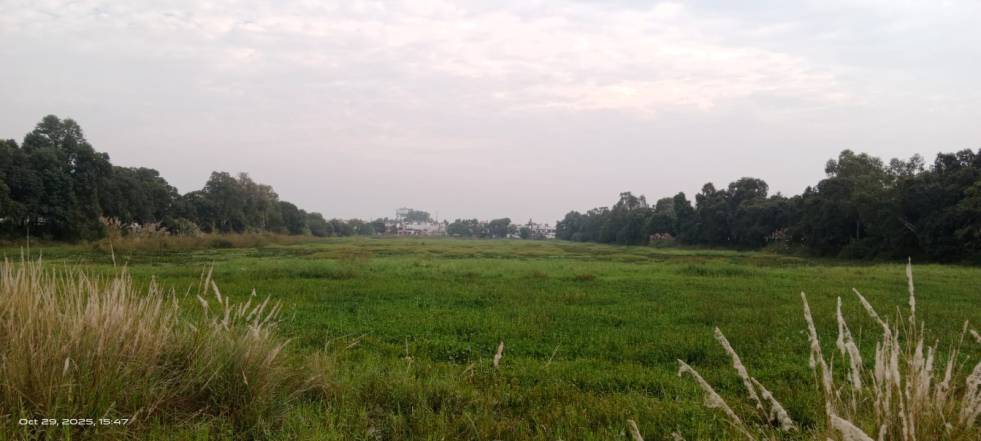
(Feature Image: Vegetation layer covering entire surface of Giri taal of Kashipur in US Nagar, Uttarakhand in Oct. 2025)
While the World Wetlands Day (WWD) 2026 on February 02 will be celebrated with “Wetlands and traditional knowledge: Celebrating cultural heritage” theme, the top ten reports about wetlands in India in one year since 2025 WWD shows our collective failure in protecting both the traditional knowledge and cultural heritage concerning Indian wetlands. At national level, the progess of identification and notification process of wetlands over 2.25 ha is very slow. Official health cards of very few wetlands are in public domain.
Proposal for an industrial park in Assam have endangered the rich aquatic, wildlife and socio-economic services offered by Dorabeel wetland. In J&K the solid waste dump near Anchar lake has ruined the livelihoods of lake dependent people. A study has found reduction in wetlands area in Kerala.
A controversial private road has been built along the ecologically sensitive shorelines of the Periya Eri and Chitteri lakes in in Chengalpattu district of Tamil Nadu. The dumping of cow dung and panchayat lacking management funds have defeated the purpose of over 20 Amrit Sarovar in Karnal, Haryana created after spending crores. In Dharmashala, Himachal Pradesh the historic Dal lake has turned dry after an ill convinced renovation plan.
The reports from Uttar Pradesh show how conservation burden alienating local people has affected the management of several major wetlands. Amid this alarming situation, the climate change impact, invasion of micro-plastic and harmful algal bloom, decline in aquatic diversity have worsened the state of wetlands governance affairs across the country. The first part of the overview highlighting continual degradation of Ramsar wetlands in India can be seen here.
1 Only 102 of over 200k wetlands notified in country Of the country’s estimated over 200,000 wetlands, only 102 have been notified and even these are concentrated in 3 states and one Union territory, data from the Ministry of Environment, Forest & Climate Change (MoEF&CC) has revealed as per this March 2025 report. While Rajasthan has notified 75 wetlands and Goa 25, both Uttar Pradesh & Chandigarh have notified 1 each, the data shared in response to an RTI and available on ministry’s Wetlands of India Portal, showed.
In 2024, the environment ministry filed an affidavit in the top court in the Anand Arya Vs Union of India, giving details of the notified wetlands. It said that only 92 of the 231,195 wetlands, an estimate of the ISRO in 2021, have legal protection. The remaining 10 were notified after Nov. 2024. Further, in response to queries on why notified wetlands remained concentrated in 3 states and one UT, the ministry said that water and land are state subjects and it is the discretion of the state govts to notify them.
Hence, Wetlands (Conservation and Management) Rules 2017 rules currently apply to only 102 wetlands and 96 Ramsar sites. Last year, about seven years after the rules were issued, the ministry released its “Wetland Wise Use” framework for implementation of the rules. Despite the centrality of the wise-use concept, the term remains vague, the document acknowledged. (Jayashree Nandi)
As per this report, an affidavit filed by Centre on Oct. 07, 2025 revealed that out of the 2,31,195 wetlands inventoried in the SAC Atlas 2021, ground-truthing of 1,89,270 wetlands has been completed, and boundaries of 1,12,460 wetlands have been demarcated. The court granted time till Oct. 19, 2025 for the exercise to be completed for the remaining wetlands and posted the matter for further consideration on Oct. 28, 2025.
2 Assam Proposed industrial park endangers Dorabeel wetland As per the govt’s plans, an industrial park is set to come up on the wetland – a disturbing move that triggered a mass protests. Located near Bijoynagar area, Dorabeel is much more than a wetland. Aside from supporting wide-ranging plants, mammals (including the endangered Gangetic river dolphin), birds (four endangered species of vultures), fish, reptiles and birds, its ecosystem overlaps with grassland (which sustains a village grazing ground) and fertile farmland. This makes the entire area of around 1,800 bighas (excluding agri land) a haven for diverse species as well as a constant livelihood provider for the local populace who are into tilling and fishery. No less significant is the cultural worth of the wetland, which is rooted in local lore and has been at the Centre of traditional cultural and religious practices for generations.
The industrial park will permanently damage the wetland’s biodiversity, especially the Gangetic river dolphin, which breeds in the Kolohi river connected to Dorabeel. Villagers pointed out that during floods, the grazing field holds the overflow waters of Dorabeel & any shrinkage in the floodplain will inundate nearby villages, creating a disaster. Construction will also reduce groundwater recharge, leading to scarcity of water for drinking & irrigation.
When asked, Kamrup district commissioner Deba Kumar Mishra said that objections from local people and organizations were being taken for the second time (from Sept 1 to Oct. 1, 2025) and a public hearing would soon follow. The local people are unhappy with the second notification, saying that it only consolidates the previously proposed two plots into a single plot of 150 bighas for the construction of the logistics park. “We will continue with our fight to protect the wetland and the grazing ground, which is our collective heritage,” said Md Nizamuddin Ahmed of the Dorabeel Grazing Field Protection Committee.
3 Jammu & Kashmir Toxic landfill waste is affecting livelihoods around Anchar lake As pollution from toxic waste spreads across canals and fields, families who relied on Anchar Lake for food and income face shrinking harvests, vanishing fish, and broken promises of waste management reforms.
In the 1990s, local fishermen supplied 800 to 1000 kg of fish daily to Srinagar markets. Today, the catch barely reaches 50 kilograms, most of it unsold. Along the western shore, the Achan landfill rises like a mountain of waste. Every day, trucks dump tonnes of garbage. Toxic leachate drains into water and soil, infiltrates canals, and spreads through the waterways that once supported entire communities.
Anchar Lake stretched across 19 sqkm for centuries. Fishing families, nadru cultivators, and vegetable farmers across dozens of villages depended on its waters. It powered markets, traditions, and Kashmir’s food economy. Today, the lake covers only 7 sqkm. Thick weeds choke the remaining water, and sewage and landfill toxins dominate its surface. Scientists estimate that 600 families once earned a living from nadru cultivation. Nearly 1,000 more depended on fishing, farming, and lake-based trade. That economy has collapsed.
Irrigation canals now carry toxic leachate from Achan landfill into the fields. Crops wither, livestock refuse to drink, and farmers struggle with shrinking harvests. Anchar Lake is dark and lifeless, leaving families without livelihoods.
Families once earning seasonal incomes now struggle with poverty. Women who processed and sold nadru lost their livelihood. Elderly fishermen cannot adapt and depend on relatives. The social structure of lake-dependent communities collapses alongside the ecosystem. Villages that organised life around the lake now turn away from its poisoned waters.
4 Maharashtra Only 18 out of 23,046 wetlands get health cards Maharashtra has recorded official health cards for only 18 of its 23,046 major wetlands, leaving the state dangerously behind its peers, environmentalists said. Maharashtra’s shortfall stems from an incomplete ground-truthing exercise assigned to the National Centre for Sustainable Coastal Management (NCSCM). Without ground-truthing, wetlands cannot be formally notified for protection. Documentation is in progress, as per information obtained by NatConnect through a RTI.
According to the latest data on the Union MoEFCC Indian Wetlands portal, Madhya Pradesh leads the nation with 94 wetland health cards, followed by Odisha (77), Bihar and Tamil Nadu (71 each), Uttar Pradesh (58), Delhi NCR (56) and Jharkhand (43). Nationally, the gap is stark: of more than 200,000 wetlands larger than 2.25 hectares identified by ISRO’s National Wetland Inventory Atlas in 2010, only 684 have health cards in the public domain.
The MoEFCC portal shows only 1,309 wetlands listed nationwide, including 96 internationally recognized Ramsar sites, against the NWIA list of over 200,000 major wetlands. “The govt announces Ramsar sites with great fanfare but neglects broader wetland conservation,” B N Kumar, the director of the environmental watchdog NatConnect Foundation pointed out.
5 Kerala Study calls for urgent conservation as wetlands shrink Kerala’s wetlands, a lifeline for biodiversity and livelihoods, have witnessed a decline of 58 ha between 2019 & 2024, according to a study that assessed temporal changes using multi-date satellite data.
The study, conducted by the Centre for Water Resources Development and Management using Sentinel-2A MSI imagery within a GIS framework, revealed that the total wetland area in Kerala shrunk from 152,826 ha in 2019 to 152,768 ha in 2024.
The study also documented the disappearance of three wetlands covering 74.78 ha and the emergence of three new wetlands spanning 0.52 ha, reflecting the dynamic and shifting nature of wetland boundaries under changing climatic and anthropogenic pressures. While the overall reduction appears modest, localised wetland losses, especially in inland systems, could trigger serious ecological consequences and needs more detailed study.
Inland natural wetlands accounted for 45.09% of Kerala’s total wetland area, followed by coastal natural wetlands (28.03%), inland man-made wetlands (24.38%), and coastal man-made wetlands (2.5%). The analysis found that inland waterlogged areas shrank by 73.58 ha, tanks and ponds declined by 11 ha, whereas coastal natural wetlands such as mangroves and lagoons registered increase of 61 ha.
6 Road built on lakes near Vandalur A 30-foot-wide bituminous road has been laid along the ecologically sensitive shorelines of the Periya Eri and Chitteri lakes in Unamancheri village near Vandalur in Chengalpattu district in Tamil Nadu. The road – built on land officially classified both as a water body and reserve forest – provides access to a film producer’s 300-acre property, allegedly proposed to be developed into a film city.
The legitimacy of the road-cum-bridge has been a subject of controversy for the past 5 years, with all the govt departments so far pleading ignorance and claiming it as a private initiative encroaching on the waterbody. However, following a series of protests by the local residents, officials from the water resource department have confirmed that the road was approved by the Kancheepuram District Collectorate in 2019. The village was then brought under Chengalpattu district after bifurcation in September 2019.
The project, which began in 2021, was later brought under the Namakku Naame public-contribution scheme. However, villagers contested this claim stating that they never contributed the mandatory 50% share required under the scheme. Local residents allege that the road leads directly to a 300-acre land parcel where a film city is being planned. The original path — classified as vandi pathai (a waterbody access route) and only three to five feet wide — was illegally widened into a 30-foot road, encroaching deep into the water body. A 750-metre stretch, including a bridge, has been constructed, they claimed.
7 Haryana ‘Amrit Sarovar’ facing threats Despite crores of rupees being spent on these Sarovars, poor maintenance and villagers’ lack of cooperation are threatening them. The wastewater treatment systems, designed to filter water for irrigation and other uses, are frequently choked by cow dung and other waste. At least 20 villages in Karnal dist – including Ramba, Chochra and Ballah – are facing issues due to cow dung disposal into drains.
In Karnal district, the govt initially sanctioned 75 Sarovars, later expanding the plan to cover all water bodies under the Amrit Sarovar scheme. The cost of developing an Amrit Sarovar is approximately Rs 18 lakh per acre, while upgrading it to Amrit Plus costs around Rs 29-30 lakh per acre. However, village panchayats, responsible for maintenance, often lack funds and resources, leading to neglect.
The Panchayati Raj Department, along with the Irrigation Department and Micro Irrigation Command Area Development Authority (MICADA), oversees the project. The govt has increased the number of sanctioned Sarovars to 205, with 20 Amrit Plus Sarovars completed and inaugurated, 15 awaiting inauguration and 35 more under development. The govt has allocated Rs 170 cr for the project, of which Rs 35.86 cr has already been spent. However, despite regular cleaning efforts, ground reports highlight severe neglect & contamination.
8 Uttar Pradesh Challenges in Wetland conservation In first of three part series, India Spend report highlights that several wetlands in the state have been facing threats from farming and other human activities reducing their area and environmental services. Mentioning the case of Talab Baghel (1383 ha) the largest inland natural lake in Bahraich district, the report finds that govt wetland protection policy and laws are clashing with inheritance, displacement and politics on the ground. It further reveals difference between satellite-identification of wetlands and their existing land use.
Citing example of Gonda’s Parvati Arga Bird Sanctuary the second part signifies that local communities, particularly women, are crucial in protecting wetlands, but they need support and empowerment to conserve these ecosystems. The third part takes the example of Nawabganj Bird Sanctuary in Unnao, a Ramsar site and focuses on how developing holistic understanding regarding the natural wet and dry periods of wetlands & involvement of local people are crucial steps for their sustainable management. Minus these, the conservation efforts could be counterproductive and severe communities’ connections with the wetlands.
9 Himachal Pradesh Dal lake remains dry Revered for its religious significance and famed as a tranquil retreat, the historic Dal Lake in Naddi, Dharamsala has been without water ever since ill-conceived renovation efforts disrupted its delicate natural balance a few years ago. The lake—long considered a cultural and spiritual symbol for the region—was altered in the name of “development”, but the fragile ecosystem couldn’t withstand the interference. Since then, multiple government departments have tried and failed to revive it.
In a last-ditch effort, the govt turned to “Lake Man”, an expert known for reviving dying water bodies. Following his advice, the district administration has begun efforts to plug the leakage. Dharamsala BDO Abhineet Katyayan said that Rs 15 lakh was utilised for desilting the lake, and now an additional Rs 10 lakh is being spent on constructing a retaining wall.
Locals trace the lake’s degradation to an excavation carried out a few years ago, which disrupted the green grass floor known locally as “Dhruv.” Many residents lament the current state of the lake, calling it a blow to their cultural identity. “Our childhood memories, rituals and festivals are deeply linked to this lake,” said one local elder. “It’s heartbreaking to see it dry. If we don’t act now, other natural treasures will meet the same fate.”
10 Haryana Dhauj lake filling fast with farmhouses The 100-acre seasonal waterbody – one of several rain-fed lakes within the creases of the Aravali ranges in Haryana and Rajasthan – is today a fraction of its prime. The drying that began in the 90s as rains became erratic and the catchment began to be viewed as prime real estate is now irreversible. Construction has since made deep inroads.
This is how Dhauj lake, for which the state irrigation dept has a Rs 100-cr revival plan, is gradually getting wiped off the map. Parts of its submergence and catchment areas enjoy legal protection as ‘shamlat deh’ or village common land but that hasn’t come in the way of the terrain being flattened with mud, plots getting carved out, demarcated and sold. The amoeba-shaped lake has 11 ha in Mangar village, 6.07 ha in Silokhari village & 7.28 ha in Dhauj village.
Other Relevant Reports
Wetlands protection policies missing in action Despite the introduction of the Wetlands (Conservation and Management) Rules in 2010 and their revision in 2017, India’s wetlands continue to degrade at an alarming rate. These ecosystems, vital for biodiversity, water security and flood mitigation, face unchecked urban encroachments, pollution and poor enforcement of conservation policies. Judicial interventions have repeatedly highlighted the ecological and social significance of wetlands, yet progress remains elusive.
In Dec. 2024, conservationists Manu Bhatnagar and Vikrant Tongad filed a plea before the Supreme Court, urging the inclusion of all wetlands less than 2.25 hectares under the Wetlands (Conservation and Management) Rules, 2017. This plea highlights a longstanding judicial push for wetland conservation, dating back to 2001, when the Supreme Court directed the government to create a comprehensive inventory of wetlands. However, persistent delays and non-compliance have left many of these vital ecosystems vulnerable to degradation and encroachment.
The responsibility for protecting water bodies lies with state govts, yet many have failed to act effectively. In July 2024, the SC ordered the Uttar Pradesh govt to investigate illegal fillings of water bodies in Nagina tehsil, Bijnor district. This case highlights the pervasive neglect of water resources, worsened by rapid urban expansion and encroachments. Similarly, Tamil Nadu’s Pulicat Bird Sanctuary faces ongoing threats from land-use changes. While the Tamil Nadu SWA has advocated for extending protections under the 2017 Wetland Rules, significant action remains uncertain.
Climate change killing India’s rivers, lakes, wetlands? A major 2025 global analysis used satellite data to show that continents are losing freshwater from rivers, lakes, wetlands and soil at an unprecedented rate. It marked a large-scale decline in terrestrial water storage and has major implications for Asia. This shift is being driven by shorter and erratic monsoon, longer dry spells, rapid groundwater depletion, reduced snowmelt, and rising temperatures that accelerate evaporation.
Experts are calling for aggressive groundwater recharge, protection of wetlands, efficient irrigation, treated-wastewater reuse, and river-basin-level planning. Without urgent action, India’s rivers may continue drying earlier each year — turning a seasonal challenge into a long-term water-security crisis.
Declining waders indicate deterioration of wetlands A decade-long study in southwestern India found that rising salinity, temperature shifts, and nutrient imbalances disrupted fish populations, leading to a significant decline in wading birds like egrets and herons. Conservation efforts such as wetland restoration, pollution control, and sustainable fishing are essential to maintaining healthy habitats for wading birds and preserving biodiversity.
Unveiling microplastic menace in wetlands A recent paper ‘Source, fate, toxicity, and remediation of micro-plastic in wetlands: A critical review’ delves into the sources, ecological impacts, and potential remediation strategies for microplastics in wetland ecosystems, emphasizing the urgent need for targeted research and mitigation efforts. The presence of microplastics in wetlands poses significant threats to aquatic organisms and plants. These impacts occur at various levels of the ecosystem and include physiological, behaviour and ecological disruptions.
Toxic blooms invade India’s waters An alarming increase in harmful algal blooms (HABs), which are toxic algal overgrowths that threaten ecosystems and public health, is occurring in India’s lakes, rivers, and coastal waterways.
Revisiting HAB in India This study highlights the current state of HAB research and monitoring in India, where ∼17% of the human population resides in the vicinity of its long coastline and is dependent on the sustainable blue economy.
HAB turning India’s waters toxic Many lakes, wetlands and coastal waters across India have started turning bright green, red or murky. It’s a warning sign pointing to a worsening climate crisis.
SANDRP

 SANDRP