(Feature Image Source: Question of Cities)
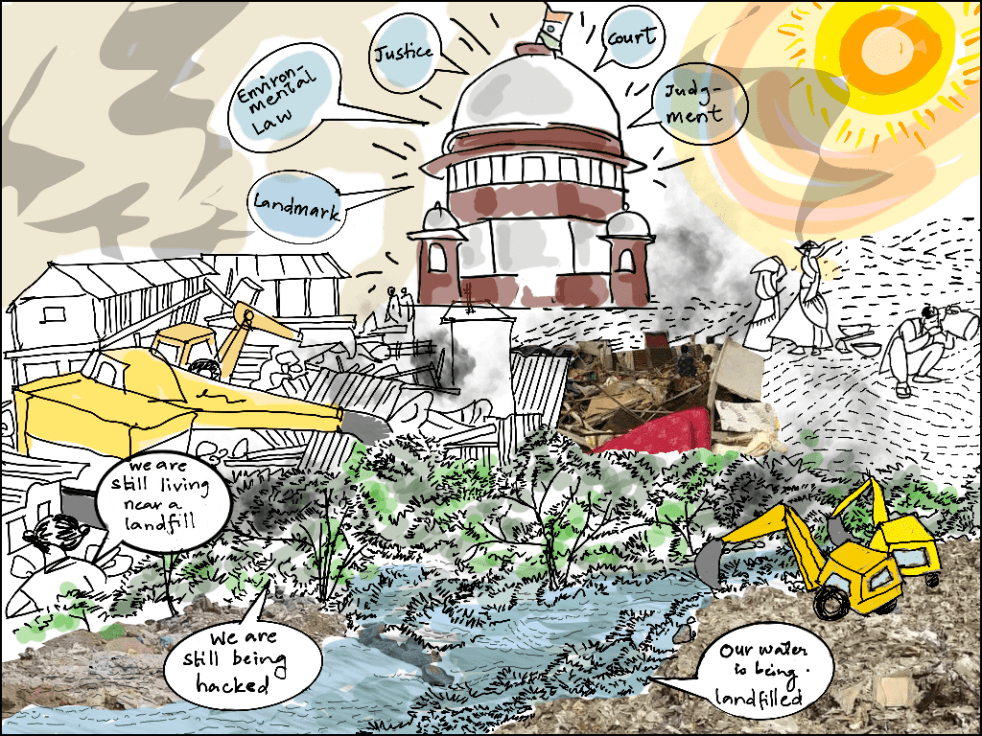
In an interview (see below) to Question of Cities, Senior High Court Lawyer Gayatri Singh explains, giving examples from court cases, why she has a negative sense of the Judiciary and how courts are passing conflicting orders. She showed how slum dwellers were forced to live in polluted areas, detrimental to their health. She shows examples of how judiciary interprets environmental laws differently for the powerful sections and differently for the poor people and citizens.
She also explains why government policies has to be examined in the context of fundamental rights of the people, public interest and environment. She underlines that each case related to environment has livelihood implications for poor people. She also explains how different judges interpret the laws differently, which creates problematic precedents that then gets used for future cases too. She also raises how judges are not seen concerned about implementation of the orders they give and contempt of law cases rarely help.
The lawyer also explains how difficult it has become for the environment movement groups to approach the courts. All this is not coming out for the first time, but when it comes from a senior High Court lawyer, one hopes the concerned will give these issues the required attention and urgently take up appropriate corrective steps. These issues need to be debated, disseminated and taken to the right quarters.
‘I have a negative sense of the judiciary; conflicting orders are passed’ HC Lawyer Gayatri Singh Every environmental case has had to do with people’s lives and livelihoods.
When the BMC and Maharashtra government issued notices to people evicted from Tansa pipeline to go to Mahul industrial area, the slum dwellers approached the Bombay HC. Bombay High Court framed the issue: Can you evict people and forcibly make them live in an area that’s detrimental to their health? It decided ‘No’. Several case laws were relied upon, including international, to show that the right to housing is not simply a roof over the head but there must be a healthy and safe environment, assured water supply and electricity, open spaces too. This is not only about individual cases in Mumbai. These can be cited in other cities too.
I see two problems. One, how the judiciary interprets these (environment) laws. When it’s businesses, developers, and those in power, the interpretation favours them. Two, government policy; authorities come to courts and cite government policy which the court says it cannot interfere with. If the policy is against public interest and the environment, it’s important that courts go into that.
This has happened in the case of the dumping yard in Kanjurmarg which is on a wetland and was polluting the water, the creek, the mangroves, the groundwater and, obviously, the people around. This is on record. The residents and environmentalists have been fighting this case since 2012. This is forest land which means it cannot be used for non-forest purposes – a straightforward case – but it has dragged on. Finally, after 15 years, when it was heard, the High Court held that the Forest Conservation Act had been violated and ruled against a dumping yard there. The contractor filed an appeal and the order was stayed. The result was that the company continues to dump both hazardous and non-hazardous waste in an ecologically sensitive area adversely affecting the health of thousands of residents.
Similarly, in the case of salt pan lands which are affected by inter-tidal waters, the government has allowed residential buildings. With climate change, the lands ought to have been protected. Unfortunately, the Supreme Court threw out the case. The field is now open for builders. These and many such cases have been thrown out where activists painstakingly gathered information about violations. Importance is given to tenders and contracts because someone says ‘my crores of rupees are going down the drain’ but forests cut down is not equally urgent. And then, it’s also about which judge hears environmental cases.
The point is that each judge looks at it differently. That’s why there are such conflicting orders. There are some judges who pass sweeping orders in favour of the environment; they couldn’t care about the consequences. There was Justice Abhay Oka, who came out strongly against post-facto environmental clearances for projects, but an influential party filed a review application which was reopened.
People, even activists, hesitate to go to the courts. You might get an order in favour of the environment but it can be stayed in the higher court and then have an adverse impact on the entire campaign. The legal fight is linked to the agitation on the ground; it cannot be any other way. If people come out, they can get arrested as in the Aarey tree-cutting case in which the state government filed FIRs. This demoralises people as much as the long delays in the court.
Judges being targeted for passing strong orders on environment: Abhay Oka Justice Oka was speaking on the topic concerning clean air and sustainability at an event organised by the Supreme Court Bar Association (SCBA). “Unfortunately, these activists who do this pro bono work. They take so much effort. They take so much risk by taking the environmental issues to the court. They’re ridiculed by the political class. They’re targeted by religious groups. This is the most unfortunate situation,” Justice Oka said in his speech.
He lamented that only a few citizens showed “enthusiasm and courage” to take up environmental issues before the court due to lack of support from the society and those who took up such issues to the court were labelled “anti-development”. “There are very few citizens who show enthusiasm and more importantly, muster courage to take up environmental issues by approaching the court. Unfortunately, the reason is that they don’t receive active support of the society at large. In fact, our experience has been that those who take up environmental issues to the court are branded as anti development and somebody who wants to obstruct their developmental activities,” he said.
HYDRO POWER PROJECTS
2025: Hydro Projects Accidents & Disasters in Himalaya The accidents and disasters occurring particularly during monsoon months have affected several Hydro Electric Projects (HEP) both built and under construction in Himalayan states of India. In this overview, we put together information about such disasters to underline their increasing vulnerabilities to climatic disasters endangering the lives of workers and local people living in the vicinity of these projects.
Himachal Pradesh: Sainj HEP Remains Out of Operation for over 4 months The 100 Mw project of the Himachal Pradesh Power Corp Ltd (HPPCL) is the fourth HEP which was severely affected by flash flood in Jiwa nullah on June 25, 2025. This is not the first time the project has faced the flood damages. In July 2023, the project was blamed for worsening flood damages in downstream areas after its gates got jammed due to muck and silt. In May 2019, the project remained out of operation for couple of months after significant leakages in its adit tunnel-4.
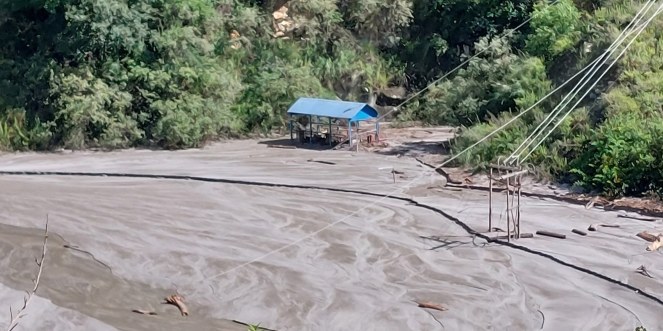
Sunni HEP workers stage protest Hundreds of workers staged a two-day strike on Nov. 13 at the 382 MW Sunni Dam Hydroelectric Project against Ritwik, the project construction company for its failure to implement the agreement reached with the workers and the subsequent layoffs. Speakers stated that the company has continuously been perpetrating injustice against the workers. They are being denied numerous benefits under labor laws and are also being harassed for raising their voices. Three workers who were fired nearly three months ago have yet to be reinstated. The agreement reached between the workers and the company management on August 22 is also not being implemented by the company and they are forced to strike every month.
DAMS
Singur Dam Facing Imminent Threat The irrigation department has said that the Singur dam, which supplies 6.96 tmc ft of drinking water to the city, faces an “imminent breach risk”, and to avoid “catastrophic” failure the reservoir needs to be immediately emptied substantially for urgent repairs to the dam’s severely damaged bund. The department officials, at a meeting of Singur dam safety on November 11, concluded: “if repairs are not taken up immediately, a risk of breach exists, leading to catastrophic downstream flooding (impacting Manjeera barrage, Nizamsagar dam, and several check dams).”
Warning of an “imminent breach risk,” the department called on the government to instruct the HMWS&SB to find alternative drinking water supplies to Hyderabad instead of from Singur till the repairs are completed. The water drawn from Singur is supplied to several areas of the city including Banjara Hills, Jubilee Hills, Madhapur, Gachibowli, Puppalguda and Manikonda. The irrigation department also said that depleting the Singur reservoir will impact Mission Bhagiratha supply which will need to draw water from the downstream Manjeera barrage when Singur is under repairs. Mission Bhagiratha water from Singur, totalling 5.7 tmcft a year is supplied to erstwhile unified Nizamabad and Medak districts.
AP scraps Banakacherla project The Andhra Pradesh govt has decided not to go ahead with the contentious Polavaram-Banakacherla project. The water resources department has officially revoked all tenders called for the detailed project report (DPR) of the Polavaram-Banakacherla scheme.
Instead, it has proposed a new project, which will be planned to take water from Polavaram to Nallamala sagar, which is part of the Veligonda project in Prakasam district. The new scheme is estimated to cost around Rs 58,000 crore as against Rs 90,000 crore required for Banakacherla scheme. The draft proposal suggested pumping of water from the Polavaram project to the Prakasam barrage and from there a separate canal would be taken up to link it with the Nagarjuna Sagar right canal. Then, water will be taken to Bollapalli reservoir near Vinukonda and from there channelled directly into the Nallamala sagar reservoir. The Banakacherla phase will be considered at a later stage depending on the completion of the initial phase.
CWC approves Polavaram ECRF Dam Gap II works The Central Water Commission has given its ‘in-principle’ approval for the Polavaram project’s earth-cum-rock-fill dam gap-II works. This is conditional to the clearance of certain designs and drawings. Based on the approval, the authorities would be taking up gap-II works from the sand reach from 430 metres to 890 metres chainage as the diaphragm wall works have been completed in that stretch of the sand reach. With regard to the ECRF dam gap-I, the authorities are yet to get the nod from CWC for some designs and drawings.
L&T response to Telangana on Medigadda L&T, in its response dated Nov 11 to Telangana threat through letter of Nov 3 to black it nationally if they do not repair Medigadda barrage at their own expense has said the works being asked of it would require several steps to be completed which need to be done by the department. These include tests to be done at the barrage site by the Central Water and Power Research Station (CWPRS) for which depletion of water in Godavari river was a must, and this in turn requires construction of a cofferdam, which in turn required drawings for its layout, and design.
Only once the coffer dam was in place could any work including testing be taken up, L&T indicated. It also said investigations will need to be done based on designs to be provided by the rehabilitation designer to be picked by the irrigation department as per guidelines of the National Dam Safety Authority, and sought a list of activities required from the contractor to facilitate the rehabilitation designer and CWPRS together.
Telangana seeks CWC’s help to restore 3 damaged Kaleshwaram barrages Chairing a high-level review meeting at the secretariat, Irrigation minister N Uttam Kumar Reddy on Nov. 12 said the govt’s priority was to safeguard the massive public expenditure incurred under the previous BRS regime and restore the structures responsibly. The minister said once floodwaters recede, a series of geo-physical and hydraulic tests would be conducted by the Central Water and Power Research Station (CWPRS), Pune, to assess the extent of damage and guide rehabilitation design. Preliminary testing during the monsoon has been completed, and detailed investigations would resume within 15–20 days after river discharge levels drop.
Acknowledging that the Central Designs Organization (CDO) of the irrigation department had failed in its duties, Uttam said the govt decided to engage independent, highly qualified technical institutions and consultants. The govt has invited requests for proposals from reputed firms, giving preference to those with formal tie-ups with IITs or national technical bodies. Five firms were shortlisted, from which three will be chosen based on technical and financial evaluation. The selected consultant will use CWPRS data to prepare detailed restoration designs and cost estimates for all three barrages, he said. Uttam made it clear that the entire cost of testing and repairs would be borne by the original contractors responsible for the damage.
Uttam further reviewed multiple irrigation projects, including Sammakka Sarakka, Seethamma Sagar, Sitarama Sagar, Modikunta Vagu, Chanaka-Korata, and Chinna Kaleshwaram, directing officials to expedite clearances and secure a No Objection Certificate from Chhattisgarh. He also assessed progress on the Dr B R Ambedkar Pranahita-Chevella project, J Chokka Rao Devadula scheme, Dindi project, and Singur canal works, besides reviewing legal, environmental, and inter-state coordination issues.
Meanwhile, the state government in a counter affidavit to the Telangana High Court termed former CM K Chandrasekhar Rao’s plea against the Justice PC Ghose Commission’s findings on Kaleshwaram irregularities “premature”. Principal Secretary (Irrigation) Rahul Bojja said the Commission, constituted lawfully under the Commissions of Inquiry Act, 1952, was only a fact-finding body with no binding effect. The affidavit stated KCR had full opportunity to participate, calling his claims “false and misleading”. It urged the court to dismiss the plea, citing res judicata and previous refusals of interim relief.
Neglect leaves KLIP’s costly pumps idle for 2 years KLIP is today facing the perils of neglect. Designed to irrigate 37 lakh acres across the State, it has been crippled by deliberate neglect and inactivity. Barring a few of the 104 high-capacity pumping units spread across 19 pump houses, including the key Medigadda (Kannepalli), Annaram and Sundilla facilities, most have remained dormant for over four crop seasons. These pumps, with capacities ranging from 27 MW to 139 MW, are designed to lift Godavari River water to elevations of up to 618 metres.
Mullaiperiyar dam is in good shape: NDSA chief Speaking to reporters after inspecting the dam and chairing the fourth supervisory committee meeting, National Dam Safety Authority (NDSA) Anil Jain said on Nov. 11 said the committee inspected various aspects of the dam, including its structure, instruments, hydro-mechanical components, and gallery. “We visually observed the condition of the dam after the 2025 monsoon. As of now, we have not found anything alarming or of a concerning nature. The dam is in good shape,” he said. He added that several issues between Tamil Nadu and Kerala were amicably resolved during the meeting.
The committee also discussed the next steps based on the upcoming report of the remotely operated vehicle (ROV) survey assessing the dam’s underwater condition. He further said that the supervisory sub-committees had finalized the scope of work for comprehensive dam safety evaluation. When asked about Tamil Nadu’s request for maintenance work on the baby dam, Anil Jain said it depended on obtaining permission from the MoEF for felling trees. “Both states have agreed to approach the MoEF to expedite the process of granting permission,” he said.
Former regulatory panel chief bags dam safety award Devendra Kumar Sharma, president of International Commission on Large Dams and former chairman of the Himachal Pradesh Electricity Regulatory Commission, has been conferred with the ‘National Honour for Global Leadership in Dam Safety’. Sharma was honoured at the third ‘Indian Near Surface Geophysics’ conference organised by the Aqua Foundation Academy and the European Association of Geoscientists and Engineers in New Delhi on November 13 and 14. He hails from Mehrin Kathla village in Bilaspur district. Sharma has over 44 years of experience in energy and water resources sectors in India and abroad. He has worked as Chairman, Bhakra Beas Management Board, where he was responsible for managing dams and six power houses.
Decisions of EAC meeting on River Valley Projects held on Oct 31 2025: 1. Adnadi Close Loop Pumped Storage (1500 MW) in 240.61 Ha located at Village Adnadi, Bhandri, Jambli, etc, Sub-dist Chikhaldara, District Amravati, Mah by Adani Hydro Energy Ten Ltd – Terms of References: APPROVED
2. Mudghusri Close Loop Pumped Storage (1000 MW) in 307 Ha at Village Murghusri & Reserved Forest, Sub-district Bodla, District Kabeerdham, Chhattisgarh by Renew Vidyut Tej Pvt Ltd – Terms of References: APPROVED
3. Gond Major Irrigation Project (10 MW & CCA of 33,015 ha) in 1088.57 Ha at Village Siroli, Sikra, Bakwa, Bhadaili, etc, Sub-District Majhauli, Kusmi and Deosar, District Singrauli and Sidhi, MP – Amendment in Terms of References: APPROVED
4. Bargi Open Pumped Storage Hydro Project (1000 MW) at Village Pindrai Mal. (Sahajpuri), Salaiya Mal.(Barangada), Jamthar, Khapa, Newari and Pondi, Sub- Dist Narayanganj, Dist Mandla, MP by Serentica Renewables India 21 Pvt Ltd – Terms of Reference: APPROVED
URBAN RIVERS
‘Stop tree-felling along Pune riverbanks’ Chief conservator of forests (land records), Maharashtra forest department, N Jaikumaran, has directed Pune forest department officials to stop any tree-felling activity related to the Riverfront Development (RFD) project along the banks of the Mula, Mutha, and Mula-Mutha rivers. The official communication – issued to the conservator of forests, Pune, on Nov 10 comes pending the evaluation of ‘deemed forest land’ in riparian zones by an expert committee constituted by the state of Maharashtra in keeping with a Supreme Court (SC) order dated March 4, 2025.
The directive also comes in the wake of a representation submitted by advocate Ronita Bhattacharya Bector and Kedar Bhagwat, director, Ecological Society, Pune; urging authorities to prevent further ecological damage along the banks of the city’s rivers. Jaikumaran has instructed the conservator of forests (territorial) to take ‘appropriate action’ to restrain tree-felling during the expert committee’s evaluation, and inform applicants of the action taken. Furthermore, a report has been sought by the state forest department’s Nagpur office. According to official data, nearly 22,000 trees are expected to be felled for the RFD project in Pune and Pimpri-Chinchwad.
Heaps of waste turn Musi River into eyesore Heapsof garbage and debris lie scattered along the Musi River stretch between Puranapul and Moosarambagh areas and officials yet to take up cleaning drives in the Musi River. The situation has drawn attention to a growing lack of civic sense among officials, which has also turned into an eyesore and tarnishing the city’s image. It has been over 15 days since the Cyclone Montha hit the city, which led to the opening the gates of twin reservoirs Osman Sagar and Himayat Sagar water being released in the River Musi, the debris flowed and now lies on the banks of river.
Fed up with govt ‘apathy’, citizens take up post-Chhath clean-up With the authorities yet to clear the mess left behind on riverbanks after Chhath Puja celebrations, citizens Nov. 15 took it upon themselves to clean up the Ghaggar. Chhath celebrations were allowed at four major ghats in the city, of which only one was cleaned by the authorities, that too following a complaint to the DC and after the press highlighted the matter. Volunteers said the irrigation department was to undertake the cleaning of the river and its banks, while HSVP was to take up a similar drive on the kaccha road leading to the river. With neither reportedly doing the needful, and the riverbanks strewn with garbage, residents took up the cudgels to restore the ghats under the Save Ghaggar Campaign.
After public outcry, waste removed from Ghaggar banks A Day after images of Ghaggar banks littered with waste triggered public criticism, workers of the Haryana Shehri Vikas Pradhikaran (HSVP) today reached the Chhath Puja venue and began a cleanliness drive. The move came nearly 24 hours after environment activists and residents flagged the neglect at the state-level celebration site, where heaps of floral offerings, polythene bags and food waste lay scattered in the aftermath of Chhath rituals. Residents, however, said the delayed response underlined a lack of planning. Activists from Save River Ghaggar Campaign, who had raised the alarm about the neglect yesterday, welcomed the cleanliness drive but demanded a system in place for future events.
Chhath Puja over, heaps of waste dot Ghaggar banks in Panchkula Days after Haryana’s state-level Chhath Puja celebrations along the Ghaggar in Sector 23 here, the glow of diyas and devotion has dimmed — leaving behind a trail of waste on the banks of the river. Despite prior assurances of post-event sanitation, the area bore the unmistakable stench of neglect. Civic workers never arrived. What makes the situation more concerning is that activists had made a request in writing to the Deputy Commissioner, Panchkula, on the day of the event — urging authorities to install dustbins, clean the ghats and deploy sweepers during and after the celebration. The letter, dated October 27 and addressed by Tapasya Sharma, co-founder of Save River Ghaggar Campaign, was marked to the XENs of the Haryana Shehri Vikas Pradhikaran (HSVP) and the Irrigation Dept for necessary action. However, the requests went unheeded.
11th Mission Clean Kley River The Apatani Youth Organisation (AYA) conducted the 11th edition of Mission Clean Kley River, with the theme ‘Clean Ziro, Green Ziro’, here in Lower Subansiri district on Nov. 13. During the cleanliness drive, the entire stretch of the Kley river – the lifeline of Ziro valley – and all its tributaries were cleaned by thousands of volunteers, including students from various educational institutions, members of government departments, police personnel, and members of panchayati raj institutions, NGOs, and apex bodies of the valley. The entire region was divided into 16 sectors, and each sector was supervised by a HoD, supported by AYA volunteers. The Mission Clean Kley River initiative aims to strengthen community engagement in environmental conservation, promote sustainable waste management practices, and ensure the long-term preservation of Ziro’s natural ecosystem. (DIPRO)
RIVERS
BRAHMAPUTRA River Traveller – A Majestic Journey Along the Brahmaputra Speaking Tiger Books brings forth a remarkable new work by acclaimed journalist and author Sanjoy Hazarika — River Traveller, an epic narrative that traces the life, history, and mysteries of one of the world’s great rivers: the Brahmaputra.

What are the unique challenges that emerge due to the river’s transnational existence? What are some of the pressing environmental and developmental concerns related to the river and what could nimble policymaking look like for such a dynamic landscape? To answer all this and more, renowned author, journalist, and human rights advocate Sanjoy Hazarka, joins Kripa Koshy, Staff Programme Manager, to discuss pressing contemporary issues related to the vast Brahmaputra river, exploring themes covered in his recently released book. Here is an excerpt from ‘River Traveller: Journeys on the Tsangpo-Brahmaputra from Tibet to the Bay of Bengal’, by Sanjoy Hazarika. Here the author speaks with Mayank Chhaya on his new book “River Traveler: Journeys on the Tsangpo-Brahmaputra from Tibet to the Bay of Bengal’
GODAVARI Telangana HC directs petitioner to approach NGT over pollution plea The Telangana High Court on Nov. 12 disposed of a PIL seeking action to curb pollution in the Godavari river, observing that the NGT is the appropriate forum to hear such matters. The PIL sought directions to stop the discharge of untreated sewage and industrial effluents into the Godavari and its tributaries, to make all STPs fully operational, and to establish new ones across the river basin. It also requested regular water quality checks by the SPCB and CPCB) and public disclosure of data under the ‘polluter pays’ principle.
During the hearing, the court asked the petitioner who was discharging waste into the river. The petitioner cited a study by the Ministry of Jal Shakti, prepared by IIT-Hyderabad, showing pollution along several stretches. When questioned why the case was not filed before the NGT, the petitioner argued that the high court could intervene under Article 21 of the Constitution since the river provides drinking water. The bench, however, noted that the NGT has the technical expertise and authority to order inspections and issue remedial directions.
The judges observed that the problem extended beyond Telangana, noting that in Maharashtra, nearly 200 STPs were planned 15 years ago, but only two were built and are now non-functional. “If the water entering Telangana is already polluted, what is the use of setting up STPs here?” the court remarked. Pollution Control Board’s counsel informed the court that the NGT is already hearing similar cases. The court then disposed of the PIL, granting liberty to the petitioner to approach the NGT for appropriate relief.
NARMADA Single use plastic waste littered along Tawa River bank at Bandravan near its confluence with Narmada in Hoshangabad, two days after a fair organized by Nagar Panchayat Narmada Puram. Pics taken on 09.11.2025.
RIVERS BIODIVERSITY
Reconfirming Smooth-Coated Otter First Photographic Evidence after 25 Years from ITR Abstract: -We reconfirm the presence of the Smooth-coated otter (Lutrogale perspicillata) based on first photographic evidence since 2001, 25 years since being reported by ZSI. The Indravati river separates the states of Chhattisgarh and Maharashtra and the otters have been found to utilize both sides of the river channel. Although this is a widely distributed species across its range but in India, they are mostly limited to protected areas. Across its historical distribution the species is continuously suffering from anthropogenic activities including hunting, habitat destruction, construction of dams, conversion of forest lands etc. The species is in urgent need of intensive surveys and increased vigilance within their distributed range in order to highlight the current status of the species to the scientific and management authorities which in turn may elevate the Smooth-coated otter conservation effort in the country.
The sightings were reported along a 15-km stretch of the Indravati River, which forms the natural boundary between Chhattisgarh and Maharashtra. Researchers said otter groups were observed using both banks of the river, suggesting a wider distribution than previously known. The breakthrough came during a wild buffalo survey when local villagers reported “cat-like” aquatic animals frequently damaging fishing nets. Guided by these accounts, the researchers conducted multiple field visits and captured clear photographs using high-zoom cameras and GPS documentation.
The study warns that illegal fishing, snaring, and habitat disturbances continue to threaten the species, even in remote forest areas. “Otters are apex predators in river ecosystems. Their presence reflects the overall health of aquatic habitats. Protecting them means protecting the rivers themselves,” said co-author Moiz Ahmed. With this confirmed record, researchers note that Chhattisgarh now hosts all three otter species found in India – the smooth-coated otter, the Asian small-clawed otter, and the Eurasian otter – underscoring the state’s ecological significance in central India.
FISH, FISHERIES, FISHERFOLKS
Jhelum, Wular under grave threat The Wular Fisherfolk Unionand Nature Conservation Alliance have raised an alarm over the accelerating ecological degradation of the Jhelum River and Wular lake, warning that without immediate and decisive interventions, these vital water bodies risk losing both their biological vitality and socio-economic significance. They have condemned the persistent government apathy and institutional neglect that have pushed the once thriving ecosystem to the brink of collapse. The recent mass mortality of snow trout across several stretches of Jhelum River have worsened the situation.
SAND MINING
SC prohibits mining within National Parks, Wildlife Sanctuaries The Supreme Court on Nov 13) directed that no mining activities shall take place within national parks and wildlife sanctuaries and within an area of 1 kilometer from such national park or wildlife sanctuary. The Court reiterated its order passed on April 26, 2023, which observed that though such a restriction on mining was imposed with respect to Goa in the Goa Foundation case, there was a need to extend the restriction on a pan-India basis. (https://www.livelaw.in/pdf_upload/299719952025-11-13-630829.pdf) -Court directed the State of Jharkhand to notify the region as wildlife sanctuary. The Court also directed that the rights of the tribals and forest dwellers in the region should be protected as per the Forest Rights Act. Likewise, all schools, rail lines, dispensaries, in the region shall stand protected. However, no mining activity will be permissible.
WETLANDS, LAKES, WATER BODIES
Researchers to study rare dolphin-fisher kinship in Ashtamudi Lake Study aims to unravel mechanisms driving unique cooperation between wild dolphins and traditional fishers in Ashtamudi Lake. No animals will be captured, handled, or disturbed as part of the research.
Experts identify widespread destruction of Kottooli wetlands A group of experts who visited the Kottooli wetlands in Kozhikode city has identified widespread destruction of the body subject to encroachment and pollution.
WATER OPTIONS
Telangana has constructed highest number of water conservation structures Union Jal Shakti Minister C R Patil announced the first-ever Jal Sanchay Jan Bhagidari (JSJB) Awards On Nov 11, with Telangana emerging as the top performer among states and UTs in construction of 5.2 lakh water conservation structures, followed by Chhattisgarh (4.05 lakh) and Rajasthan (3.64 lakh). The JSJB initiative was launched in Surat on Sept 6 2024.
“Under this initiative, states are divided into five zones, and the districts are encouraged to construct a minimum of 10,000 artificial recharge and storage structures. This number is 3,000 for the districts in northeastern and hilly states, and 10,000 for municipal corporations. The structures include those for rooftop rainwater harvesting and the rejuvenation of lakes, ponds and stepwells,” the Jal Shakti Ministry said.
URBAN LAKES, WETLANDS
Pallikaranai marshland dispute Tamil Nadu is the only State in the country to boast of as many as 20 wetlands designated as ‘Ramsar sites’ of international importance in accordance with an intergovernmental environmental treaty signed at Ramsar in Iran in 1971, the State Wetland Authority told the Madras High Court on Nov. 12. Appearing before the first Division Bench of Chief Justice Manindra Mohan Shrivastava and Justice G. Arul Murugan, senior counsel P. Wilson, representing the Tamil Nadu State Wetland Authority (TNSWA), said, the State government was very keen on protecting the wetlands and not allow them to vanish. When the Chief Justice asked why then a PIL had been filed in the court alleging construction of high rise residential towers within the Ramsar site around Pallikaranai marshland in Chennai, the senior counsel said, the petitioner’s averments remain to be just allegations as on date.
He said, the ‘ground truthing’ exercise to fix the boundaries of the Ramsar site at Pallikaranai was yet to be concluded fully and that the Supreme Court, in a case related to protection of wetlands across the country, had granted time till December 2 for the TNSWA to submit its ‘ground truthing’ report. Mr. Wilson urged the Division Bench to take up the present PIL petition for hearing after the Supreme Court hears the related matter next on December 2. Accepting his submission, the judges directed the High Court Registry to list the case before them on December 3. They also extended, till the next date of hearing, an interim order that they had passed on October 31, 2025 in the PIL restraining private real estate developer Brigade Enterprises Limited from constructing the high-rise towers at its Pallikaranai project.
Road built on lakes near Vandalur A 30-foot-wide bituminous road has been laid along the ecologically sensitive shorelines of the Periya Eri and Chitteri lakes in Unamancheri village near Vandalur in Chengalpattu district. The road — built on land officially classified both as a water body and reserve forest — provides access to a film producer’s 300-acre property, allegedly proposed to be developed into a film city.
The legitimacy of the road-cum-bridge has been a subject of controversy for the past five years, with all the government departments so far pleading ignorance and claiming it as a private initiative encroaching on the waterbody. However, following a series of protests by the local residents, officials from the water resource department have confirmed that the road was approved by the Kancheepuram District Collectorate in 2019. The village was then brought under Chengalpattu district after bifurcation in September 2019.
The project, which began in 2021, was later brought under the Namakku Naame public-contribution scheme. However, villagers contested this claim stating that they never contributed the mandatory 50% share required under the scheme. Local residents allege that the road leads directly to a 300-acre land parcel where a film city is being planned. The original path — classified as vandi pathai (a waterbody access route) and only three to five feet wide — was illegally widened into a 30-foot road, encroaching deep into the water body. A 750-metre stretch, including a bridge, has been constructed, they claimed.
Bangalore’s lakes: Long way ahead The restoration of Bangalore’s lakes is at a crucial juncture. As the authorities announce plans to rejuvenate more of the nearly 300 lakes in the city, the experience of volunteer groups, individuals who have done the work so far, and the traditional knowledge of local communities will be important. Most critical, as Bengaluru expands, is for the Bruhat Bengaluru Mahanagar Palike to stock-take its approvals for construction that threaten lakes and getting its act together on the sewerage disposal system.
In April 2025, WELL Labs, in collaboration with Friends of Lakes and the Bengaluru Climate Action Cell, developed a framework for the management of lakes. There are numerous instances of citizen groups collaborating with the civic body to restore and manage lakes in their neighbourhoods.
Pollution rises lakes post monsoon: Study A new lake health study, covering three major water bodies in Bengaluru -Ulsoor, Doddabommasandra and Shivapura – has revealed dangerous levels of pollution and a clear link between rapid urbanisation and deteriorating water quality. The study – Lake Health Index by Friends of Lake, a group working on lake rejuvenation and protection – used citizen volunteers to track seasonal changes in water parameters such as pH, colour, odour, floating garbage and others. Samples were collected during the pre-monsoon and post-monsoon cycles.
Of the three water bodies, Shivapura lake in Peenya, surrounded by heavy industries and receiving untreated effluents and sewage from neighbouring slums, showed the most severe degradation. In contrast, Doddabommasandra lake supplied with treated water through a STP showed better water clarity and fewer signs of eutrophication. Ulsoor Lake showed moderate pollution with greenish water and occasional fish deaths.
Across all three lakes, pollution levels worsened post-monsoon. The study attributes this to rainfall flushing industrial chemicals, sewage and surface pollutants into the lakes, especially from concretised urban catchments. The report notes that Bengaluru’s lakes, historically built to harvest rainwater and support agriculture, are now reduced to sewage-fed holding ponds. Encroachment, solid waste dumping, untreated sewage inflow and lack of accountability among agencies have prevented meaningful restoration.
The study also highlights that surrounding land use has direct impact such as residential areas adding detergents and nutrients; farming zones contributing fertiliser runoff; and industrial belts driving spikes in acidity and toxic solids. The report concludes that lakes surrounded by industrial activity and dense concretised development show the most severe degradation, with most parameters exceeding permissible limits. The study emphasises that lake revival cannot be piecemeal – it must consider the entire ecosystem, including biodiversity, water chemistry and land use patterns.
Hyderabad’s lakes rise from rubble The Hyderabad Disaster Response and Asset Protection Agency, known as HYDRAA, has emerged as both saviour and disruptor, reclaiming encroached lakes even as its methods draw scrutiny. The ambitious restoration efforts aim to improve water quality, enhance flood control and boost groundwater recharge. But will this mark real change or end up as just another cycle of revival and neglect? Swathi Vadlamudi finds out.
Govt agencies are the greatest threat to wetlands In a landmark order in December 2024, the Supreme Court directed every state to appoint its Wetland Authority, complete ground truthing, and notify wetlands to protect 2.3 lakh wetlands across India from landfilling and construction. In the absence of being notified, wetlands continue being lost. In Navi Mumbai, with nearly 934 acres of wetlands as compiled by activists, the excitement of the order gave way to rigorous follow-up. Despite this, none have been notified due to official lethargy, says environmentalist and director of NatConnect Foundation B N Kumar in this interview.
JMC on mission to restore 17 water bodies The initiative includes desilting, cleaning, landscaping and creating public-friendly spaces around these long-neglected water resources, including ponds and wells, marking one of the largest urban water-heritage revival drives in recent years, an official said. The rejuvenation of Jal Talab in Upper Barnai is being undertaken at an estimated cost of Rs 35.70 lakh. The project includes the cleaning and desilting of the pond, construction of a walking track around it for residents, plantation of trees and ornamental plants to enhance greenery and installation of high-quality benches for the comfort of visitors. Similarly, a total of Rs 23.36 lakh has been earmarked for the Durgochak project. The rejuvenation plan includes cleaning the pond, installing guardrails, constructing a walkway around the pond, planting ornamental plants, and developing high-quality green banks.
URBAN WATER
Bhama Askhed dam villages stare at water crisis For nearly two decades, the Bhama Askhed dam on the Bhama river flowing through the district’s Khed tehsil has served as a crucial lifeline for 30 villages. However, the same dam that once symbolised prosperity for these villagers could soon become the cause of their distress. Activists and farmers are issuing stark warnings that these villages, which depend entirely on Bhama Askhed’s water, are now staring at a severe shortage in the coming years. This growing concern stems from a steady increase in the reservation of dam water for fast-expanding urban and industrial areas, leaving progressively less for vital agricultural use.
According to the state irrigation department, over the past decade, 2.67 TMC (thousand million cubic feet) of water has been earmarked for the Pune Municipal Corporation (PMC), and another 2.15 TMC for the Pimpri Chinchwad Municipal Corporation (PCMC). Additionally, 19 villages within the Chakan industrial belt already draw drinking water from the same dam. Now, both the Chakan and Alandi municipal councils have submitted fresh proposals, seeking their own share of Bhama Askhed’s supply. If these demands are approved, officials estimate that out of the dam’s total 7.35 TMC capacity, more than 6 TMC will be diverted for urban and semi-urban consumption — leaving a paltry less than 1.5 TMC for irrigation and other rural uses.
Water tank bursts, houses flooded A drinking water tank with a storage capacity of 1.35 crore litres burst in Kochi early on Nov. 10, resulting in flooding. The incident occurred around 2 am, catching several families in their sleep. No causalities have been reported, the officials said. The tank, located near the Kuthappady Temple in Kochi’s Thammanam, burst and released a gush of water into houses behind the reservoir. The flood, which caught people off guard, damaged walls and portions of several structures. Vehicles, including autorickshaws and two-wheelers, were swept away and sustained damage.
The ruptured tank, over 40 years old, stored water pumped from the Periyar river before distribution to homes in Thammanam. Initial assessments suggest that age-related deterioration could be a key reason for the structural failure. According to reports, the reservoir had two chambers, and it was the wall of one chamber that collapsed. Authorities have begun assessing household losses.
KWA maps worst-hit areas after tank collapse With water shortage expected to worsen in the coming days, the Kerala Water Authority (KWA) has launched a drive to identify the areas most affected. Several KWA officials have been deployed across the city to assess regions likely to face scarcity and prepare onsite reports. These reports will help the agency implement measures to address the situation effectively. The shortage followed the partial collapse of KWA’s 1.34 crore-litre water storage tank at Thammanam, which disrupted supply to several city areas. Before the collapse, the tank distributed 1.34 crore litres of water from both chambers. Currently, only 85 lakh litres can be supplied, raising concerns about scarcity in tail-end areas.
Steps taken to ensure water supply Minister for Water Resources Roshy Augustine has said that emergency measures have been taken to ensure that the drinking water supply in Ernakulam is not disrupted following the collapse of the Kerala Water Authority’s water storage tank on Nov. 10. The tank had two interlinked compartments, each with a capacity of 68 lakh litres. One of these compartments has caved in. Emergency efforts are under way to plug the leakage. Water was pumped into the tank from Aluva and Maradu, with water from Maradu stored in the now-collapsed compartment. This water now has to be diverted to the other compartment, where minor leakage has also been detected and must be resolved before resuming the drinking water supply.
KWA shuts Aruvikkara plant temporarily The KWA has temporarily shut down the Aruvikkara 72 mld Water Treatment Plant from 10 am on Nov. 16 to repair a leak in the 1200 mm CI pipe that supplies water from Aruvikkara to Vellayambalam. The shutdown will continue till 10 am on Nov. 17.
55k Agra homes to get drinking water under Yamuna belt project Uttar Pradesh Jal Nigam has started construction of an 85 MLD intake well in the Yamuna at Poiyia Ghat near Dayalbagh, along with a 55 MLD Water Treatment Plant (WTP). Once operational, the project will supply treated water to nearly 55,000 households in the Yamuna belt. The project is expected to be completed within 12 to 18 months. Implemented under Phases I and II of the govt’s new drinking water mission, the scheme will directly benefit key localities, including Trans Yamuna Colony (Phase I & II), Foundry Nagar, Shahdara, Raj Nagar, Sita Nagar, Nagla Ramdas, Kalindi Vihar and Kachhpura.
The intake well, being developed towards Khandouli, will be positioned three to seven metres in the river, depending on soil strength. Officials said soil testing and sampling have been completed, and structural work will soon begin at the most stable point. About half a km from the intake site, the 55 MLD treatment plant will purify raw Yamuna water before channelling it through a newly laid network of pipelines. A 231-km pipeline is being laid simultaneously, with household connections being installed.
DJB signs MoU with IIT Kanpur Delhi Jal Board (DJB) is set to integrate Artificial Intelligence (AI) in groundwater recharge and maintenance of its water and sewage treatment plants. This comes as part of DJB signing a MoU with IIT Kanpur on Nov. 12. Partnering with IIT Kanpur’s Airawat Research Foundation, the DJB will develop AI-based systems for managing the city’s water and wastewater network, including billing accuracy and pollution control, officials said. As per an official statement, IIT Kanpur and DJB will collaborate on research, data integration, and the deployment of advanced AI technologies to modernise and streamline the city’s water and wastewater management systems.
Key focus areas under the MoU include: AI-enabled public grievance redressal for faster, fairer complaint resolution. AI-driven revenue management system to improve billing accuracy and reduce losses. Digital Twin models for water and sewage treatment plants to enable predictive maintenance. AI-based pollution monitoring and predictive planning for the Clean Yamuna Mission. Groundwater Digital Twin for real-time monitoring, forecasting, and recharge planning.
Delhi’s Biodiversity Parks: Face of Urban Ecological Restoration Delhi’s seven biodiversity parks offer a glimpse into how urban ecological renewal can take shape and why it is critical in the time of rapid urbanisation and intense climate change. Spread over nearly 3,000 acres, these parks, thoughtfully and scientifically made, now host thriving wetlands, native forests and hundreds of species, cool neighbourhoods, and clean the air in one of India’s most polluted cities. Jointly developed by the Delhi Development Authority (DDA) and the Centre for Environmental Management of Degraded Ecosystems (CEMDE) at the University of Delhi, the network of includes the Yamuna, Aravalli, Tilpath Valley, Neela Hauz, Kamala Nehru Ridge, Tughlaqabad and Kalindi biodiversity parks.
One of the earliest is the Yamuna Biodiversity Park developed on its floodplain. It’s important to distinguish this from the riverfront development currently underway. Riverfront projects often focus on beautification and infrastructure rather than restoring the river’s natural ecosystem, becoming real estate projects as in Sabarmati in Ahmedabad and the Mula-Mutha in Pune.
In 2000, the then Vice-Chancellor of Delhi University introduced Professor CR Babu, project in-charge of the Biodiversity Parks Programme, to the then Lieutenant Governor of Delhi, Vijay Kapoor, who was interested in improving the city’s environment. Babu was leading CEMDE. To counter the rapid disappearance of native flora and degradation of wetlands, he proposed an ambitious plan beginning with the Yamuna floodplains.
The area (157 acres of Yamuna floodplains first allotted) that once hosted only about 35 bird species now supports nearly 300; plant diversity has expanded from fewer than 100 species to over 1,200; mammals too have returned from just a handful earlier to around 25 today, including wild boars, hog deers – both seen in Delhi after 150 years – along with jackals and porcupines. The restored ecosystem now sustains four trophic levels – from plants to herbivores, wild boars and carnivores, jungle cats and jackals, even a leopard.
Research also shows that the blue-green infrastructure (BGI) is a way to combat climate impacts and is now recommended as an integral part of urban planning. Nidhi Jamwal, well-known environmental journalist, says, “When we plan cities, we think about highways, flyovers, or stormwater drains, but we don’t realise that BGI is core to urban planning. Because we have dissociated ourselves from it, our cities are in such a mess. If we want our cities to survive the next few decades, we have to start valuing our urban commons, whether it’s forests or wetlands.”
INDUSTRIAL WATER USE
Data Centre Boom confronts water shortage The Data Centre sector in India is poised for “explosive growth”, according to global real estate advisory JLL, with India’s data centre capacity projected to surge 77% by 2027 to reach 1.8GW. Some $25-30bn is expected to be spent in capacity expansion by 2030, according to various estimates. The growth of such energy hungry, water-guzzling infrastructure has profound implications for the country. India’s data centre water consumption is expected to more than double from 150 billion litres in 2025 to 358 billion litres by 2030.
While the country is said to account for 20% of global data generation, it has only 3% of global data centre capacity. And demand for such infrastructure is soaring, with India expected to consume the most data in the world by 2028 – higher than developed markets like the US, Europe and even China.
Companies need to bring greater innovation and explore mechanisms to use treated domestic and industrial waste water instead of fighting for this limited resource.
A booming Data Centre Hub in UP running on empty wells In the first part of this series, Down To Earth (DTE) explored what data centers are, why they require vast quantities of water to operate, and their rapid expansion into water-stressed regions such as Greater Noida where local communities already struggle for access to clean water. The second part travels south to Karnataka, India’s Silicon Valley, to examine how the same pattern is unfolding in and around Bengaluru. This third part returns to Uttar Pradesh’s Gautam Buddha Nagar (GB Nagar), now emerging as one of India’s biggest data center corridors, to uncover how the promise of “24×7 water supply” for billion-dollar digital parks coexists with neighborhoods where residents pay for every drop they drink.
AGRICULTURE
Stubble Mulching improves soil health, income & yields in Punjab Sukhjit Singh, 38, a farmer from Biroke Kalan village in Punjab’s Mansa district, has transformed his eight-acre land into a model of sustainable agriculture. Since 2013, the graduate has adopted stubble management and natural farming practices alongside his brother, slashing cultivation costs by 40-50 per cent and boosting soil health while earning a handsome income. By incorporating stubble into the soil using a super seeder and practicing mulching, he has seen remarkable improvements, he said. “Every two years, I get the soil health tested. It keeps getting better.” This year too, he plans to sow wheat with the super seeder.
Sukhjit highlighted a significant income boost of 20 to 30 per cent, attributed to cost reductions through stubble incorporation in the soil and the adoption of natural farming practices. He explained that conventional wheat farming costs farmers around Rs 10,000 per acre, whereas his expenses are limited to just Rs 4,000 per acre. For paddy, typical costs range from Rs 15,000 to Rs 20,000 per acre for others, but his cost stands at Rs 8,000 to Rs 10,000 per acre.
MONSOON 2025
Bundelkhand: Overview of 2025 Monsoon Bundelkhand is known as a drought prone region. It is comprised of 7 districts of Uttar Pradesh and 6 districts of Madhya Pradesh. The region is known as drought prone region in recent years. Let us see the situation of 2025 SW Monsoon rain in Bundelkhand. Here we have included the October rainfall too in addition to the normal SW Monsoon months of June to September. This is because the monsoon did not withdraw by the end of September and October had significant surplus rainfall. All these figures are from India Meteorological Department’s (IMD) daily district rainfall bulletins during June-Oct 2025.
2025 South West Monsoon in Upper Yamuna Basin Finally, despite good rainfall in upper basin, the river has hardly been getting even the 5 percent of the available inflows from Hathni Kund Barrage since the beginning of the November 2025. The increase in water diversion, pollution and riverbed mining operations in upper segment after the season have largely been undoing the rainfall and flood impacts. It is remained to be seen if the rains in winter and pre monsoon months would be able to provide some respite to the river. Otherwise, river will return to and remain in flowless and highly polluted state in upper segment during the lean season ahead.
Monsoon retreat from Marathwada It has been a month since Marathwada, a drought-prone region, was ravaged by unprecedented floods, leaving 108 people dead and over 45,000 in shelters. Marginal farmers, who form at least 75% of the area’s farmer population, are the worst affected, many trapped under the burden of debt. Over 54 lakh farmers have been affected and 41 lakh hectares of farmland have been ravaged. The Maharashtra government announced a package of ₹31,628 crore for flood-affected farmers in the State before Diwali in October, but the disbursement is still on. In Beed district farmers wait for government-promised aid, the rabi sowing has been disrupted with the damaged soil and retreating monsoon.
The rains began in July and continued for days, halting in between. While the worst came in September, what aggravated the situation were the concentrated heavy bouts of rain. On September 16, 2025, for example, Beed received 143.7 mm rainfall, making it the highest in the region for that 24-hour period. This was the first time in recorded history that the entire region had seen floods, says Marathwada Divisional Commissioner, Jitendra Papalkar. “Historically, this is the first time that all the rivers were flooded at the same time. There was high discharge from all the dams and 1.5 lakh cusecs of water was discharged at the same time. All the rivers were flowing above the danger mark. We had more than 70 severely affected villages in Beed alone. We had to carry out a chopper rescue in Ashti (a city in Beed),” Beed district collector Vivek Johnson says.
Johnson says that in several places, rivers changed course. “This was observed with the Sindphana particularly,” he says. Though Sindphana is a minor tributary of Godavari river, it is an important river in Beed as its drainage basin covers 80% of the district.
Excess rains in Mumbai linked to 8% deaths Excess rains were responsible for around 8% of Mumbai’ deaths – an average 2,500– in the monsoon season from 2006-2015, a figure “comparable” to deaths from all causes of cancer, says an econometric analysis published in the journal Nature on Nov 12. While it is anecdotally known that flooding and water-logging from excess rains are linked to road accidents, water-borne diseases, electrocution, infrastructural damage that may kill, the study is unique in putting a number to such deaths.
The authors analysed municipal deaths records and correlated it with rainfall data during this period to calculate ‘excess mortality’ from extreme rain – or how many of the deaths, over and above what’s usual in Mumbai city in the monsoon months- could be attributable to heavy rains alone. Days that saw extremely heavy rains (15 cm or more) raised the city’s death rates by 2%.
URBAN FLOODS
Community-led solution sought to tackle recurring flooding in Vyasarpadi A recent survey by civic groups, including the Chennai Climate Action Group (CCAG), Vyasai Thozhargal, and the Youth Climate Resilience Movement (YCRM), has highlighted the flooding in Vyasarpadi, a recurring threat year after year, severely impacting the residents’ lives, livelihoods, and health.
The survey of 120 residents found that over the years, 99.2% had been affected by flooding, 95% reported loss of income, and 37.5% suffered waterborne or vector-borne diseases, often with little or no access to medical care. Other major impacts included property damage to vehicles and homes (57.5%), loss of critical documents (23.3%), and physical injuries (12%). Rise in prices of essential commodities during floods further worsened the situation, affecting all respondents.
Despite being surrounded by major waterways such as the Buckingham Canal to the east, Otteri nullah to the south, and Captain Cotton Canal to the north, Vyasarpadi remains highly flood-prone. The report attributes this to blocked channels, fly ash deposits, and encroachments on wetlands. The report cited, as per a joint expert committee appointed by the NGT, fly ash has covered approximately 3.51 sq km of Ennore Creek and 1.51 sq km of the Kosasthalaiyar River, an area equivalent to 492 football fields, often creating bottlenecks for floodwater flow, resulting in floodwaters reaching 3.5 feet inside houses.
CLIMATE CHANGE
Glaciers feeding Char Dham towns shrinking: Study A new scientific assessment raises alarm over rapidly shrinking glaciers that feed Uttarakhand’s four Char Dham shrine towns — Gangotri, Yamunotri, Badrinath and Kedarnath — warning that the accelerating melt is dramatically increasing the region’s exposure to floods, landslides and extreme weather events. The study, published in the ‘Scientific Reports’ journal of Nature, maps glacier behaviour, climate trends, terrain fragility, biodiversity sensitivity and tourism pressure across all four pilgrimage circuits.
As per the findings, the Gangotri glacier is retreating the fastest at 22.3 metres per year, followed by Yamunotri (20 m/year), Badrinath (17.3 m/year) and Kedarnath (14.1 m/year). Satellite data analysed in the study shows a consistent rise in temperature across all seasons from 1990 to 2020, with the steepest increase recorded during the pre-monsoon and monsoon months. The report also highlights sharp variability in rainfall, particularly in the Yamunotri valley, which has seen a significant rise in monsoon precipitation fluctuations over recent decades.
The study calculates strict daily carrying-capacity limits for each shrine: 15,778 for Badrinath, 13,111 for Kedarnath, 8,178 for Gangotri and 6,160 for Yamunotri. These thresholds, designed to reflect terrain fragility, ecological sensitivity and infrastructure limits, are routinely exceeded during peak yatra months. Tourist inflow, for instance, surged from around 1 million in the early 2000s to more than 3 million in 2022.
India’s Climate mitigation pledges rhetoric rather than substance? On Nov 8, Indian Ambassador to Brazil, Dinesh Bhatia, delivered “India’s national statement” at the leaders’ summit of COP30 in Brazil’s Belam, summing up India’s climate mitigation commitments since 2014. The UNEP’s Emissions Gap Report 2025, released on Nov 4, 2025 says, in 2024 “the highest absolute growth in emissions occurred in India”, adding, the growth in India’s emission (3.6 per cent) was “the second highest”.
India claims to have achieved over 50 per cent of installed capacity for electricity from green energy, but electricity generation from this capacity is just 22.4% of total power generation in India. India’s claims of rapidly increasing forest and tree cover — thereby raising carbon sink “between 2005 and 2021” is grossly misleading too. India has damaged all the laws that protect its environment and prevent climate crisis in the past few years, undoing decades of hard work.
3-day Conclave to develop Strategic Vision for Himalayan Region by 2047 The G.B. Pant National Institute of Himalayan Environment (NIHE) is organizing a three-day Himalayan Conclave – ‘Indian Himalayan Region–2047: Environmental Conservation with Sustainable Socio-Economic Growth’ – from 13th – 15th November, 2025. The conclave aims to develop a strategic vision for the Indian Himalayan Region (IHR) by 2047 in alignment with India’s ‘Viksit Bharat 2047’ vision.
The deliberations will focus on six thematic areas, including Himalayan biodiversity under changing climate; Land, water, and atmosphere interactions; Environmental sustainability and climate actions for resilience building; Socio-economic development and sustainable livelihood in the Indian Himalayan Region; Policy and governance frameworks to strengthen regional cooperation; and Gender equality and social inclusion for sustainable development, through 21 sessions.
SOUTH ASIA
Bangladesh’s groundwater trade-offs Abstract Here we assess groundwater trade-offs of solar irrigation deployment in Bangladesh by comparing farmers’ water use for dry season paddy cultivation under diesel pumps and a solarized fee-for-service model. After accounting for soil, variety, land type and sowing time, no significant difference in terms of water application was found between solar (694–1,014 mm) and diesel (663–775 mm) plots in 2021–22 and 2022–23. A marginal 4.2 percentage point increase in dry season paddy area was observed under solar irrigation. Groundwater modelling shows solar irrigation has minimal regional impact, though risks arise if water use and dry-season area increase significantly. These results provide empirical evidence of changes in farmers’ water use after the transition to solar irrigation, but they are highly context-specific. Further research and tailored policies—such as water-saving practices, volumetric pricing, targeted scaling and smart subsidies—will ensure sustainable solar irrigation upscaling.
REST OF ASIA
Iran facing unprecedented water crisis Iran – especially its capital, Tehran – is facing the worst drought in six decades, with rainfall at record lows and reservoirs nearly empty. Officials are pleading with citizens to conserve water as the crisis deepens. President Masoud Pezeshkian said if there is not enough rainfall soon and “If rationing doesn’t work we may have to evacuate Tehran.” Iranian officials have announced water rationing in Tehran, as the province faces its worst drought in about a century. It recorded only 159 mm of rainfall last year.
Also to blame are the country’s water management policies. Unchecked dam construction, unsustainable agricultural practices and illegal well drilling have depleted Iran’s water reserves. In Tehran alone, the ground has sunk at 300 mm per year, about 60 times the critical threshold for infrastructure stability and safety, The New York Times reported. A 2016 paper authored by Kaveh Madani with Amir AghaKouchak and Ali Mirchi blamed official mismanagement of water bodies, like lakes, wetlands and rivers, for causing country-wide desertification and frequent dust storms. (“Iran’s Socio-economic Drought: Challenges of a Water-Bankrupt Nation”, Kaveh Madani, Amir AghaKouchak & Ali Mirchi, Iranian Studies, 2016)
REST OF WORLD
Water Atlas 2025 The English edition of the Water Atlas, published by Heinrich-Böll-Stiftung, presents the complexity and urgency of global water issues in a visually compelling, accessible format. It provides facts, trends, case studies, and political context to inform public discourse and shape policy. From the unequal distribution of water and industrial pollution to climate-linked water insecurity and geopolitical tensions, the Atlas aims to sharpen understanding and support action toward more sustainable and equitable water governance.
HC rules company liable for Brazil dam collapse The 2015 Fundao Dam collapse – also known as the Mariana dam disaster – resulted in flooding that devastated two nearby villages. The case was brought in the UK as company BHP was listed on the London Stock Exchange at the time of the collapse. A judge has ruled that a company can be held liable for a dam collapse which devastated indigenous communities in Brazil and became the country’s worst environmental catastrophe.
Fly-tippers bury field in ‘shocking’ mountain of waste Fly-tippers have dumped a “grotesque” mountain of waste in a field in Oxfordshire. The “environmental catastrophe unfolding in plain sight” is up to 150m (490ft) long and 6m (20ft) high and has appeared on a site between the River Cherwell and the A34 near Kidlington. Calum Miller, Liberal Democrat MP for Bicester and Woodstock, has raised the issue in Parliament, saying it was “threatening an environmental disaster”. He also said Cherwell District Council had estimated the cost of removing the waste would be greater than its entire annual budget.
SANDRP

 SANDRP