Central Inland Fisheries Research Institute (CIFRI) is a premier institute under the Indian Council for Agricultural Research (ICAR) of the Ministry of Agriculture and Farmer’s Welfare, Government of India. It is one of the only government institutes researching the status of inland fisheries and recommending steps to improve fisheries and well-being of dependent population. Founded in 1947, an expert from CIFRI sits on the Expert Appraisal Committee, (EAC) on River Valley Projects of the Ministry of Environment, Forests and Climate Change (MoEF and CC), recommending environmental clearances to dam projects across the country. This expert is supposed to look at impacts on fish diversity, fisheries and dependent population and judge whether the project is feasible or not based on its impact and possible mitigation measures.
Down the years, CIFRI has come up with some important reports, which when read together, draw a clear conclusion that dams have single-handedly been responsible for a stupendous collapse in riverine fisheries, affecting millions of fisherfolk.
According to CIFRI, “Larger dams are major cause of degradation of aquatic environment and disruption of livelihoods of communities dependent upon the fishery along the rivers and the situation is alarming in case of India which is, at present, the third largest dam building country in the world with 5254 large dams and 447 dams under construction.”
“Dams have been singled out as the main reason behind fisheries collapse in major rivers like Ganga and its tributaries, Krishna, Mahanadi and Narmada. Dams and related hydrological fluctuations have magnified the impacts of several other aspects detrimental to fisheries like pollution, sedimentation, destructive fishing practices and invasion by exotic introduced fish species.”
“The present-day riverine fishery is below subsistence level with an average yield of 0.3 tonnes per km, which is only about 15% of their actual potential.”
Strangely its own research does not stop CIFRI’s expert from recommending environmental clearance to almost all dam projects that it considers as a part of the EAC. Based on CIFRI’s, other institutes and community interactions, SANDRP has published a comprehensive report on this, to be found here: https://sandrp.in/wp-content/uploads/2018/03/july_august_2012.pdf
SANDRP has been raising the issue of riverine fisheries impacted by dams for more than two decades. We have sent submissions to the ministers, to EAC, to CIFRI and have highlighted the lack credible studies about social and ecological impacts of large dams and hydro projects, the absence of fish ladders, the non-functionality of fish passages, problems with e-flows, bumper to bumper dams, ineffective management plans etc. CIFRI has never responded to the SANDRP’s submissions.
One of the possible measures to mitigate the singular obstructing effect of dams on fish migrations has been fish passages. They come in different shapes and sizes and are supposed to help the fish pass the obstacle of the dam wall on its way upstream. Fish passes to help fish go downstream are nearly nonexistent. Fish passes have to be tailor made for the situation based on the river, its eco-hydrology, the dam, its height and function, and more importantly the fish species that the pass is supposed to help. Based on their structure and function they can be called as fish passages, fish-ways, passes, locks, lifts etc.
While world over, fish pass technology has gone through several cycles of research, implementation, monitoring, criticism and further research, we have not achieved any development in the science. While becoming the third largest dam builder in the world and accelerating the pace of dam building substantially, no successful implementation or innovation has happened on the front of fish passages or in fact, any mitigation measure when it comes to fish.
A singular example of our collective indifference towards fish passages is Farakka Barrage. After the construction of Farakka Barrage in 1974, flourishing Hilsa (Tenuolsa ilisha, a fish which swims upstream from the ocean to the river for breeding and prized for its flavor) fishing economy in West Bengal, Bihar and further upstream collapsed. What makes the tragedy startker is the fact that the barrage had a fish lock designed and constructed, but it was not operationalized for over 4 decades! When I visited Farakka Barrage in 2013, the barrage officials did not even know where the lock is. Most remarkably, India’s premier inland fisheries institute CIFRI sits just 300 kms from Farakka Barrage, but it took no proactive step to help the fish or the fisherfolk.
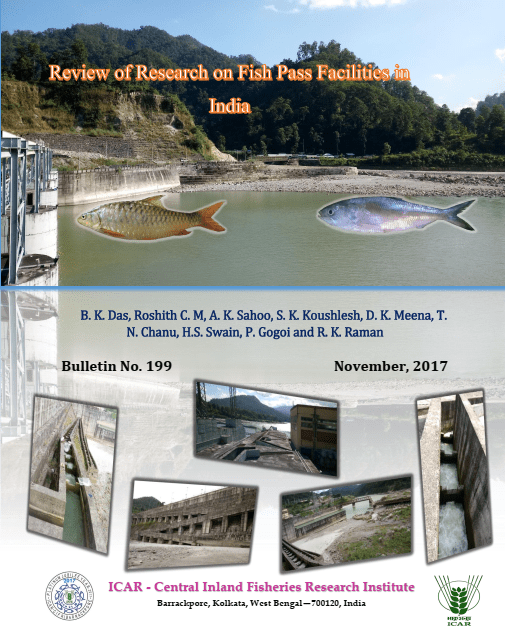
This longish introduction is necessary as a background before we look at CIFRI’s publication: ‘Review of research on fish pass facilities in India’ by Dr. B. K. Das, Roshith C. M, A. K. Sahoo, S. K. Koushlesh, D. K.Meena, T. N. Chanu, H. S. Swain, P. Gogoi and R. K. Raman.
The report, published as a Bulletin by CIFRI in 2017, is divided in 7 chapters:
- Introduction
- Overview of Indian rivers and obstacles
- Migratory fishes of India and impact of dams on their fishery
- Fish Pass facilities developed in India
- Passage Performance of Fishways
- Challenges and Prospects
- References
We were hoping that the report will explore the reasons about absence of fish passes in India, non-operation of existing fish passes, absence of monitoring and governance around fish passes and what can be the way forward from here. Most of the important questions have been left unanswered.
The Preface itself points out in no uncertain terms. “Large dams are major cause of degradation of aquatic environment and disruption of livelihood communities dependent upon the fishery along the rivers and the situation is alarming in case of India which is, at present, the third largest dam building country in the world with 5254 large dams and 447 dams under construction.”
“Majority of the fish pass facilities in India were rendered ineffective due to lack of proper knowledge on the biology and migratory behavior of key migratory species which are more likely influenced by construction of dams.”
Chapter 1, 2 and 3 lay the ground about freshwater fisheries in India, migratory nature of specific fish and impacts of dams on migrations and resultant fish recruitment. No mention has been made about the impact of fisheries collapse on fisherfolk population.
Many of the fish found in Indian waters migrate upstream and downstream seasonally. They are potamodromous when the fish are born in freshwater habitats, then migrate within freshwater for food, shelter and breeding. Generally, these migrations are for spawning purposes and cover short distances viz. Mahseer Tor tor and Tor putitora.
Diadromous fish regularly migrate between freshwater and seawater. This category includes sub-categories anadromous, catadromous and amphidromous fishes such as Tenualosa ilisha, Anguilla bengalensis and Sicyopterus griseus. (Anadromous: born in freshwater, spend life in salt water, come back to freshwater for spawning like salmon, hilsa, Catadromous: Spend most of life in freshwater and return to the sea to spawn eg. Eel.)
Unlike anadromous or catadromous fish, a potamodromous fish spends its whole life in fresh water. However, based on the orientation of migratory path these can be categorized further as either “longitudinal” (from an upstream tributary to a mainstream river) or “lateral” (between connected lake and river systems or main river channel and floodplains) as reported in Indian Major Carps (IMCs).
Chapter 3 titled ‘Impact of dams and other cross-river obstacles on Indian Fisheries’ states, “Dams have been singled out as the main reason behind fisheries collapse in major rivers like Ganga and its tributaries, Krishna, Mahanadi and Narmada. Dams and related hydrological fluctuations have magnified the impacts of several other aspects detrimental to fisheries like pollution, sedimentation, destructive fishing practices and invasion by exotic introduced fish species.”
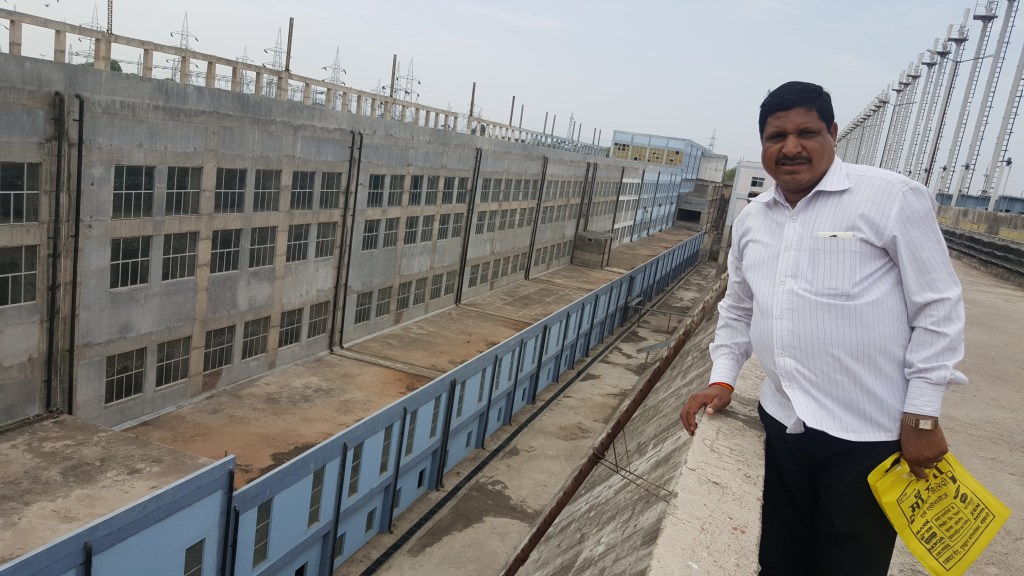
Above: Mangtaramji at Maheshwar dam on the Narmada. Mangtaramji is a local fisherfolk leader Photo: Parineeta Dandekar
It is an interesting chapter which talks about various migratory fish in India, their needs and impacts of dams on their lifecycle. The species include:
Hilsa “By far the most influential factor thought to be responsible for the hilsa migration is state of sexual maturity and volume of freshwater discharge from river while among various extrinsic factors viz. temperature, rainfall, low salinity, current velocity, turbidity, primary production and availability of planktonic food that have been known to trigger the migratory movement. “… river discharge and water temperature” has been the most influential factor .
Mahseers Mahseers are local migrants which perform seasonal migrations within a short distance mainly for feeding and breeding. The limit of such migrations is determined by water temperature, floods and physico-chemical properties of water specially transparency/clarity of water.
Snow Trouts To cope with the steep fall in temperature in winter months schizothoracines migrate from headwaters to lower altitude where they represent a sizeable part in fish catches in large rivers and their tributaries. The rise in temperature in Kashmir streams from near-freezing level to 10- 17°C during May-June induces Schizothorax richardsonii, S. longipinnis and S. curvifrons to spawn.
Eel Primarily inhabitant of freshwaters and rivers, also occur in estuaries and in the sea during early life and near maturity. A. bengalensis undergoes long range catadromous migration to breed in the ocean.
Indian Major Carps Catla (Catla catla), Rohu (Labeo rohita) and Mrigal (Cirrhinus mrigala) are the three Indian Major Carps also known as Gangetic Carps. The breeding migration of Catla catla is similar to other Indian major carps. Mature Catla catla move in a group to the inundated areas in the flood plains for breeding during the monsoon. Rohu move in small shoals in fry and fingerling stage for feeding while adults migrate in batches during spawning. Rohu is also local migrant and undertakes short journey in search of suitable breeding grounds with the onset of monsoon (Chonder, 1999). Mrigal is local and medium range migrant in the search of food and breeding ground. During floods it migrates to inundated flood plains for breeding (Chonder, 1999).
Thus, lateral connectivity of the river to its floodplains is important for carp breeding.
Other carps and fish discussed are Silond species, Garua Bacha, Aor/ Seenghala, Goonch, Sucker mouthed barb, Penga and freshwater prawns.
Section 3.3 outlines the impacts of dams on various rivers and fish unequivocally. This section alone can be a detailed report. In fact, SANDRP has published a detailed report on this several times.
Such impacts include:
- 1984 Hilsa crash in Hooghly, Godavari, Krishna and Cauvery following dams.
- Collapse of Mahseer above Nangal and Talwara dams, Snow trout, rohu, eels, prawns.
- Formation of reservoirs in India has had negative impact on snow trout (Schizothoraxspp.), rohu (Labeo rohita) in Himalayan streams, catadromous eels and freshwater prawns in all major river systems.
- Sunder Raj study (1941) outlining collapse of Hilsa following Mettur Dam on Cauvery.
- Gill (1984) on Barrages at Ropar, Harike, Ferozepur led to collapse of Indian Major carps
- Drastic fall in fish catch following Salandi Dam (1970) in Orissa from 350 tonnes (1950-65) to 25 tonnes (1995-2000).
- 68.24% fall in Hilsa catch in Narmada from 1993 to 2004, accelerated post-1999 (Milton 2010)
- Tawa Dam on Narmada leading to loss of carp feeding, breeding and spawning ground (Shrivastava 1999). Hoshangabad was the best Mahseer landing in the country with monthly catches of 2-3 tonnes. But after Tawa dam, Mahseer dropped drastically (Arya 2001) and Hoshangabad now imports Mahseer for reservoir fisheries.
- In Manipur, Mahseer was severely threatened in the wild following the Ithai barrage and there is no possibility of recolonization from Myanmar (CAMP, 1998).
- After dams on Beas, the catch proportion of Mahseer which are 10-13%, dropped to 0.5% (Sehgal 1999).
- Tehri dam reduced water flow and stopped Mahseer migrating routes (2003 study)
- Lakra (2010) loss of fish species downstream Betwa River due to damming and resulting fragmented river channel. The dam prevents migratory fishes such as Tor tor, Bagarius bagarius, Pangasius pangasius, Silonia silondia and Sperata aor from accessing their native ranges for spawning, resulting in genetic isolation and declining fish population.
Chapter 4 deals with Fish passages existing in India. It is unbelievable to realize that in 1867, Sir Arthur Cotton alerted the govt about impacts of Mettur on fisheries and immediately, Sir Franscis Day was commissioned as Inspector General of Fisheries in India. He condemned the impact of dams on fisheries and recommended that every irrigation weir should have “a practicable fish pass”. This is in 1893!! Not only was a fish pass built, but it was also monitored and rigorously evaluated in 1909. SANDRP’s detailed report on the fascinating history of fish passes on Mettur can be found here: https://sandrp.in/2014/06/07/fishing-the-cauvery-river-how-mettur-changed-it-all/
4 types of fish ways were constructed on weirs of Punjab in the late 1800s. Department of Fisheries issued a bulletin “Note on fish ladders” in 1916! Khan examined these in 1940 and derived some basic principles for fish ladders:
- The slope of the fish pass/ladder should not be steeper than 1 foot vertical to 10 feet horizontal, to ensure a current velocity not exceeding 10 feet/second in any portion of the fish-way. The flow of water should be gentle without steep falls.
- The compartment or bays of the pass must be of such dimensions that the fish do not risk collision with the sides and upper end of each bay while ascending (Dunsford, 1911).
- Plenty of light should be admitted in a fishway, both for maintaining the natural conditions of water and for easy inspection of the interiors to remove any foreign matter (Bayer, 1908).
- There must be nothing in the formation of the pass to suggest the existence of a trap (Dunsford, 1911).
- The water supply should be ample and there should always be water in the ladder during the season when fishes make the ascend.
- The top and side of a fishway should be above ordinary highwater (Bayer,1908).
- The location of fish pass should be such that it is self-advertising, i.e., it must form a current impinging into a certain place below the obstacle so strongly that it becomes the chief or predominant current of the stream, when the fish will be led to that point for attempting the ascent (Dunsford, 1911).
- The position of the entrance is of paramount importance no matter what type of pass is selected. The ideal position for the entrance to the pass is close to where the fish lie, so that there will be an attraction flow of water from the pass, when the river is at the level at which they chiefly run
- (Calderwood, 1926). The entrance should be in a pool at the bottom of the pass/ladder where the fish would naturally aggregate before ascending the river and these pools must be kept clear of silt and other deposits.
Since the 1940’s, we have not updated or worked on any such guiding principles.
Section 4.4 deals with existing fish passes in projects on Ganges, Yamuna, Mahanadi, Jhelum and Teesta. This seems to be a severely incomplete list, either the passes are on government projects or designed by CIFRI. Passes like the one of 126 MW Larji HEP on Beas in Himachal Pradesh, 100 MW Sainj HEP on Parbati River in Himachal Pradesh, Narora barrage on Ganga, etc are missing in the list.

“The fish facilities installed in India during recent times can be broadly categorised in to four – pool pass, Denil pass, fish ramps and fish locks. CIFRI have been instrumental in carrying out feasibility studies regarding installation of many of the fish passage structures in Indian dams. The recommendations of the institute were considered for developing fish passage facilities at Farakka in the Ganges, Kurichhu dam in Bhutan, Bichum dam in Arunachal Pradesh and Teesta Low Dam stages III and IV.”
Examples in India
1. Naraj Barrage, Mahanadi, 2005: Denil pass.
2. Mahanadi Barrage, Mahanadi, Cuttack,1991: Denil pass
3. Hathnikund Barrage, Ganga, Yamuna Nagar District, 1999: Denil Pass
4. Bichum Hydropower Project, Bichom River, West Kameng dist, Arunachal Pradesh, Ongoing project. Part of Kameng HEP 600 MA NEEPCO: Pool pass
5. Kurichhu Hydropower Project, Bhutan on Kurichhu river, tributary of Manas. at Mongar dist Bhutan: Pool pass.
6. Teesta Stage III and IV on Teesta, Darjeeling disct. completed 2013 and Teesta IV Low dam completed 2016: Pool passes
7. Farakka Barrage, Ganga, Murshidabad, completed 1975: Fish Lock. The fish lock was planned very carefully in consultation with CIFRI. “But these fish locks are not operational at present and the hilsa catches are very meagre in the upstream of the barrage.”

The report goes on to justify the absence of fish ladders post-independence as the dams were busy “Nation building”.
Chapter 5 ‘Passage Performance of Fishways’ is a cut-paste mix of unrelated facts, hasty introductions already made. It talks of fish ladder monitoring studies including conventional fish trapping, blocking and fishing, electrofishing, video recording and auto counting, mark and recapture, visual observation, eco-sounding, Telemetry etc.
The chapter gives no examples of review studies or how and on which dam they were done, their efficacy, experiences, stories or pictures.
It does not talk of anything CIFRI has done or plans to do in monitoring, why no monitoring of fish ways has been done in India, not even studies planned by CIFRI for monitoring the efficiency of fish ladders.
Chapter 6 Challenges and prospects “There has been no comprehensive scientific study or the evaluation of fish passage or efficiency of fishways in India. Some of the observations of fishes moving upstream through the fishway are visual observations which need be quantified. Detailed investigation into the post installation functioning and the efficiency using modern tool has not been attempted.” We have not done any flume experiments to see how fish perform against various barriers.
The chapter states that we need more work on: understanding of impacts of hydropower in Indian context, improved understanding of migratory behavior and biology of fish, detailed understating of hydro-morphological and hydraulic conditions, situation with multiple dams, for multiple species and high number of migratory fish in tropical rivers, potential location of fish pass entrances are a an issue with high variability of flows and designing downstream fish pass.
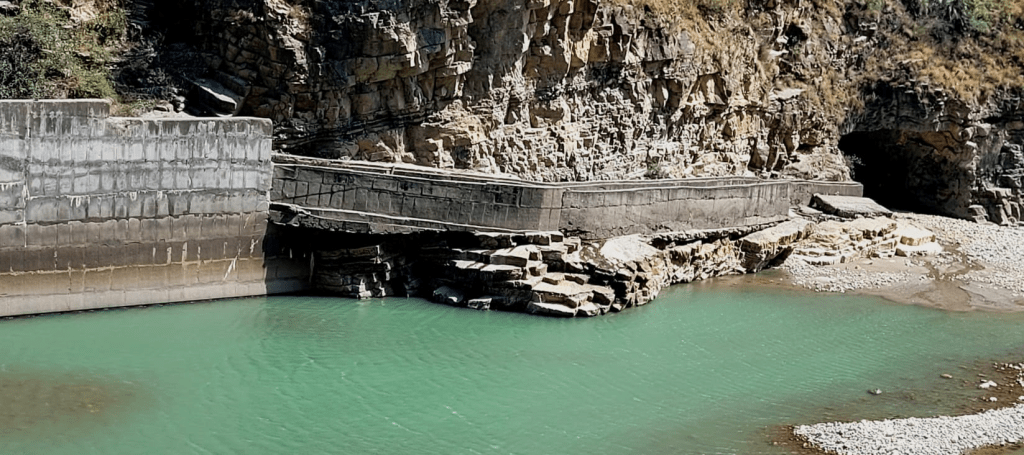
In conclusion While CIFRI report is useful in highlighting some of the important impacts of dams on riverine fisheries, as a review of status of fish passes in India, it faces serious shortcomings.
These are serious as CIFRI is not only an academic institution. It is a part of the governance mechanism, part of the environmental clearance process around dams, it is the premier research institute on freshwater fisheries, it designs and recommends fish passes on dams. It cannot be a mute spectator and simply state that we have not conducted enough work on fish passes. We have not done it, because CIFRI and in effect, Ministry of Fisheries, Animal Husbandry and Dairying and the Ministry of Agriculture and Farmer’s Welfare have not deemed it important enough to understand what ails our rivers, what ails the second largest inland fish producer in the world that India is and what affects the livelihoods of over 10 million fisherfolk who depend on rivers and freshwater bodies for their livelihoods in India.
The report does not talk about the difficulties of fish ladders over a certain height (50-60 meters), global discourse about fish ladders on high dams, governance problems of fish ladders, project proponent’s reluctance to invest in fish ladders, lack of political and administrative will to monitor fish ladders, importance of ladders especially in low dams and barrages, etc.
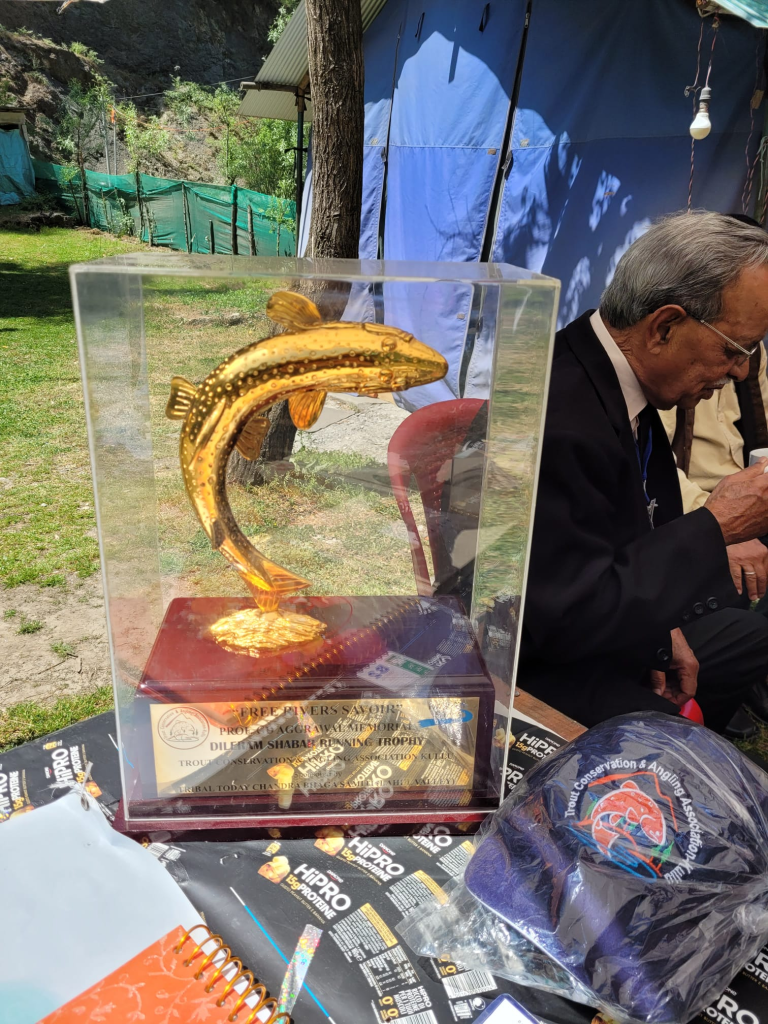
SANDRP participated in the World Fisheries Congress in March 2024 in Seattle, USA where various leading experts from the world talked about fish ladders designs, fish friendly weirs, fish friendly turbines, effective monitoring of fish passes, problems with hydropower in ecologically rich river stretches etc. CIFRI was not represented at the congress, nor was any Indian government department. Below are some glimpses from the Congress.


Our questions on this Review sent to two authors of CIFRI, both of whom have served in the EAC, have not been responded to. We will update the report if we hear from them.
We had specifically asked them about the new fish locks at Farakka Barrage, their functioning and the reasons why the original locks were never used. No response.
We again request CIFRI, Ministry of Agriculture and Farmers Welfare, Ministry of Fisheries, Animal Husbandry and Dairying, to look at the issue of impacts of dams on riverine fisheries and fisherfolks with the seriousness it deserves. At stake are endemic species, fish diversity, flowing rivers and livelihoods of millions of riverine fisherfolk.
Parineeta Dandekar (parineeta.dandekar@gmail.com)
Further reading:

 SANDRP