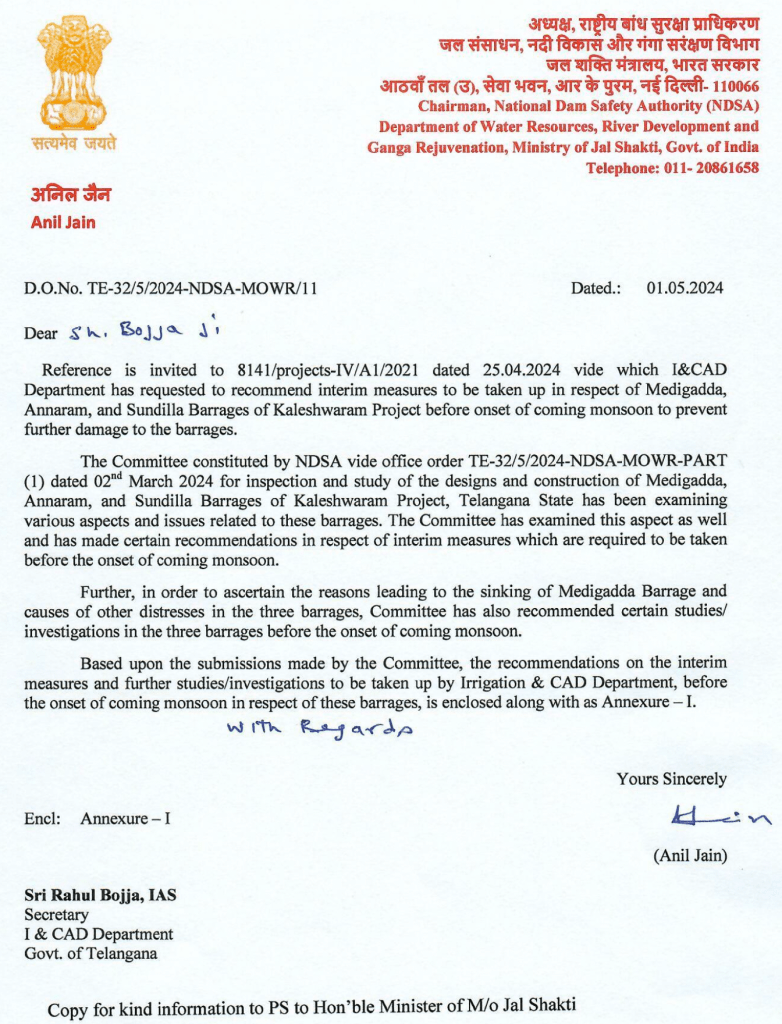
The National Dam Safety Authority (NDSA) Chairman Shri Anil Jain has through a letter dated May 1, 2024, sent an interim report of the NDSA committee to the Telangana govt. The 16 page interim report titled: “RECOMMENDATIONS ON THE INTERIM MEASURES AND FURTHER STUDIES/INVESTIGATIONS TO BE TAKEN UP BY IRRIGATION & CAD DEPARTMENT, BEFORE THE ONSET OF COMING MONSOON” came as an annexure to the letter addressed to Rahul Bojja, Irrigation and Command Area Department (I & CAD) of Govt of Telangana.
The six member NDSA committee chaired by former Central Water Commission (CWC) J Chandrasekhar Iyer (strangely, the report or the letter does not mention the name of the chair or members of the committee) was constituted on March 2, 2024. The committee visited Telangana and project site on March 6-9. The committee also held meeting with the key persons in Hyderabad on March 20-22 and in Delhi on Apr 3-4 and has submitted the interim report on the request of Telangana govt so that necessary steps can be taken before the South West Monsoon 2024 to minimise further damage to the three dams called Medigadda, Annaram and Sundilla.
The three Dams The key dimensions of the three dams are:
| Name | Length, m | Height, m |
| Medigadda | 1632 | 20.1 |
| Annaram | 1278 | 19.85 |
| Sundilla | 1452 | 19.48 |
It is clear from above that all the three structures, called barrages in the report, are big dams as per the CWC and ICOLD definition as all three have height above 15 m.
The Interim Report The 16 page interim report is divided into three sections: Section 1: Report of the site inspection and interaction with the stakeholders; Section 2: Recommendations on Interim Measures before the onset of coming monsoon; Section 3: Recommendations on futher studies and investigations before the onset of monsoon. Each section is subdivided into three sections, one each for the three dams.
The disaster, the earlier Dam Safety Panel report not referred to: Earlier SANDRP reports on this disaster highlighted the nature of the disaster[i] and the previous Dam Safety Panel report[ii]. It is very strange to see no reference in this report to the earlier Dam Safety Panel report dated Nov 1 2023. The disaster was first noticed in the evening of Oct 21 2023 and NDSA promptly sent a team and published within ten days of the disaster.
The findings In the interim report the Central government agency said that damages were observed to the downstream cement concrete blocks and apron of the Medigadda barrage after the 2019 monsoon, soon after the barrage was inaugurated in June 2019.
– Despite this, “the impounded water was not released for repair and rectification, instead the barrage reservoir continued to be used for its stated purpose,” the report said. Though incidents of damage to the structures of the barrages at Medigadda, Annaram and Sundilla were observed in the subsequent years too, no full-fledged repairs were taken up as the water storage had to be maintained as per the then government’s instructions.
– In its report, the NDSA also said that repairs of the failure in Block-7 of the barrage — which suffered failure and portions of which sank by more than 1.2 metres — “is quite extensive.” The report said that the portion of Block 7 of the barrage in which eight radial gates were stuck because of the sinking and tilting of the piers, “is in a highly-distressed state of condition.” To try and save Block 7, all the 85 gates of the Medigadda barrage (77 of them are opening, but gate nos 15 to 22 in distressed block no 7 are not) have to be lifted fully before the onset of the monsoon, the report said and added that, if need be, the steel plates of the gates should be cut.
– The report did not say this in as many words, but the engineers familiar with the structure and its construction said that four of the piers – Nos. 17, 18, 19, and 20 – in Block 7 will eventually have to be taken down along with the rest of their associated structures and rebuilt. “But that can be done only after the (2024) monsoon season ends and the flows in the river fall to low levels,” one of the engineers said.
The Recommendations: Medigadda The recommendations include checking integrity of each pat of the barrages and gates, the opening of the gates and removal of the gates when not possible to open, removal of cement concrete (CC) blocks, both upstream and downstream, under Block 7 of the Medigadda barrage, which had suffered maximum damage and is in a ‘highly distressed condition’.[iii]
The report has not ruled out the possibility of any further unexpected movement/ behaviour of the Medigadda structure which is “in highly distressed condition”. In case of the Block-7 of Medigadda (the dam has eight blocks, of which Block 7 is in most distressed situation) the panel suggested extensive crack monitoring, bracing piers 16 to 22 adequately at appropriate locations to arrest any likely lateral movement and rectification/ replacement of defective/ damaged pressure release valves in the raft.
– Installation of optical targets — one each at upstream and downstream and at the middle on all piers in the Block for continuous monitoring and recording, assessment of upstream and downstream secant pile and parametric joint, removal of plinth slab which has been settled/ displaced/ damaged, compacting of river bed properly and placing of sand-filled bags against the vertical face of the plinth slab. In order to avoid/ minimise hydraulic force on gates as well as the structure, all gates of Block-7 are to be lifted to fully open position after proper checking of integrity of all their components. The report has suggested several steps in respect of radial gates from 15 to 22 in the Block which are not opening due to sinking of piers. Further, the panel has recommended separate measures in case of Blocks 1-6 and 8.
– the panel has recommended further studies and investigation before the onset of monsoon to ascertain the reasons leading to the sinking of Medigadda Barrage piers, causes of other distresses in all the three barrages, certain geophysical and geotechnical tests in Medigadda area as well as some specific tests to assess the structural integrity.
The irrigation and command area development department will need to deploy unmanned aerial vehicles (UAVs) with high-resolution cameras to map the surface cracks of the entire barrage structures; assess river cross sections at 100-meter intervals up to 5 km on the upstream and downstream sides of the barrages along with bathymetric studies, use of optical devices to measure any shifts, including microshifts, in the structures, and use of ground penetrating radar and electrical resistivity tomography equipment.
– The report laid out a long series of steps that must be taken as interim measures before the onset of the coming monsoon, which include steps to be taken to raise eight radial gates in Block 7 that have been stuck. Raising of these gates is critical before Godavari flows rise with the barrage located after the confluence of Godavari with Pranahita river as, according to irrigation engineers, these gates in Block 7 lie towards the middle of the barrage and the flow of water, guided by the elevated banks of the river, could be the strongest towards the centre of the river.
– Some of the recommendations for Medigadda, Annaram, and Sundilla barrages
1. Repair the upstream and downstream sides of the aprons whose surfaces were either washed away or damaged in previous floods;
2. Replace the entire flood dissipation structures on the downstream side along the entire length of the barrages;
3. Drill boreholes at specified intervals to specified depths to study the sub-surface situation and strength of the barrage structures;
4. ‘Ground trimming’ at the barrages on both upstream and downstream sides to ensure smooth flow of water through the gates;
– Specific steps at Medigadda:
1. Monitoring of cracks to the accuracy of +/- 1 mm for continuous monitoring of movement across all cracks in piers and raft floor;
2. Construct girder/truss or box girders with bracing systems to prevent any further tilting of damaged piers;
3. Drive sheet pile immediately after the downstream plinth slabs to a depth of 9 metres after completing geophysical investigations;
4. Completely remove radial gates 20, and 21 in Block 7 at Medigadda either by dismantling, and or cutting them, and remove all the dismantled portions.[iv]
Quoting reports received from the Irrigation Department, the Committee said 77 out of 85 radial gates in Medigadda Barrage have been successfully lifted. However, problems were encountered while lifting the remaining radial gates No.15 to 22 in the distressed block No-7.
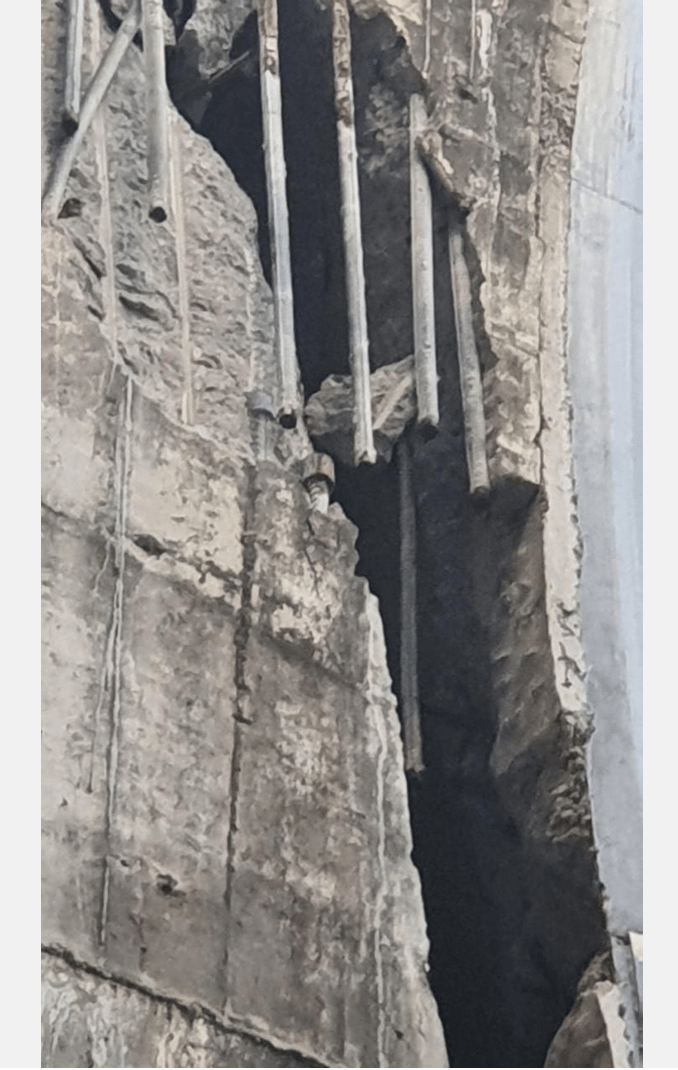
– The piers along with the raft in Block No-7 have sunk to varying depths and piers tilted to varying degrees. The worst affected Pier No 20, which has sunk by over 1.2 m is precariously standing, with the reinforcement completely sheared off along the wide-crack. The crack is running along the full height of the pier, just upstream of the radial gate wall plate of Pier No. 20, it said.
– The report also said the radial gates adjacent to pier no 20 (Gate No 20 and 21), which suffered maximum damage, should be removed completely by dismantling and cutting the gate from the assembly, and be taken away. The remaining six gates should be lifted and kept in fully open position and shall be latched firmly. In case of any difficulty in lifting any of these gates to fully open position, the gate shall be removed completely. The committee also recommended that the damaged cement concrete blocks be replaced and the dislodged apron along with toe wall be restored back to its original approved drawings.[v]
Recommendations: Annaram and Sundilla In the case of Annaram and Sundilla barrages too, the NDSA experts’ committee has recommended measures to avoid/ minimise hydraulic force on all gates as well as the structures and also lift fully open all gates before the onset of monsoon. The panel wants the Irrigation Department to remove the first four rows of the downstream cement-concrete blocks on entire length of barrages and also compact the river bed. In case of the CC blocks beyond first four rows, it sought removal of settled/ displaced/ damaged ones.
– Removal of sand heaps accumulated in front of the Annaram Barrage bay raft suitably by adhering to the Irrigation Department norms to clear the waterway and removal of all other obstructions including leftover debris, boulders, dead concrete, sheet piles and, sediment deposits to ensure smooth and even distribution of water flow through the barrage is also recommended.[vi]
– The NDSA, with respect to the Annaram and Sundilla barrages recommended complete replacement of the flood dissipation blocks and structures as well as repairs to the aprons. It shall be the responsibility of the Irrigation and Command Area Development department of the government to ensure “adequate resource mobilisation and timely execution of works before the onset of the coming monsoon season”.[vii]
Questions The report raises many questions. Let us look at only some of them here.
The report ends with an interesting para: “Nothing contained herein shall be construed to absolve the dam owner (I&CAD) of the duties, obligations or liabilities incidental to the construction, operation, maintenance and supervision of the dam or reservoir.” But is the I& CAD the only possibly responsible body? What about the responsibility of the Dam Safety Panel at the state and Central level? What about the responsibility of Central Water Commission, the elephant in the room?
These questions become important as the interim report says that the all three barrages were damaged way back in 2019 monsoon for the first time, same year of their commissioning. But the disaster came to light only in Oct 2023. What were all these agencies doing all these years? Is it possible to accept that none of them knew anything so far, than it raises a huge question mark about the monitoring of construction and operation of large dams in India. If CWC and others did know but did not do anything, than it raises question about the very functioning of CWC and other dam safety bodies.
Interestingly, the interim report provides year wise damage details of all three dams, but does not say what is the source of the information. This again raises many question, including about the NDSA itself. Let us hope the final NDSA report will be clearer, more forthright about NDSA and CWC roles among others.
The irrigation department officials feel that even the interim recommendations have come at least a month too late. If the NDSA panel visited the damaged Medigadda and other barraged on March 6-9 and never after, could they have given the interim recommendations earlier? More importantly, could NDSA have formed the committee earlier say soon after Nov 1 when its first panel submitted the report?
SANDRP (ht.sandrp@gmail.com)
POST SCRIPT: 1. May 9 2024: “We are in fact late by one month to take up even temporary measures aimed at addressing issues that are likely to make the structures further vulnerable in the event of heavy floods,” irrigation dept officials felt, adding that the focus of the department was mainly on the Medigadda barrage.
2. The interim report of the expert committee constituted by the National Dam Safety Authority (NDSA) stated that there would be no use, even if repairs were carried out to the damaged piers of Medigadda. “Under the given circumstances, any remedial measure for Block No-7 would be an interim measure only, primarily to maintain the status quo of distressed condition. However, it is pertinent to mention that the possibility of any further unexpected movement or behaviour of structure in such a highly distressed condition cannot be ruled out, despite interim measures,” the report stated. Though the committee recommended certain interim measures on three barrages before the onset of monsoon, it might not be possible, as Godavari may start receiving floodwater in the next four weeks.
https://www.newindianexpress.com/states/telangana/2024/May/08/no-use-in-repairing-medigadda-barrage-ndsa-panel-report
[i] https://sandrp.in/2023/10/24/medigadda-barrage-of-kaleshwaram-project-in-telangana-damaged-in-oct-2023/
[ii] https://sandrp.in/2023/11/03/dam-safety-panel-report-of-medigadda-dam-disaster-indicts-telangana-lt-and-dam-safety-in-india/
[iii] https://timesofindia.indiatimes.com/city/hyderabad/ndsa-report-suggests-repairs-removal-of-gates-at-three-affected-barrages/articleshow/109931142.cms
[iv] https://www.deccanchronicle.com/nation/current-affairs/kaleshwaram-barrages-pre-monsoon-protection-not-for-the-faint-hearted-892941
[v] https://telanganatoday.com/ndsa-submits-first-report-recommending-interim-measures-for-medigadda
[vi] https://www.thehindu.com/news/national/telangana/ndsa-interim-report-specifies-measures-to-maintain-status-quo-prevent-further-damage-to-medigadda/article68149980.ece
[vii] https://www.deccanchronicle.com/nation/politics/brs-decisions-led-to-medigadda-fiasco-dam-agency-892883

 SANDRP